
Meta introduces Muse with a dedicated secure VM, Sentinel checks, and approval gates
The personal agent can continue browser tasks across apps while a separate guard reviews internet access and sensitive actions return to the user.

Key takeaways
Meta introduced the Muse personal AI agent on September 8 and began rolling it out in the United States on iOS, Android, and the web. Muse runs inside a dedicated Secure VM with its own browser and can continue tasks such as planning, form filling, and work across connected applications after the user closes the app. Meta says a system-isolated Sentinel agent reviews every action before it reaches the internet, while sensitive steps such as sending an email or making a purchase require user approval. Users can choose connected services, change access, disconnect them, and inspect an audit trail. These security, privacy, and performance claims come from Meta and should be independently tested with low-risk tasks before broader delegation.
Direct answer
Meta introduced the Muse personal AI agent on September 8 and began rolling it out in the United States on iOS, Android, and the web. Muse runs inside a dedicated Secure VM with its own browser and can continue tasks such as planning, form filling, and work across connected applications after the user closes the app. Meta says a system-isolated Sentinel agent reviews every action before it reaches the internet, while sensitive steps such as sending an email or making a purchase require user approval. Users can choose connected services, change access, disconnect them, and inspect an audit trail. These security, privacy, and performance claims come from Meta and should be independently tested with low-risk tasks before broader delegation.
Verified facts
Meta says Muse is powered by Muse Spark and runs in a dedicated Muse Secure VM containing its browser and connected user data, allowing longer cross-application tasks.
A separate Sentinel agent is isolated from Muse at the system level and reviews actions before they reach the internet, requesting user permission when needed.
Muse seeks confirmation before sensitive actions such as sending email or making a purchase, exposes an audit trail, and is rolling out in the United States on iOS, Android, and muse.ai.
What changed
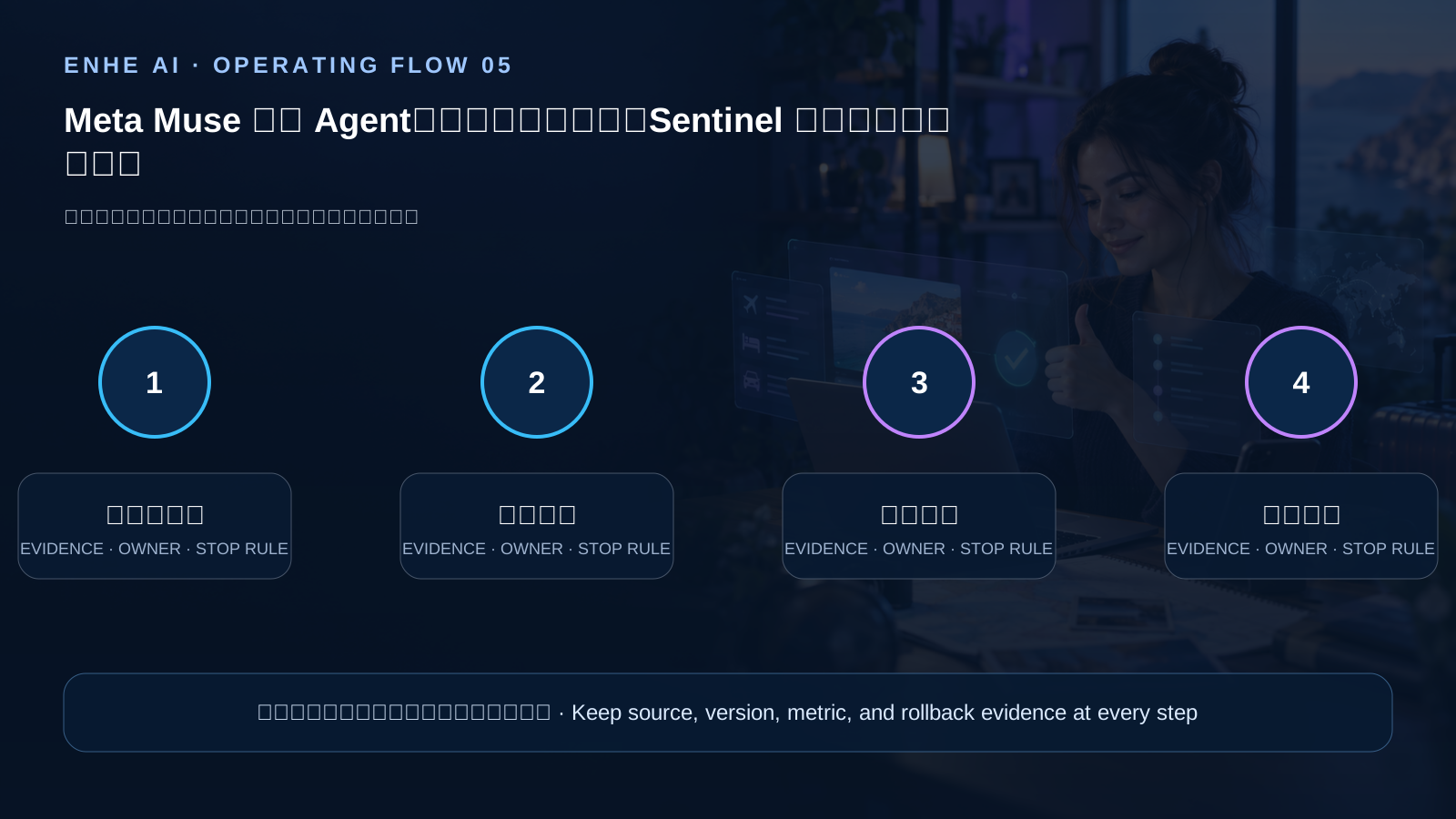
- A personal agent gets a dedicated cloud computer
- A separate guard reviews internet-bound actions
- Sensitive external actions return to the user
- Long tasks continue after the app closes
Impact for AI users
A personal agent that acts rather than only answers can reduce manual switching among browsers and apps, while bringing email, account, and payment boundaries into one workflow. Users should begin with low-risk, reversible tasks, connect services one at a time, and inspect the audit trail. Prices, recipients, submitted forms, and purchases need a final check before execution.
Operating checklist
- Start with reversible tasks that require no payment or sensitive data, testing planning, browsing, and stop behavior.
- Connect one service at a time, grant the smallest scope, and verify that access ends after disconnection.
- Keep per-action approval for email, submissions, bookings, and purchases, checking recipients, amounts, and final terms.
- Review the full audit trail regularly; stop the task, revoke connections, and preserve evidence when behavior is unexpected.
AI frontier news and analysis, AI software and model tools, AI skill tutorials and validation methods, and AI account and permission guidance
FAQ
Does Sentinel guarantee that every action is safe?
No. It is an isolated control described by Meta; independent testing, least privilege, and user confirmation still reduce risk.
Can Muse see passwords or payment details?
Meta says credentials enter secure storage and can be used without being visible to Muse. Users should still monitor permissions and account activity.
Where is Muse available now?
Meta confirms a rollout in the United States on iOS, Android, and the web. Other regions need explicit availability information.
Summary
Muse illustrates the control plane needed for a personal agent: isolated execution, an internet guard, narrow permissions, sensitive-action approval, and an audit trail, with real reliability still requiring user testing.
This AI-assisted article is checked by ENHE AI automation for official sources, bilingual fields, media rights, page safety, and historical duplication before publication.
What this means for everyday users
A personal agent that acts rather than only answers can reduce manual switching among browsers and apps, while bringing email, account, and payment boundaries into one workflow. Users should begin with low-risk, reversible tasks, connect services one at a time, and inspect the audit trail. Prices, recipients, submitted forms, and purchases need a final check before execution.
Tools you may use
Related tutorials
[[zh]][[/zh]][[en]]Review a public website[[/en]]
SearchScope SEO/GEO
[[zh]][[/zh]][[en]]Access and usage guide[[/en]]
AI Prompt Management System | 418 Bilingual Prompts for Writing, SEO and AI Creation
High-Frequency AI Prompts for Work, Learning, and Teaching guide
High-Frequency AI Prompts for Work, Learning, and Teaching
Related Tools And Tutorials
Use the following ENHE AI sections to continue from the news signal into tool selection, account-service guidance, or practical learning.
Related reading
From Chat Boxes to Personal AI Companions: AI Assistants Are Entering the Desktop Execution Era
AI assistants are moving from answering questions toward continuing real tasks. AI agents, MCP tool ecosystems, personal memory, and local workbenches are pushing this shift together. For users, the real value is not another chat box, but less repeated context setup and more continuity from thinking to doing.
When Should an AI Agent Use a Local Small Model or the Cloud? A Hybrid Routing Checklist
AWS published an Adaptive Agentic Intelligence Framework guide using Strands Agents on October 21, 2026. The reference routes routine status checks and local vision work to small models through Ollama, while complex analysis goes to Amazon Bedrock. This durable guide helps teams decide when an AI agent should stay local and when it should use a cloud model. It classifies tasks, marks data that may leave the device, establishes local and cloud quality baselines, defines timeouts and fallbacks, applies one safety policy across both paths, and measures actual routing before estimating cost. The example can run on an 8 GB Raspberry Pi, but that hardware detail is not evidence that every workload belongs on a small local model.
GitHub Copilot Usage API Names Custom Skills, Agents, and MCP Servers: How to Read the Report
GitHub updated the Copilot usage metrics API on October 22, 2026, so customer-defined skills, agents, MCP servers, slash commands, and plugins can appear by configured name instead of being grouped entirely under other or custom. Each totals_by_* list now includes as many as 25 entries per record, up from five. This article helps administrators turn the change into a reliable adoption report. It covers required Copilot CLI and SDK versions, a naming review before reports are shared, one-day and 28-day comparisons, and a reconciliation check against known pilots. It also explains why historical days, path-like names, outdated clients, and blocked telemetry can still undercount activity. The metrics are useful for trends and enablement, not exact billing.
How to Validate AI-Agent Runtime Safety: A Four-Layer OpenShell Evidence Checklist
NVIDIA launched the OpenShell Reference Architecture on October 21, 2026 for building, containing, observing, and enforcing safer agents across enterprise infrastructure and edge systems. This durable guide turns that architecture into a four-layer acceptance checklist rather than a product summary. For one low-risk agent task, teams verify build provenance, identity and tool boundaries, file and network isolation, observable action logs, policy denials, human approval, and rollback. Each layer requires evidence and a failure response. The goal is not to claim that one runtime makes an agent safe. It is to decide which actions can proceed automatically, which must stop for review, and how operators can reconstruct what happened after a failed or unexpected action.
When Should an AI Agent Act Autonomously? A Scope, Know, Bound, Observe Checklist
An AI agent should receive more autonomy only when its actions can be verified, not because one demonstration looked successful. AWS describes a Trust in Depth framework organized around four lifecycle questions: Scope, Know, Bound, and Observe. This durable guide turns those questions into an operational checklist for a small team. Using an internal task-status update as the example, it identifies evidence required before launch, controls during execution, records after execution, and conditions that should stop the agent and request human review. Precise rules can sometimes be tested or formally checked, while tone, sensitive context, and high-impact decisions still require judgment. The objective is bounded, reviewable autonomy rather than either constant approval or unrestricted action.
Nine-Stage AI Agent Evaluation Checklist: From First Commit to Production Drift
AWS published a nine-stage production AI-agent evaluation framework built around Amazon Bedrock AgentCore on October 16, 2026. It follows an agent from defining quality and comparing experiments through merge checks, deployment gates, canary scoring, adversarial testing, drift detection, live pulse monitoring, and feedback-driven improvement. The framework evaluates five dimensions—safety, quality, performance, cost, and operational control—at tool, individual-agent, and multi-agent levels. This durable guide converts the public framework into a vendor-neutral checklist for ordinary teams, with minimum evidence, ownership, and stop conditions designed to catch soft failures where latency and uptime remain normal while answer quality quietly declines over time.