
AWS connects AgentCore evaluations to GitHub Actions for pre-merge agent regression gates
A pipeline can deploy, invoke, score, and block agent regressions, while identity design and evaluation cost remain explicit engineering choices.

Key takeaways
AWS published a reference workflow on September 8 for integrating Amazon Bedrock AgentCore Evaluations with GitHub Actions. The pipeline deploys a development agent and an OAuth-protected MCP server, invokes representative prompts, collects OpenTelemetry traces, and scores behavior before allowing a pull request to proceed. AWS describes built-in dimensions such as helpfulness, correctness, goal success, tool selection, tool parameters, and trajectory order, with custom and code-based evaluators available. The post compares three authentication patterns: evaluating stored traces, using a pre-authorized test user, or issuing machine-to-machine credentials for CI. Its implementation uses the third pattern. Teams should validate that CI credentials cannot escape their intended environment, that evaluation samples cover important failures, and that score variance, latency, evaluator cost, and rollback behavior are visible before treating the threshold as a release gate.
Direct answer
AWS published a reference workflow on September 8 for integrating Amazon Bedrock AgentCore Evaluations with GitHub Actions. The pipeline deploys a development agent and an OAuth-protected MCP server, invokes representative prompts, collects OpenTelemetry traces, and scores behavior before allowing a pull request to proceed. AWS describes built-in dimensions such as helpfulness, correctness, goal success, tool selection, tool parameters, and trajectory order, with custom and code-based evaluators available. The post compares three authentication patterns: evaluating stored traces, using a pre-authorized test user, or issuing machine-to-machine credentials for CI. Its implementation uses the third pattern. Teams should validate that CI credentials cannot escape their intended environment, that evaluation samples cover important failures, and that score variance, latency, evaluator cost, and rollback behavior are visible before treating the threshold as a release gate.
Verified facts
AWS's reference pipeline deploys an agent and MCP service, runs evaluation prompts, collects OpenTelemetry traces, and fails a pull request when scores fall below a threshold.
AgentCore Evaluations supports built-in, custom, Lambda code-based, and third-party evaluators across correctness, goal success, tool selection, parameters, and trajectories.
The post compares stored traces, a pre-authorized test user, and machine-to-machine authentication. Its example uses M2M and notes that this pattern does not test user-role enforcement.
What changed
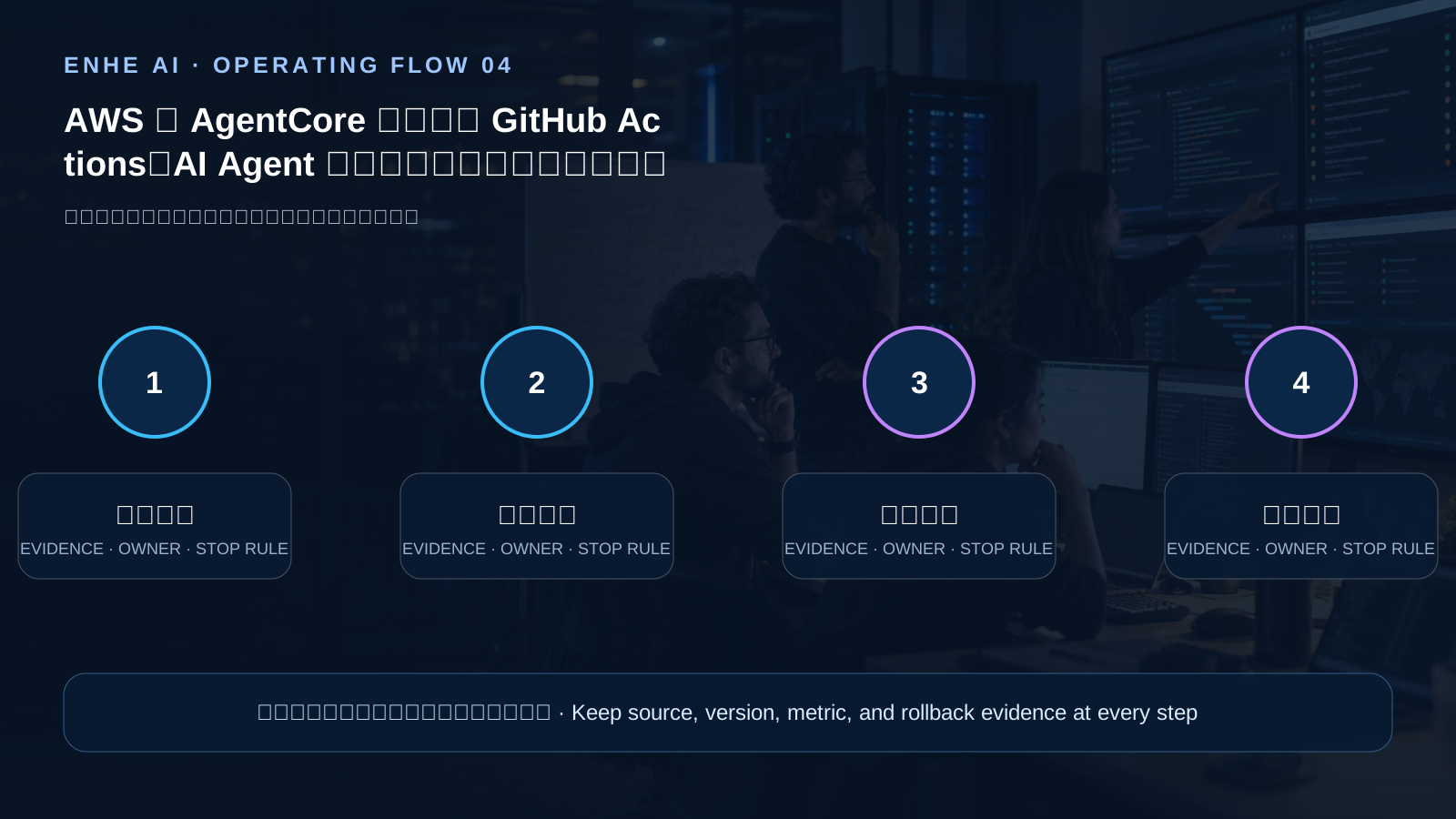
- Agent behavior becomes a pull-request gate
- Traces and tool calls receive layered scores
- CI identity receives a separate auth design
- Threshold failures can block merge automatically
Impact for AI users
Traditional software tests focus on deterministic code, while changes to an agent's model, prompt, tools, and permissions introduce statistical variation. CI evaluation catches regressions earlier, but one judge score is not stable quality. Teams need baselines, repeated samples, variance tracking, and separate deterministic security checks. A CI machine identity should also remain isolated from production permissions.
Operating checklist
- Start with stored traces and offline fixtures to establish a baseline without production permissions.
- Add deterministic schema, sensitive-content, unauthorized-tool, and output-format checks alongside model judges.
- Repeat critical cases and record mean score, variance, cost, and intermittent failures.
- Advance only when several quality dimensions pass together and a rollback version remains available.
AI frontier news and analysis, AI software and model tools, AI skill tutorials and validation methods, and AI account and permission guidance
FAQ
Must the test agent be deployed in the cloud?
No. AWS's stored-trace approach can score fixed traces at pull-request time, with live invocation reserved for a test environment.
Is one aggregate threshold enough?
Usually not. Correctness, tool choice, parameters, safety, and cost can regress independently and should be observed separately.
Can M2M credentials test user permissions?
The post says the example cannot fully test user-role enforcement. Use a user-context pattern when role behavior is the target.
Summary
Putting agent evaluation in CI helps quality gates keep pace with prompt and tool changes, provided the gate uses reliable samples, layered metrics, and isolated identities.
This AI-assisted article is checked by ENHE AI automation for official sources, bilingual fields, media rights, page safety, and historical duplication before publication.
What this means for everyday users
Traditional software tests focus on deterministic code, while changes to an agent's model, prompt, tools, and permissions introduce statistical variation. CI evaluation catches regressions earlier, but one judge score is not stable quality. Teams need baselines, repeated samples, variance tracking, and separate deterministic security checks. A CI machine identity should also remain isolated from production permissions.
Tools you may use
Related tutorials
[[zh]][[/zh]][[en]]Review a public website[[/en]]
SearchScope SEO/GEO
[[zh]][[/zh]][[en]]Access and usage guide[[/en]]
AI Prompt Management System | 418 Bilingual Prompts for Writing, SEO and AI Creation
High-Frequency AI Prompts for Work, Learning, and Teaching guide
High-Frequency AI Prompts for Work, Learning, and Teaching
Related Tools And Tutorials
Use the following ENHE AI sections to continue from the news signal into tool selection, account-service guidance, or practical learning.
Related reading
From Chat Boxes to Personal AI Companions: AI Assistants Are Entering the Desktop Execution Era
AI assistants are moving from answering questions toward continuing real tasks. AI agents, MCP tool ecosystems, personal memory, and local workbenches are pushing this shift together. For users, the real value is not another chat box, but less repeated context setup and more continuity from thinking to doing.
Bayer Shares Production Lessons From 22 Specialist Agents: HTTP Success Is Not Task Success
AWS published Bayer Crop Science’s Agentic Decision Engine case study on October 23, 2026. The production system runs 22 specialist agents over governed analytics workflows, models, logs, and visualization tools. This article turns the architecture into five reusable acceptance checks for enterprise agent teams: persist the state needed to resume work, define identity and authorization at every boundary, scope each agent’s tool catalog, distinguish transport success from task success, and release to a gated group before broader access. It also explains why Bayer’s adoption and resolution figures are evidence about one implementation, not promises for another organization. The focus is operational proof, least privilege, rollback, and observable outcomes rather than prompt polish.
When Should an AI Agent Use a Local Small Model or the Cloud? A Hybrid Routing Checklist
AWS published an Adaptive Agentic Intelligence Framework guide using Strands Agents on October 21, 2026. The reference routes routine status checks and local vision work to small models through Ollama, while complex analysis goes to Amazon Bedrock. This durable guide helps teams decide when an AI agent should stay local and when it should use a cloud model. It classifies tasks, marks data that may leave the device, establishes local and cloud quality baselines, defines timeouts and fallbacks, applies one safety policy across both paths, and measures actual routing before estimating cost. The example can run on an 8 GB Raspberry Pi, but that hardware detail is not evidence that every workload belongs on a small local model.
GitHub Copilot Usage API Names Custom Skills, Agents, and MCP Servers: How to Read the Report
GitHub updated the Copilot usage metrics API on October 22, 2026, so customer-defined skills, agents, MCP servers, slash commands, and plugins can appear by configured name instead of being grouped entirely under other or custom. Each totals_by_* list now includes as many as 25 entries per record, up from five. This article helps administrators turn the change into a reliable adoption report. It covers required Copilot CLI and SDK versions, a naming review before reports are shared, one-day and 28-day comparisons, and a reconciliation check against known pilots. It also explains why historical days, path-like names, outdated clients, and blocked telemetry can still undercount activity. The metrics are useful for trends and enablement, not exact billing.
How to Validate AI-Agent Runtime Safety: A Four-Layer OpenShell Evidence Checklist
NVIDIA launched the OpenShell Reference Architecture on October 21, 2026 for building, containing, observing, and enforcing safer agents across enterprise infrastructure and edge systems. This durable guide turns that architecture into a four-layer acceptance checklist rather than a product summary. For one low-risk agent task, teams verify build provenance, identity and tool boundaries, file and network isolation, observable action logs, policy denials, human approval, and rollback. Each layer requires evidence and a failure response. The goal is not to claim that one runtime makes an agent safe. It is to decide which actions can proceed automatically, which must stop for review, and how operators can reconstruct what happened after a failed or unexpected action.
When Should an AI Agent Act Autonomously? A Scope, Know, Bound, Observe Checklist
An AI agent should receive more autonomy only when its actions can be verified, not because one demonstration looked successful. AWS describes a Trust in Depth framework organized around four lifecycle questions: Scope, Know, Bound, and Observe. This durable guide turns those questions into an operational checklist for a small team. Using an internal task-status update as the example, it identifies evidence required before launch, controls during execution, records after execution, and conditions that should stop the agent and request human review. Precise rules can sometimes be tested or formally checked, while tone, sensitive context, and high-impact decisions still require judgment. The objective is bounded, reviewable autonomy rather than either constant approval or unrestricted action.