
GitHub adds enterprise controls for Copilot agent commands, files, and network access
Central policy can block, require approval, or allow agent operations, and local settings cannot weaken the enterprise boundary.

Key takeaways
GitHub released enterprise-managed permissions for Copilot agent operations on September 9. Administrators can centrally set shell commands, file reads and writes, and access to network domains to blocked, approval required, or allowed without a prompt. User preferences, workspace settings, automatic approval, and earlier approvals cannot make the enterprise policy less restrictive. GitHub says the controls are generally available in the Copilot app, Copilot CLI, and Visual Studio Code sessions that use Agent Host for Copilot Business and Enterprise customers. Security and platform teams should begin with a minimum-permission baseline, test representative repositories, and expand only the operations that have a clear owner, audit trail, and rollback path.
Direct answer
GitHub released enterprise-managed permissions for Copilot agent operations on September 9. Administrators can centrally set shell commands, file reads and writes, and access to network domains to blocked, approval required, or allowed without a prompt. User preferences, workspace settings, automatic approval, and earlier approvals cannot make the enterprise policy less restrictive. GitHub says the controls are generally available in the Copilot app, Copilot CLI, and Visual Studio Code sessions that use Agent Host for Copilot Business and Enterprise customers. Security and platform teams should begin with a minimum-permission baseline, test representative repositories, and expand only the operations that have a clear owner, audit trail, and rollback path.
Verified facts
GitHub says enterprise administrators can centrally configure shell commands, file reads and writes, and network-domain access as blocked, approval required, or allowed without a prompt.
Enterprise policy takes precedence over user preferences, workspace settings, automatic approval, and previous approvals, so lower-level configuration cannot relax the central boundary.
The controls are generally available for Copilot Business and Enterprise in the Copilot app, Copilot CLI, and Visual Studio Code sessions that use Agent Host.

What changed
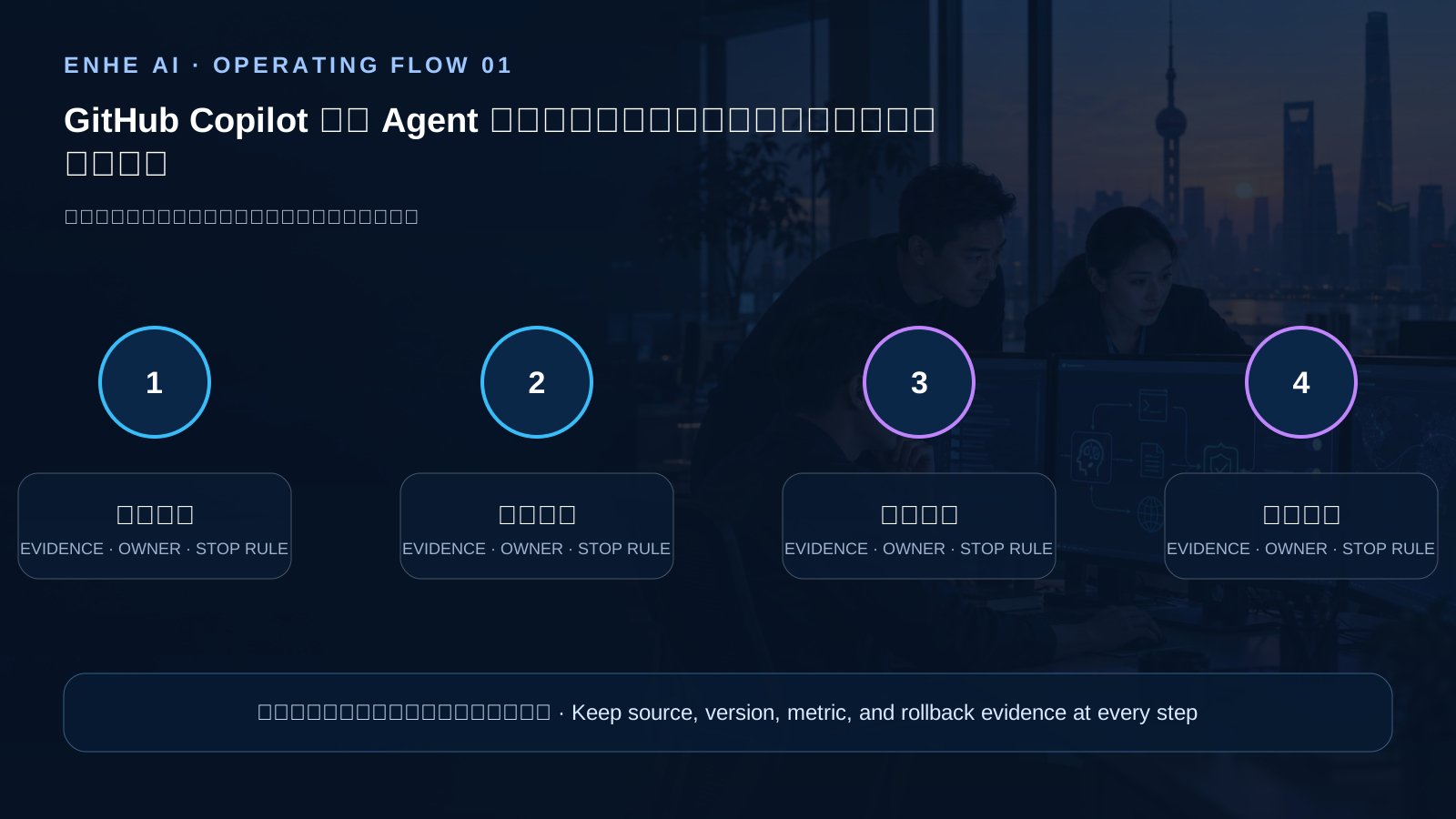
- Agent permissions move into enterprise policy
- Commands, files, and networking get separate gates
- Past approvals cannot bypass new restrictions
- One boundary spans supported Copilot clients
Impact for AI users
Developers may see more approval prompts for sensitive operations, but the boundary becomes more predictable. Enterprises gain a common control plane for least privilege, audit, and exceptions. A policy that is too broad can also expand permissions across several clients at once, so teams should test by repository sensitivity, command class, and destination domain before wider adoption.
Operating checklist
- Inventory required commands, directories, and network domains, and assign a business owner to each item.
- Block unknown destinations and high-impact commands by default, then allow narrow scopes for reproducible tasks.
- Test blocked, approval-required, and allowed paths in a non-production repository and retain the audit record.
- Review exceptions and prior approvals regularly, tightening policy and revoking related access when anomalies appear.
AI frontier news and analysis, AI software and model tools, AI skill tutorials and validation methods, and AI account and permission guidance
FAQ
Can a user setting override an enterprise restriction?
No. GitHub says user, workspace, automatic-approval, and previous-approval settings cannot weaken enterprise policy.
Does every Copilot surface support the controls?
The announcement lists the Copilot app, CLI, and Visual Studio Code sessions using Agent Host. Check current compatibility for other surfaces.
Does no-prompt access mean an operation is risk free?
No. It changes the approval interaction; teams still need narrow command, file, and network scopes plus an audit trail.
Summary
The update moves agent safety from individual prompts into the enterprise control plane, while reliable use still depends on least privilege, staged testing, accountable owners, and continuing audit.
This AI-assisted article is checked by ENHE AI automation for official sources, bilingual fields, media rights, page safety, and historical duplication before publication.
What this means for everyday users
Developers may see more approval prompts for sensitive operations, but the boundary becomes more predictable. Enterprises gain a common control plane for least privilege, audit, and exceptions. A policy that is too broad can also expand permissions across several clients at once, so teams should test by repository sensitivity, command class, and destination domain before wider adoption.
Tools you may use
Related tutorials
[[zh]][[/zh]][[en]]Review a public website[[/en]]
SearchScope SEO/GEO
[[zh]][[/zh]][[en]]Access and usage guide[[/en]]
AI Prompt Management System | 418 Bilingual Prompts for Writing, SEO and AI Creation
High-Frequency AI Prompts for Work, Learning, and Teaching guide
High-Frequency AI Prompts for Work, Learning, and Teaching
Related Tools And Tutorials
Use the following ENHE AI sections to continue from the news signal into tool selection, account-service guidance, or practical learning.
Related reading
From Chat Boxes to Personal AI Companions: AI Assistants Are Entering the Desktop Execution Era
AI assistants are moving from answering questions toward continuing real tasks. AI agents, MCP tool ecosystems, personal memory, and local workbenches are pushing this shift together. For users, the real value is not another chat box, but less repeated context setup and more continuity from thinking to doing.
GitHub Copilot Metrics Add OpenCode and Other Clients: Requests Are Not Prompts
GitHub added totals_by_client to the Copilot usage metrics API on October 23, 2026. Enterprise and organization reports can now show model traffic from OpenCode, Claude Code, Codex, Zed, Copilot CLI, GitHub apps, cloud agents, code review, VS Code, JetBrains, and other clients. This article helps administrators build reliable one-day and 28-day reports without confusing model calls with user prompts. It explains request, session, token, model, and selection-mode fields; separates client traffic from agent-app jobs; and adds checks for unknown identifiers, empty arrays, permissions, and coverage. The result is a governance trend report, not an exact invoice or individual productivity score.
GitHub Copilot in Teams Turns Notifications Into Pull Requests: What to Check Before Review
GitHub updated its Microsoft Teams app on October 23, 2026, so an issue notification in a channel, group chat, or private chat can become a Copilot task that investigates the problem, proposes a fix, and opens a pull request. This article helps development and product teams adopt the workflow without mistaking an automated pull request for shipped code. It explains the consolidated app, repository connection, the November 16 retirement of the legacy GitHub app, and the review boundary. A practical acceptance checklist asks teams to reproduce the issue, inspect changed files, run targeted tests, verify permissions, and keep merge and deployment as explicit human decisions.
When Should an AI Agent Use a Local Small Model or the Cloud? A Hybrid Routing Checklist
AWS published an Adaptive Agentic Intelligence Framework guide using Strands Agents on October 21, 2026. The reference routes routine status checks and local vision work to small models through Ollama, while complex analysis goes to Amazon Bedrock. This durable guide helps teams decide when an AI agent should stay local and when it should use a cloud model. It classifies tasks, marks data that may leave the device, establishes local and cloud quality baselines, defines timeouts and fallbacks, applies one safety policy across both paths, and measures actual routing before estimating cost. The example can run on an 8 GB Raspberry Pi, but that hardware detail is not evidence that every workload belongs on a small local model.
How to Validate Amazon Quick Before Health-Data Use: HIPAA Eligible Does Not Mean Automatically Compliant
AWS published an Amazon Quick deployment guide for HIPAA-regulated environments on October 22, 2026. Its central distinction is durable: HIPAA eligible means the service can be used to process protected health information under the right agreement and configuration; it does not make an entire environment automatically compliant. This guide is for healthcare organizations, business associates, and technical owners working with legal, compliance, and security reviewers. It turns the source into an acceptance checklist covering the business associate addendum, data classification, irreversible key and identity choices, ACL-aware knowledge bases, least-privilege and read-only connectors, masked audit logs, adversarial access tests, and staged expansion from non-PHI work. It is operational guidance, not individualized legal advice or a substitute for professional review.
GitHub Copilot Global Defaults Take Effect: Review Unconfigured Features Before October 26
GitHub began enforcing the global default policy for Copilot Business and Copilot Enterprise on October 22, 2026, with the gradual rollout continuing through October 26. Eligible generally available features that remain Unconfigured will receive the selected default: Enabled, Disabled, or Let organizations decide. This is a one-time change. Explicit feature choices are preserved, and preview features remain opt-in. This article gives administrators a practical review before the policy reaches their enterprise or organization. It separates unconfigured items from deliberate decisions, checks both Features and clients and MCP servers in Copilot, records exceptions, and defines a user-access verification. The goal is to prevent silent access changes caused by assuming that Unconfigured means disabled.