What AI news does for users
AI news should help users decide whether a model, tool, policy, or platform change affects their creative work, operations, learning, or workflows. Useful news explains what happened, why it matters, and what to do next.
ENHE AI INSIGHTS
Track AI tools, model updates, industry trends, and practical tutorials so you can turn new technology into real productivity.
Do not just watch the trend. Learn how to use it.
AI news should help users decide whether a model, tool, policy, or platform change affects their creative work, operations, learning, or workflows. Useful news explains what happened, why it matters, and what to do next.
After reading an article, convert the signal into one of three actions: watch the trend, test a software app, or learn a related skill. This turns news into practical decisions.
Prefer articles with source links, publication dates, related tools, and related tutorials. For platform policy, account subscription, model capability, and compliance changes, verify against official sources.
Extractable answer
ENHE AI news is not a raw headline feed. It turns changes in AI agents, MCP-style tool ecosystems, local AI, open models, platform policy, and practical AI tools into clear next steps: watch the trend, choose software, learn a skill, or check account-service boundaries.
AI updates arrive every day, but the real value is not chasing headlines. The new ENHE AI news module turns important AI information into context, practical meaning, tool guidance, and next-step reading paths so users can decide what matters and how to apply it.
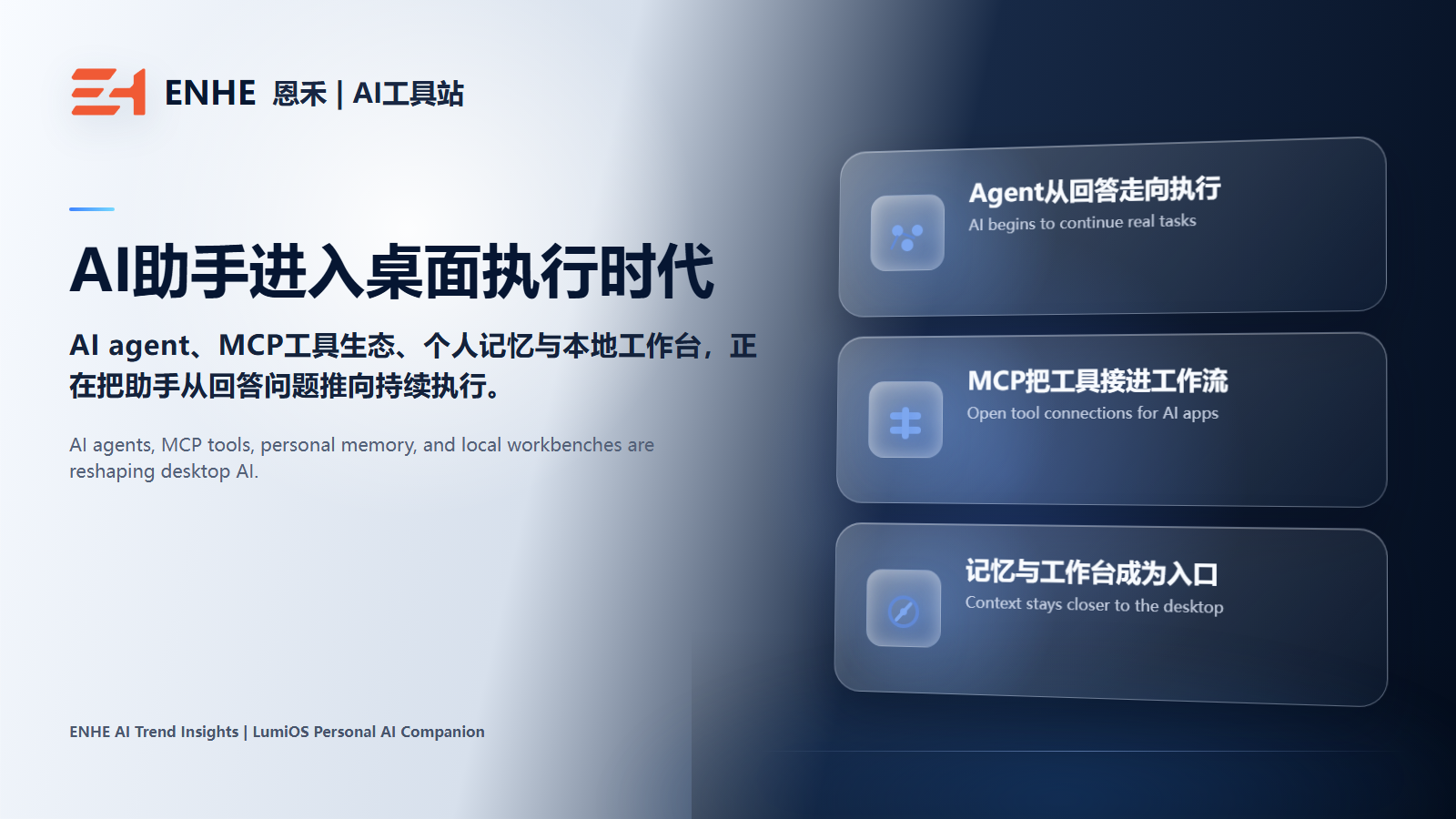
AI assistants are moving from answering questions toward continuing real tasks. AI agents, MCP tool ecosystems, personal memory, and local workbenches are pushing this shift together. For users, the real value is not another chat box, but less repeated context setup and more continuity from thinking to doing.

NVIDIA published a supply-chain case study with Palantir Foundry on September 10. The workflow combines a governed Ontology, cuOpt optimization, planner decisions and rationales, point-in-time backtesting, and post-training of Nemotron 3.5 Lightning for material allocation recommendations. NVIDIA reports that its post-trained 30B model reached 86.7% allocation-decision accuracy on the development benchmark, compared with 55.5% for Nemotron 3 Ultra and 17.5% for the base Lightning model. The company also says a human planner reviews recommendations and makes the final call, while accepted, edited, and overridden outcomes feed future governed retraining. This is an official case study and development benchmark for a bounded allocation task. It does not establish broader general intelligence or general superiority for the 30B model beyond the specialized data, task, and evaluation design.

AWS published a reference workflow on September 8 for integrating Amazon Bedrock AgentCore Evaluations with GitHub Actions. The pipeline deploys a development agent and an OAuth-protected MCP server, invokes representative prompts, collects OpenTelemetry traces, and scores behavior before allowing a pull request to proceed. AWS describes built-in dimensions such as helpfulness, correctness, goal success, tool selection, tool parameters, and trajectory order, with custom and code-based evaluators available. The post compares three authentication patterns: evaluating stored traces, using a pre-authorized test user, or issuing machine-to-machine credentials for CI. Its implementation uses the third pattern. Teams should validate that CI credentials cannot escape their intended environment, that evaluation samples cover important failures, and that score variance, latency, evaluator cost, and rollback behavior are visible before treating the threshold as a release gate.

GitHub announced on August 18, 2026 that Copilot for JetBrains now supports enterprise managed settings for plugin governance, MCP server access, OpenTelemetry, and permission modes. Administrators can restrict plugin marketplaces, define allowed and denied MCP servers, route telemetry to an approved collector, and set permissions.disableBypassPermissionsMode to prevent the agent from using Bypass Approvals or Autopilot. Managed values take precedence over developer settings. JetBrains users should therefore verify which enterprise policy is applied before treating a local option as effective. Teams should test blocked MCP connections, telemetry content capture, and approval prompts with a managed test account before rolling the policy out broadly.

Cloudflare announced MCP security updates on August 14, 2026. Cloudflare One can identify inspected MCP protocol traffic, users, and servers, then combine Gateway policies, logs, data loss prevention, and MCP Server Portals for remote connections. The company also frames governance across client, network, and server control points. That distinction matters because local stdio transport creates no network traffic for a gateway to inspect. Teams should inventory each MCP client's transport, server, identity, tools, write permissions, and sensitive data before choosing to block a connection, allow it directly, route it through a portal, or control it on the endpoint. Logged policy hits, not configuration screenshots, should prove coverage.

Google announced Gemini Spark updates on June 30, 2026. A macOS beta is starting with Google AI Ultra users aged eighteen or older in the United States, and Spark can access Mac files only after the user grants permission. The update also connects Google Tasks and Keep plus services including Canva, Dropbox, Microsoft OneDrive, Outlook, Notion, Quizlet, and Todoist. Custom MCP servers and task monitoring expand what an agent can do across tools. Because access rolls out by account, region, plan, and feature, verify availability first. Test with a separate folder and non-sensitive accounts, restrict every connector and MCP credential, review logs and writes, then disconnect and confirm that permissions and residual tasks are removed.

GitHub announced on August 12, 2026 that Agent Plugins 1.0 support is generally available in VS Code, Copilot CLI, the Copilot SDK, and the Copilot app. A single package can carry skills, MCP server configuration, and client-specific extensions, reducing duplicate setup across tools. The practical task is to verify the publisher, manifest version, commands, external connections, and permission boundaries before installation. Test one reversible, read-only workflow in a repository without production credentials, then decide whether the package belongs in a team marketplace or managed policy. Portability is not a security endorsement: every command, credential, server, and tool call inside the package still needs an explicit review and revocation path.

GitHub announced on August 6, 2026 that MCP allowlists are available in enterprise managed settings. Administrators can define which MCP servers an organization may use instead of leaving every developer to make an isolated choice. The practical task is to confirm plan, policy, and client support, approve only audited servers, and test read-only requests that should be allowed or rejected. Keep the server identity, version, permissions, logs, credential rotation, and rollback path in the same record. An allowlist reduces accidental tool access, but it does not prove that a server is safe or that its data scope is minimal. Human approval remains necessary for sensitive changes and production actions.

GitHub announced on August 7, 2026 that enterprises can install third-party GitHub Apps. The capability can bring more automation, Copilot extensions, and agent workflows into an organization, but it also increases the number of suppliers that can touch repositories, issues, webhooks, or credentials. Treat an install as a supply-chain change: verify publisher identity and maintenance, inspect every requested permission, restrict the installation to a test organization, and check audit logs and revocation behavior. “Available to install” is not a security endorsement. Production approval should have an owner, a review date, a rollback contact, and a record of where app data goes.

GitHub published Secret Scanning coverage updates on August 7, 2026. Expanded detectors and coverage can help teams find credentials in AI-generated code, automation, MCP services, and CI, but detection is not a guarantee that every secret will be found. The practical job is to inventory repository, branch, workflow, and local environment sources, confirm organization policy, and respond to an alert by revoking or rotating the credential before investigating history and impact. Bot and app permissions should be minimal, and a small incident drill should verify notification, ownership, deadlines, and postmortem steps. Treat scanning as the discovery layer of a credential lifecycle, not as permission to put secrets in prompts or logs.

Cloudflare announced a WebMCP developer preview on August 6, 2026. A site can enable tool packs in the Cloudflare Dashboard so browser AI agents can discover and call actions through a standard surface instead of guessing buttons and parsing human-oriented HTML. The preview injects a bridge at the edge, runs tools in the visitor’s browser, and can reuse the visitor’s existing session for a site MCP endpoint. Because it is a preview, users should start with a test account, minimal tool packs, non-critical actions, and explicit confirmation before allowing messages, purchases, or account changes. Recheck permissions whenever the browser or pack version changes.
How to Choose Kimi K3 and Qwen3.8-Max: Version and Task Guide
#2AgentScope Java 2.0 brings enterprise AI agents closer to production deployment
#3Grok Launches Build Mode for Creating and Publishing Websites, Apps, and Games in Chat
#4GitHub Agent Finder Moves AI Tool Discovery Into Registries
#5What Is ChatGPT Work and How Is It Different From a Chatbot?
#6ChatGPT Business Standard vs Premium Seats: Choose by Usage, Price, and Admin Work
Keep useful AI updates close to your workflow without missing tool upgrades or new opportunities.
ENHE AI focuses on how news affects real workflows. A useful article explains what changed, why it matters, what users can do next, and which related software, tutorials, courses, or account guidance can help.
Classify the update as a trend, tool, policy, or tutorial signal, then move to AI trends, software apps, skill learning, or account-service guidance for the next action.
News pages should include clear titles, summaries, dates, source links, FAQ, related tools, and internal links. This helps both human readers and AI answer engines extract and cite the content.