
How to Choose Kimi K3 and Qwen3.8-Max: Version and Task Guide
Qwen3.8-Max-Preview has ended; verify the formal model ID, snapshot, interface, and task results before migrating
Key takeaways
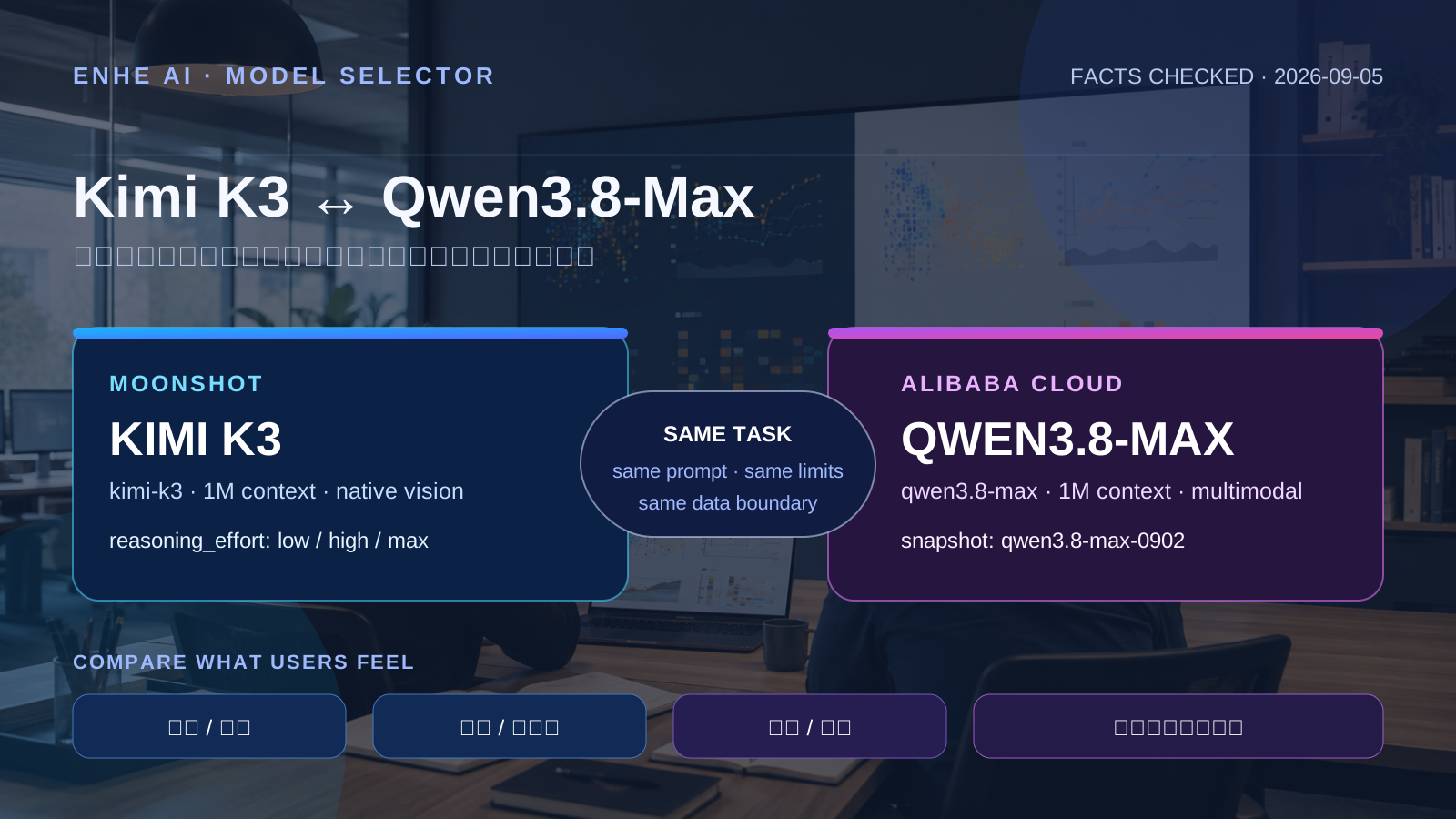
This guide follows a clear structure of key points, a direct answer, fact sources, a six-step evaluation, FAQs, and a summary. It updates the model status, API boundaries, and selection method for Kimi K3 and Qwen3.8-Max. As of September 5, 2026, Qwen3.8-Max-Preview has ended, and the old ID routes to qwen3.8-max. The article explains how to record the formal ID, the qwen3.8-max-0902 snapshot, deployment region, pricing, and rate limits, all of which can change. It also provides a reproducible checklist for comparing quality, latency, cost, stability, and rollback behavior before a team changes its production workflow.
Author: ENHE AI · Originally published July 26, 2026 · Facts checked September 5, 2026 (Asia/Shanghai)
This article keeps the existing public URL and has been rewritten around the current model status. Separate the formal model ID, the snapshot version, and the fact-check date, then compare both models with the same task set. Pricing, regions, rate limits, and service terms can change; use the provider console on the day of a real call.
Direct answer
If the priority is long-horizon coding, end-to-end knowledge work, or an existing Kimi API integration, start a controlled test with kimi-k3. If the team already uses Alibaba Cloud Model Studio and needs image, text, and video input, Function Calling, or structured output, start with qwen3.8-max. This is not a task-free ranking: evaluate both with the same prompt, output constraints, and data boundary.
Qwen3.8-Max-Preview has ended its preview period and has been formally retired. The old qwen3.8-max-preview ID can still be called, but Alibaba Cloud says requests are automatically routed to the formal qwen3.8-max model. New configurations should use the formal ID; for reproducible tests, record the qwen3.8-max-0902 snapshot released on September 2, 2026.
Fact sources
Kimi's official API overview describes kimi-k3 as its flagship for long-horizon coding and end-to-end knowledge work, with native visual understanding, up to a one-million-token context window, and an OpenAI-compatible request format. The parameter reference says K3 always reasons and accepts only low, high, or max for the top-level reasoning_effort field, with max as the default. Do not carry the K2-only thinking configuration into K3.
Alibaba Cloud's Model Studio page lists qwen3.8-max as the formal model ID and qwen3.8-max-0902 (alias qwen3.8-max-2026-09-02) as a snapshot. It lists a one-million-token context window, image/text/video input, Function Calling, structured output, and web search, while also showing that capabilities, pricing, and rate limits can differ by deployment region.
“Compatible API” is not the same as a completed integration check. Before a real comparison, record the model ID, region, SDK or HTTP version, timeout, retry policy, data retention, logging, and billing rules. Do not treat one response or one leaderboard score as a production conclusion.
Six steps to choose with the same task
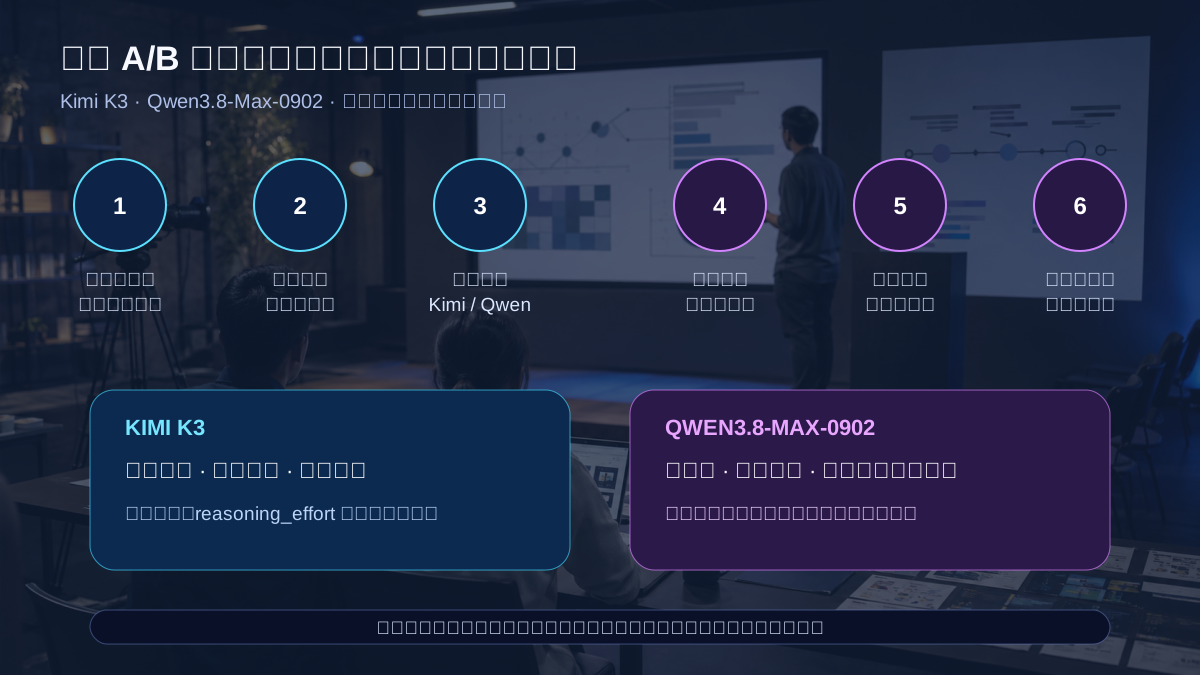
- Select 10 to 20 representative tasks with sensitive data removed, covering long documents, code changes, structured extraction, and visual understanding.
- Fix the system prompt, input materials, output format, maximum output length, timeout, and retry policy; change only the model ID.
- Record completion rate, factual errors, citation accuracy, rework, time to first token, total latency, and cost for both models.
- Test tool calls, JSON Schema, file or image input, concurrency, rate limits, logging, and data retention separately.
- Define a pass line, a fallback model, and a stop condition for each task; write snapshots such as qwen3.8-max-0902 into the test record.
- Increase data and traffic only after repeated passes, while keeping the previous model configuration, evaluation samples, and rollback switch.
Why it matters
A model name, parameter count, or context length describes an upper bound, not your task result. Kimi K3's reasoning parameters and Qwen's regional, snapshot, and quota rules are different. One shared acceptance sheet helps explain whether a failure came from the model, the API, or an operational setting.
Impact for ordinary AI users
Long-document users should watch whether cross-section citations remain stable. Developers should test whether generated patches pass their own tests and tool calls. People who rely on image, video, or file understanding should confirm the supported input format and region. Individuals and small teams should check budget, concurrency, retention, and exit paths first. No model output should directly rewrite production data.
Related tools and tutorials
ENHE AI readers can put model tools, skill tutorials, account guidance, and frontier news into one small evaluation loop: reproduce results with low-risk samples before connecting a formal workflow.
Continue with AI frontier news and analysis, AI software and model tools, AI skill tutorials and validation methods, AI account services and permission guidance, and the ENHE AI product and content hub.
FAQ
Can the old Qwen3.8-Max-Preview ID still be used?
It can still be called, but Alibaba Cloud says the old ID is automatically routed to the formal qwen3.8-max model and usage is counted as the formal model. New configurations should use the formal ID and record the region and snapshot so that an alias change does not silently alter a test.
Is qwen3.8-max-0902 a permanent fixed version?
It is the snapshot identifier released on September 2, 2026, so it is useful for evaluation and regression records. Long-term availability and regional access still depend on Alibaba Cloud's lifecycle and console status. A fixed snapshot does not guarantee fixed pricing or rate limits.
How should reasoning_effort and visual input be tested for Kimi K3?
Use the top-level reasoning_effort values low, high, or max; do not send the K2-specific thinking field. Prepare the same image or file set with a supported platform encoding, then compare recognition, citations, latency, and cost. Do not judge the integration from one image by eye.
Source links
- Moonshot AI: Kimi API overview (accessed and checked September 5, 2026)
- Kimi API Platform: Model Parameter Reference (accessed and checked September 5, 2026)
- MoonshotAI: official Kimi K3 repository (accessed and checked September 5, 2026)
- Alibaba Cloud Model Studio: Token Plan (Personal, including the preview retirement note; accessed and checked September 5, 2026)
- Alibaba Cloud Model Studio: qwen3.8-max model information (accessed and checked September 5, 2026)
- Alibaba Cloud Model Studio: model lifecycle updates (including the 0902 snapshot; accessed and checked September 5, 2026)
Summary
Treat kimi-k3 and qwen3.8-max as two access paths that need separate acceptance tests. Kimi emphasizes long-horizon coding, knowledge work, and explicit API parameter controls; Qwen should be checked through its formal Alibaba Cloud model ID and the qwen3.8-max-0902 snapshot. Preview status, regional capability, pricing, and rate limits can change, so the final decision must come from the same task set's quality, latency, cost, stability, and rollback records.
This article was assisted by ENHE AI using public official sources. Before publication, ENHE reviews the facts, links, media rights, and page rendering. Model output does not replace provider documentation or a team's own acceptance record.
What this means for everyday users
For ENHE AI users, start with de-identified tasks and fixed prompts, outputs, and data boundaries. Decide on migration using quality, latency, cost, stability, and rollback conditions rather than an alias or a single leaderboard score.
Related reading
Nine-Stage AI Agent Evaluation Checklist: From First Commit to Production Drift
AWS published a nine-stage production AI-agent evaluation framework built around Amazon Bedrock AgentCore on October 16, 2026. It follows an agent from defining quality and comparing experiments through merge checks, deployment gates, canary scoring, adversarial testing, drift detection, live pulse monitoring, and feedback-driven improvement. The framework evaluates five dimensions—safety, quality, performance, cost, and operational control—at tool, individual-agent, and multi-agent levels. This durable guide converts the public framework into a vendor-neutral checklist for ordinary teams, with minimum evidence, ownership, and stop conditions designed to catch soft failures where latency and uptime remain normal while answer quality quietly declines over time.
GitHub Copilot Model Retirement on November 16: A Migration Checklist
GitHub announced on October 15, 2026 that three models will be removed from GitHub Copilot experiences on November 16: Claude Opus 4.8, Claude Opus 5, and GPT-5.6 Terra. The change covers Copilot Chat, inline edits, ask and agent modes, and code completions. GitHub recommends Claude Opus 5.5 for both Claude models and either GPT-6.1 Sol or GPT-6 Luna for GPT-5.6 Terra. Under default model enablement, suggested alternatives are enabled automatically for Copilot Business and Enterprise unless an administrator disabled the global default or the specific model. Claude Opus 4.8 remains available to individual annual subscribers as an exception. This guide provides a durable migration checklist for inventorying model references, checking policies, testing prompts and integrations, comparing quality and cost, communicating the switch, and keeping a rollback path before the deadline.
What to Do After a Claude API Key Leak: A Seven-Step Response Checklist
GitHub added detection for anthropic_service_api_key and anthropic_user_api_key on October 13, 2026 and included both patterns in push protection by default for repositories with secret scanning enabled, including free public repositories. Prevention does not replace incident response. Anthropic recommends immediately revoking a suspected compromised key in Claude Console, using environment variables or encrypted secret storage, separating keys by environment and purpose, rotating keys, and scanning repositories. This durable seven-step checklist covers the full response: stop the affected workload, revoke the key, review usage and billing evidence, remove exposed copies from code and logs, issue a narrowly scoped replacement, redeploy and verify, then document the cause and add preventive controls. Never paste a real key into chat, screenshots, tickets, or public cleanup requests.
Microsoft Details Azure Maia 300 for Long-Context and Agentic AI Inference
Microsoft announced an expansion of its Azure Maia system on October 12, 2026. Maia 200 is already serving production workloads including Microsoft Copilot, with GitHub Copilot and Microsoft Foundry planned to follow by year-end. Maia 300 is designed for long-context reasoning, latency-sensitive conversations, and sustained multi-step agent work, with production deployments expected to begin in 2027. This article translates infrastructure claims into user-visible checks. Ordinary users do not need to buy hardware or migrate today. Instead, watch whether the services you already use become faster, more consistent, or cheaper; verify regional availability and data terms; compare quality on the same task; and keep an export or fallback path in case tighter hardware-software integration increases platform dependence.
How to Choose an AI Home Gateway: Eight Checks Beyond Local Processing
An AI home gateway can see connected devices, access records, and network controls, so a dedicated NPU or a 'local processing' label is not enough. NIST guidance for consumer routers and trusted IoT onboarding emphasizes asset identification, minimized interfaces, reliable updates, explicit authorization, secure credential delivery, and lifecycle management. This durable guide turns those principles into eight purchase checks for AI routers, smart-home hubs, and provider-supplied gateways. Before buying or enabling one, identify every product component, map local and cloud data flows, separate administrator and guest roles, test device onboarding and removal, verify signed update support, review logs and network segmentation, preserve a manual recovery route, and obtain a clear end-of-support and data-export plan.
Intel Details GPU D-Series for Open and Heterogeneous Agentic AI Inference
Intel published new details for its GPU D-series on October 12, 2026 at the OCP Global Summit. The accelerator is described with up to 480 GB of LPDDR5X memory, a standard PCIe form factor, air cooling, and support for long-context, large-model, and concurrent inference workloads. Customer sampling is underway, but the announcement does not provide general availability, retail pricing, or independent task results. This article explains what developers and smaller teams can do now: describe the actual model and concurrency target, verify framework and runtime support, measure memory and power limits, compare cloud rental with owned hardware, test output quality and latency, and delay procurement until a reproducible configuration and support path exist.
Sources
Moonshot AI:Kimi API overview
Kimi API 能力、kimi-k3、1M 上下文与 OpenAI 兼容接口;核验于 2026-09-05。
Kimi API Platform:Model Parameter Reference
kimi-k3 的 reasoning_effort 与请求参数边界;核验于 2026-09-05。
MoonshotAI:Kimi K3 官方开源仓库
Kimi K3 的原生多模态、1M 上下文与模型说明;核验于 2026-09-05。
阿里云百炼:Token Plan(个人版)
qwen3.8-max-preview 已结束预览,旧 ID 自动路由正式版;核验于 2026-09-05。
阿里云百炼:qwen3.8-max 模型信息
正式调用 ID、0902 快照、能力、区域与上下文边界;核验于 2026-09-05。
阿里云百炼:模型上下架与更新
qwen3.8-max-0902 于 2026-09-02 发布的生命周期记录;核验于 2026-09-05。