
NVIDIA and Palantir turn supply-chain allocation expertise into a governed Nemotron training loop
A specialized 30B model leads a development benchmark for a bounded allocation task, while planners retain the final decision and general capability is not implied.

Key takeaways
NVIDIA published a supply-chain case study with Palantir Foundry on September 10. The workflow combines a governed Ontology, cuOpt optimization, planner decisions and rationales, point-in-time backtesting, and post-training of Nemotron 3.5 Lightning for material allocation recommendations. NVIDIA reports that its post-trained 30B model reached 86.7% allocation-decision accuracy on the development benchmark, compared with 55.5% for Nemotron 3 Ultra and 17.5% for the base Lightning model. The company also says a human planner reviews recommendations and makes the final call, while accepted, edited, and overridden outcomes feed future governed retraining. This is an official case study and development benchmark for a bounded allocation task. It does not establish broader general intelligence or general superiority for the 30B model beyond the specialized data, task, and evaluation design.
Direct answer
NVIDIA published a supply-chain case study with Palantir Foundry on September 10. The workflow combines a governed Ontology, cuOpt optimization, planner decisions and rationales, point-in-time backtesting, and post-training of Nemotron 3.5 Lightning for material allocation recommendations. NVIDIA reports that its post-trained 30B model reached 86.7% allocation-decision accuracy on the development benchmark, compared with 55.5% for Nemotron 3 Ultra and 17.5% for the base Lightning model. The company also says a human planner reviews recommendations and makes the final call, while accepted, edited, and overridden outcomes feed future governed retraining. This is an official case study and development benchmark for a bounded allocation task. It does not establish broader general intelligence or general superiority for the 30B model beyond the specialized data, task, and evaluation design.
Verified facts
NVIDIA puts materials, capacity, commitments, and qualitative signals into a Palantir Foundry Ontology. cuOpt solves a weekly MILP; planner decisions and outcomes become training and evaluation evidence.
On its development benchmark, NVIDIA reports 86.7% allocation-decision accuracy for the post-trained model, versus 55.5% for Nemotron 3 Ultra and 17.5% for base Lightning.
NVIDIA limits the conclusion to the bounded allocation task: the specialized 30B model is not more capable overall, future production-risk forecasting remains difficult, and a human planner makes the final decision.
What changed
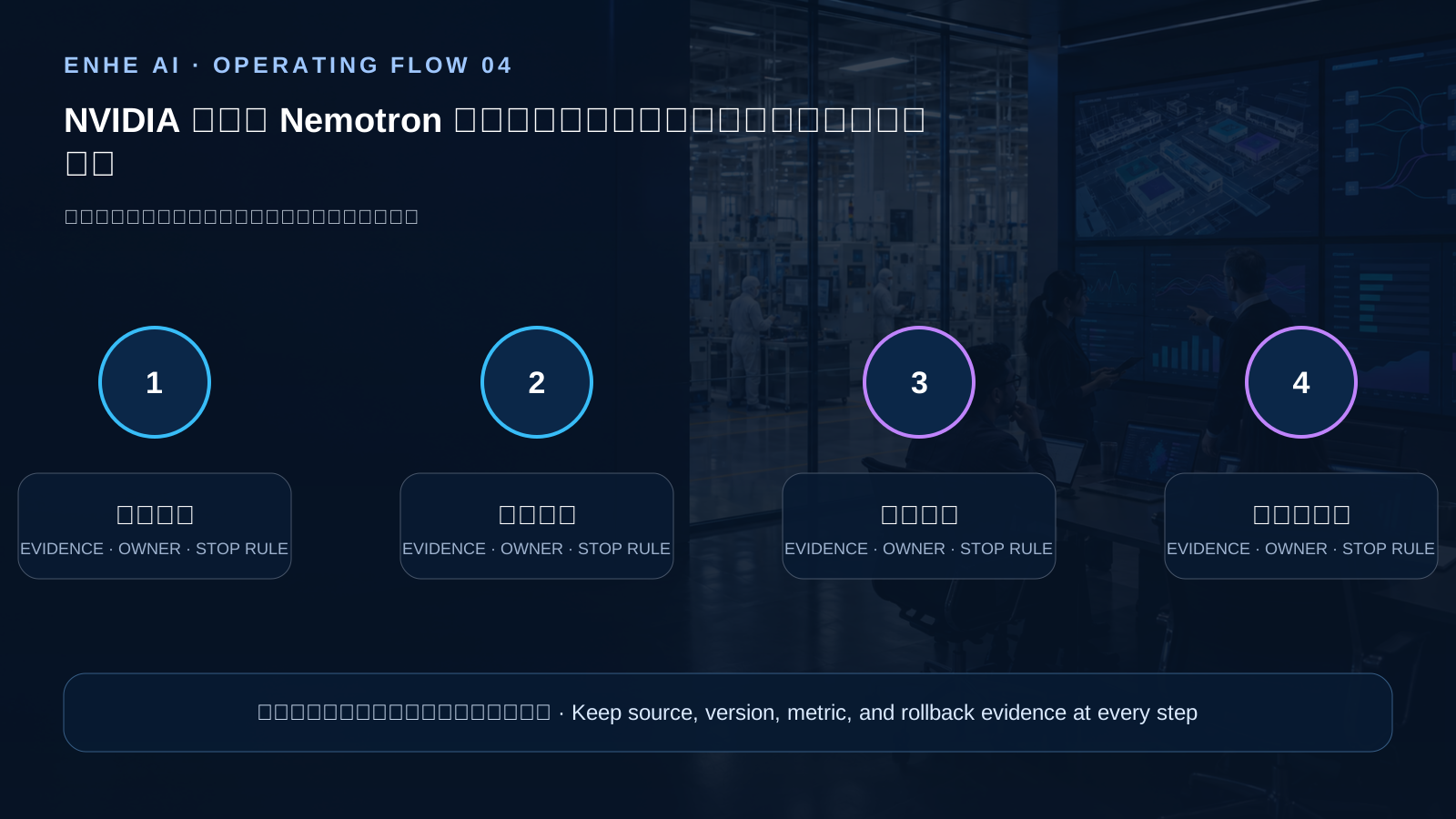
- Expert decisions, rationales, and real outcomes become traceable training assets
- Point-in-time backtesting prevents the model from seeing outcomes that were unknown at decision time
- Optimization, specialized recommendations, and final human decisions operate in one loop
- Multiple bounded-task metrics replace inferences from model size or general capability
Impact for AI users
The central lesson is not that a smaller model beats a larger one. It is that valuable, repeated, replayable expert decisions can become governed data and an evaluation loop. The approach may transfer to constrained allocation, scheduling, and operations judgments, but not automatically to open-ended question answering or high-risk autonomous action. Before adoption, verify that history contains only information available at decision time, minority-class metrics are adequate, humans can veto recommendations, and every retraining run is traceable and reversible.
Operating checklist
- Choose a repeated, replayable decision task with observable outcomes, recording inputs available at the time, rationale, recommendation, human edits, and final result.
- Build time-split backtests that prevent hindsight leakage and review accuracy, balanced accuracy, and Macro-F1 together.
- Give the optimizer, specialized model, and human approval distinct roles, retaining human vetoes, stop conditions, and escalation paths.
- Maintain end-to-end lineage for anonymization, model versions, training configuration, deployment approval, feedback write-back, and rollback.
AI frontier news and analysis, AI software and model tools, AI skill tutorials and validation methods, and AI account and permission guidance
FAQ
Does 86.7% mean the 30B model is generally better than a larger model?
No. NVIDIA limits the result to its supply-chain allocation development benchmark and explicitly says the specialized 30B model is not more capable overall.
Does the model retrain itself in production and make the decision directly?
No. NVIDIA says the model does not retrain itself in production; planners review recommendations and make the final decision, while feedback supports future governed training.
Why not use accuracy alone?
Allocation cuts are more common than increases in the case study, so accuracy can favor the majority class. NVIDIA also reports balanced accuracy and Macro-F1 to inspect performance across decision types.
Summary
NVIDIA offers a development benchmark and governance pattern for bounded operational decisions: replayable evidence, point-in-time evaluation, and final human authority turn expert experience into auditable specialized-model capability. Any cross-domain capability claim requires separate validation.
This AI-assisted article is checked by ENHE AI automation for official sources, bilingual fields, media rights, page safety, and historical duplication before publication.
What this means for everyday users
The central lesson is not that a smaller model beats a larger one. It is that valuable, repeated, replayable expert decisions can become governed data and an evaluation loop. The approach may transfer to constrained allocation, scheduling, and operations judgments, but not automatically to open-ended question answering or high-risk autonomous action. Before adoption, verify that history contains only information available at decision time, minority-class metrics are adequate, humans can veto recommendations, and every retraining run is traceable and reversible.
Tools you may use



Related tutorials
[[zh]][[/zh]][[en]]Review a public website[[/en]]
SearchScope SEO/GEO
[[zh]][[/zh]][[en]]Access and usage guide[[/en]]
AI Prompt Management System | 418 Bilingual Prompts for Writing, SEO and AI Creation
High-Frequency AI Prompts for Work, Learning, and Teaching guide
High-Frequency AI Prompts for Work, Learning, and Teaching
Related Tools And Tutorials
Use the following ENHE AI sections to continue from the news signal into tool selection, account-service guidance, or practical learning.
Related reading
Adobe and NVIDIA Expand Agentic Creation With RTX Spark Optimization
Adobe and NVIDIA announced an expanded collaboration on October 15, 2026. Adobe is optimizing Photoshop, Premiere, and Substance 3D for the NVIDIA RTX Spark superchip and says selected AI processing, editing, color, and effects workflows can run up to twice as fast. The companies are also continuing cloud acceleration work for Frame.io, while Adobe Brand Concierge is being optimized with NVIDIA Nemotron open models for enterprise conversational experiences. The announcement describes partnership direction and vendor performance claims; it does not establish that every project, device, application version, or region receives the same result. This article gives creators a purchase and rollout checklist covering supported versions, representative project benchmarks, quality parity, local versus cloud data paths, power and storage, licensing, total cost, collaboration compatibility, and a fallback to existing hardware before any upgrade decision.
Amazon Bedrock and OpenCode make multi-model coding agents auditable
AWS described on September 23 how to use open-weight models in OpenCode through Amazon Bedrock. OpenCode is a terminal-native Go agent that supports more than 75 model providers; the example uses Kimi K3, GPT-OSS 120B, and NVIDIA Nemotron 3 Super 120B while keeping inference in the customer’s AWS account. IAM, CloudTrail, PrivateLink, encryption, and model routing provide controls that fit existing delivery practices. As a durable task, teams should pin model and permission versions, isolate the workspace, log tool calls and cost, and place real-service verification after local tests before allowing an agent patch into release. Teams should verify the vendor claims against their own workloads, controls, and operating context before making a production decision.
NVIDIA Expands DGX Spark With 64GB: Evaluate a Local AI Workstation
On October 2, NVIDIA announced a 64GB unified-memory DGX Spark configuration and said partner availability would begin October 23 at a starting price of $4,999. NVIDIA says one unit can run models up to 100 billion parameters and that two systems can pool 128GB; it reports up to 1.7x performance in its own Qwen 3.8 27B test. Availability is forward-looking, and performance figures are vendor results. Model choice, quantization, context length, and concurrency change outcomes. This article offers a practical evaluation checklist for teams comparing local inference with cloud services. Teams should check applicability against their own environment, record assumptions, and validate decisions with representative operational evidence.
Microsoft’s 2026 Defense Report: AI Is Changing the Pace of Cybersecurity
In its October 1 commentary on the 2026 Microsoft Digital Defense Report, Microsoft says threat actors are using AI in parts of existing workflows, including reconnaissance and social engineering. The post does not claim that attacks have become fully autonomous; it highlights changes in speed and scale. Identity controls, least privilege, data protection, monitoring, testing, and secure development remain central. This article separates Microsoft’s observations from independent conclusions and turns the post into a practical checklist. Teams should compare the claims with their own telemetry and incident history before changing priorities. Teams should check applicability against their own environment, record assumptions, and validate decisions with representative operational evidence.
A One-Week AI Agent Security Review Using the OWASP Risk Framework
The OWASP Gen AI Security Project published its 2026 Top 10 for Agentic Applications in December 2025 as a risk framework for systems that plan, call tools, or act across services. It is a starting point for security discussion, not a certification, compliance attestation, or guarantee of safety. This article turns it into a one-week baseline review: inventory agent identities and tools, narrow permissions, treat external content as untrusted input, record consequential actions, test shutdown and revocation, and define approval and recovery for high-impact operations. Teams should extend the checklist to match their architecture and threat model. Teams should check applicability against their own environment, record assumptions, and validate decisions with representative operational evidence.
Microsoft Announces Streaming Transcription: Voice Agents Can Respond Earlier
On October 1, Microsoft AI announced MAI-Transcribe-2-Streaming, MAI-Voice-2.1, and a Flash variant. Microsoft says the streaming transcription model supports 60 languages with continuous language detection, and that initial partials can appear just over 100 milliseconds after audio arrives. Its speech-generation models are described as supporting 23 languages and 26 locales. Rankings, accuracy, speed, and price claims come from Microsoft’s announcement and do not predict results for every workload. This article explains the interaction changes and suggests tests for latency, revisions, accents, privacy, and total cost. Teams should check applicability against their own environment, record assumptions, and validate decisions with representative operational evidence.