What AI news does for users
AI news should help users decide whether a model, tool, policy, or platform change affects their creative work, operations, learning, or workflows. Useful news explains what happened, why it matters, and what to do next.
ENHE AI INSIGHTS
Track AI tools, model updates, industry trends, and practical tutorials so you can turn new technology into real productivity.
Do not just watch the trend. Learn how to use it.
AI news should help users decide whether a model, tool, policy, or platform change affects their creative work, operations, learning, or workflows. Useful news explains what happened, why it matters, and what to do next.
After reading an article, convert the signal into one of three actions: watch the trend, test a software app, or learn a related skill. This turns news into practical decisions.
Prefer articles with source links, publication dates, related tools, and related tutorials. For platform policy, account subscription, model capability, and compliance changes, verify against official sources.
Extractable answer
ENHE AI news is not a raw headline feed. It turns changes in AI agents, MCP-style tool ecosystems, local AI, open models, platform policy, and practical AI tools into clear next steps: watch the trend, choose software, learn a skill, or check account-service boundaries.
AI updates arrive every day, but the real value is not chasing headlines. The new ENHE AI news module turns important AI information into context, practical meaning, tool guidance, and next-step reading paths so users can decide what matters and how to apply it.
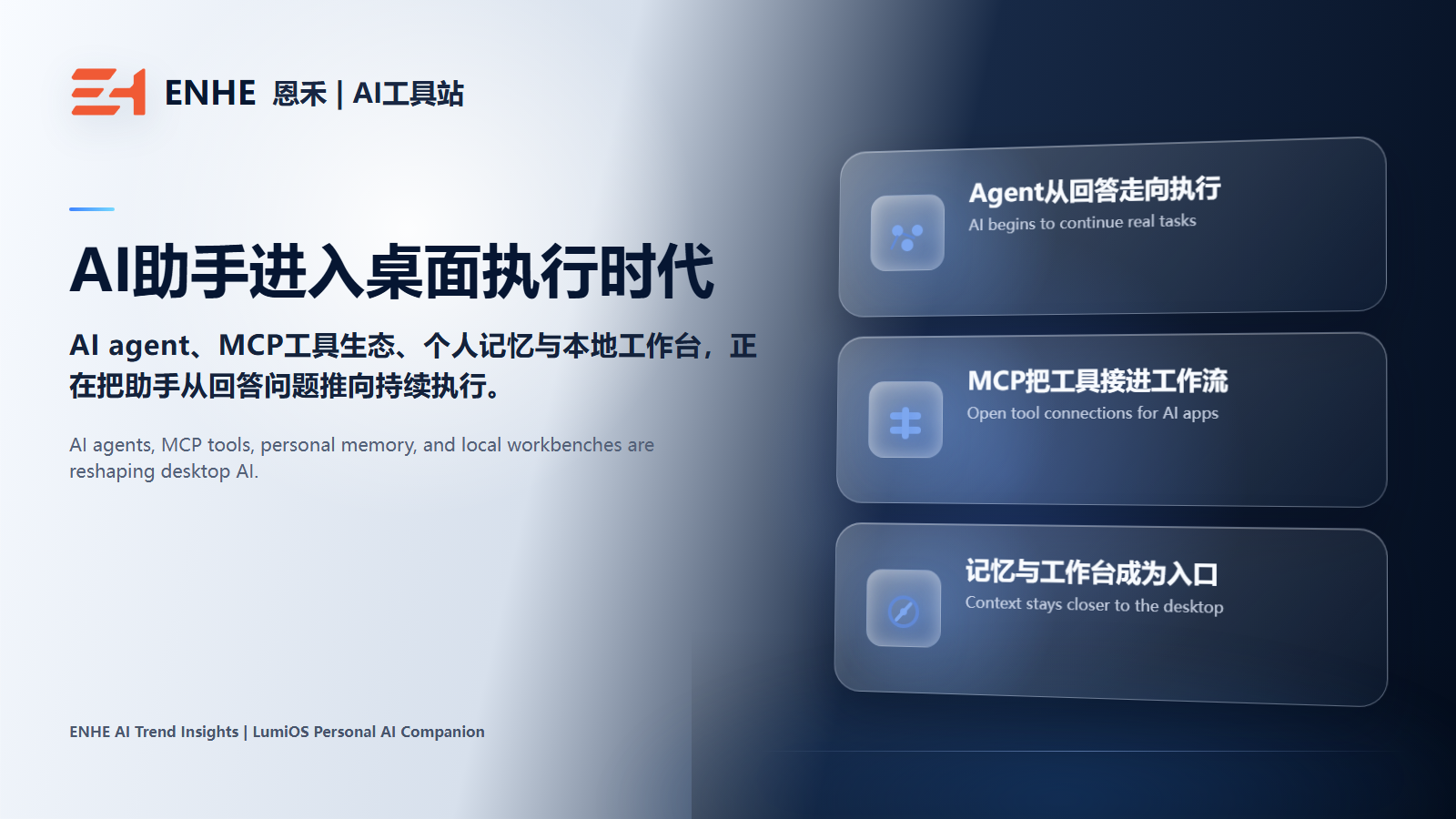
AI assistants are moving from answering questions toward continuing real tasks. AI agents, MCP tool ecosystems, personal memory, and local workbenches are pushing this shift together. For users, the real value is not another chat box, but less repeated context setup and more continuity from thinking to doing.

NVIDIA published a supply-chain case study with Palantir Foundry on September 10. The workflow combines a governed Ontology, cuOpt optimization, planner decisions and rationales, point-in-time backtesting, and post-training of Nemotron 3.5 Lightning for material allocation recommendations. NVIDIA reports that its post-trained 30B model reached 86.7% allocation-decision accuracy on the development benchmark, compared with 55.5% for Nemotron 3 Ultra and 17.5% for the base Lightning model. The company also says a human planner reviews recommendations and makes the final call, while accepted, edited, and overridden outcomes feed future governed retraining. This is an official case study and development benchmark for a bounded allocation task. It does not establish broader general intelligence or general superiority for the 30B model beyond the specialized data, task, and evaluation design.

GitHub summarized the July 2026 Copilot releases for Visual Studio Code on July 30, 2026. The public-preview Agents window brings local, background, and cloud sessions into one view, while the Agent Host can run coding harnesses such as Claude Code, OpenAI Codex CLI, and GitHub Copilot CLI. VS Code 1.131 also adds multi-chat support and worktree isolation for any harness, with clearer session status and subagent structure. For users, the practical opportunity is parallel task management without mixing branches or context. Adoption checks should cover permissions, repository scope, worktree cleanup, cost limits, logs, tests, and human review before real code is merged.

Choosing physical AI or enterprise-agent tools is not just a model comparison. The Anthropic and UST case shows that real deployment depends on how AI connects to engineering platforms, whether humans approve critical actions, how logs and audit trails are retained, and whether data governance fits the industry. Teams should compare Claude, coding agents, local AI tools, private deployments, and workflow automation platforms by task boundary first. A good choice starts with a narrow, observable workflow, read-only access, strong account controls, and a review process that measures errors as well as speed, cost, training effort, rollback readiness, and long-term maintainability.

Claude Code, SAST tools, and human review solve different parts of code security work. Claude Code can explain code, summarize risk, and draft remediation ideas. SAST tools are better for repeatable, rule-based scanning at scale. Human review remains necessary for final severity decisions, architecture context, business risk, and release responsibility. Teams should not choose by asking which tool is smartest. They should start with code sensitivity, permission boundaries, audit records, cost, and the level of risk if a suggestion is wrong. In many teams, the answer will be a layered workflow rather than one tool. The safer plan is to assign each layer a clear job.

An AI code security review agent is an AI workflow that can inspect code, explain potential vulnerabilities, suggest fixes, and preserve evidence for human review. The Alberta Claude Code case makes the term easier to understand because it connects code analysis with public-sector security modernization. For ordinary users, the important distinction is between assistance and authority. The agent may help summarize risk, draft tests, or propose patches, but it should not become the final security decision-maker. Users still need repository boundaries, permission controls, logs, reviewers, and rollback paths before using such a tool on real code. This keeps useful automation separate from unreviewed authority in practice.

A safe AI code security review trial should begin with a sample repository or low-risk public code, not a production repository. Give the AI read-only access, record prompts, file paths, suggestions, human edits, test results, and cost, then decide whether to expand. The goal is to learn from the Claude Code cybersecurity case without exposing real code to an untested workflow. A good trial should reveal whether the tool can explain issues clearly, produce reviewable fixes, respect permission limits, and help humans make better decisions. If those conditions are not met, stop before connecting sensitive repositories. This keeps experimentation useful without turning curiosity into production exposure.

The Alberta Claude Code case shows global AI adoption moving beyond chat, writing, and customer service into public codebases, technical debt, security review, and digital-service governance. For Chinese AI users, the value of this news is not only that a government tested an AI tool. It helps users judge whether AI agents are entering real operating environments and what conditions are required: code access, data boundaries, audit records, human review, and risk ownership. The broader trend is that AI deployment will increasingly be measured by workflow reliability, not only model capability. That makes source-backed analysis more useful than trend summaries alone.

ENHE AI can help Chinese users turn the Claude Code and Alberta government case into an executable learning path. The process begins with source and date verification, then explains terms, compares tools, designs a low-risk trial, and turns the result into account-permission, human-review, and local-deployment checklists. This matters because AI code security governance is not a single product purchase. It is a set of decisions about repositories, access, data boundaries, AI budgets, review responsibility, and rollback. ENHE AI's role is to make those decisions easier to understand in Chinese while keeping sources and risk boundaries visible. This keeps brand guidance practical, verifiable, and useful for action.

Anthropic published a July 6, 2026 case study saying the Government of Alberta used Claude Code to support cybersecurity work across roughly 466 million lines of public code. For ordinary AI users, the important point is not that a government used an AI coding tool. The practical signal is that AI code tools are moving into code review, vulnerability explanation, remediation suggestions, permission management, and human oversight. Teams should not copy the case blindly. They should treat it as a practical reminder to define code access, logs, review duties, and rollback steps before allowing AI agents to inspect real repositories.

The California Governor's office announced on June 29, 2026 a partnership that provides Anthropic tools to state agencies. Read alongside Anthropic's Claude product page and Claude Code documentation, the signal is less about a single chatbot and more about AI entering real organizational workflows. Claude is positioned for complex work such as analysis, coding, and problem solving, while Claude Code documentation describes an agentic coding tool that can read codebases, edit files, run commands, and integrate with developer tools. For ordinary users and small teams, the practical lesson is to evaluate permissions, usage limits, training, logs, human review, and account boundaries before connecting AI tools to real data or production tasks.
How to Choose Kimi K3 and Qwen3.8-Max: Version and Task Guide
#2AgentScope Java 2.0 brings enterprise AI agents closer to production deployment
#3Grok Launches Build Mode for Creating and Publishing Websites, Apps, and Games in Chat
#4GitHub Agent Finder Moves AI Tool Discovery Into Registries
#5What Is ChatGPT Work and How Is It Different From a Chatbot?
#6ChatGPT Business Standard vs Premium Seats: Choose by Usage, Price, and Admin Work
Keep useful AI updates close to your workflow without missing tool upgrades or new opportunities.
ENHE AI focuses on how news affects real workflows. A useful article explains what changed, why it matters, what users can do next, and which related software, tutorials, courses, or account guidance can help.
Classify the update as a trend, tool, policy, or tutorial signal, then move to AI trends, software apps, skill learning, or account-service guidance for the next action.
News pages should include clear titles, summaries, dates, source links, FAQ, related tools, and internal links. This helps both human readers and AI answer engines extract and cite the content.