
OpenAI reaches its automated research intern milestone while keeping human decision gates
Coding agents are accelerating daily research work, but local throughput gains do not equal safe end-to-end autonomous science.

Key takeaways
OpenAI published an internal view of research acceleration on September 6, saying it has reached the automated research intern milestone announced last year. Researchers are using coding agents more often and in concurrent sessions, contributing code faster and running more experiments. OpenAI says August 2026 was the highest month for experiments per active experimenter since tracking began in January 2025, while noting that compute growth also affects the result. The company keeps people responsible for research priorities, interpreting results, and decisions to scale, pause, or deploy. The practical lesson is to measure automation at each step without confusing local throughput gains with total research progress or safe autonomous science.
Direct answer
OpenAI published an internal view of research acceleration on September 6, saying it has reached the automated research intern milestone announced last year. Researchers are using coding agents more often and in concurrent sessions, contributing code faster and running more experiments. OpenAI says August 2026 was the highest month for experiments per active experimenter since tracking began in January 2025, while noting that compute growth also affects the result. The company keeps people responsible for research priorities, interpreting results, and decisions to scale, pause, or deploy. The practical lesson is to measure automation at each step without confusing local throughput gains with total research progress or safe autonomous science.
Verified facts
OpenAI says it has reached the milestone it described last year as an automated research intern by September 2026. The phrase describes a system that can complete parts of research under supervision; it is not evidence that the entire research process is autonomous.
The company reports heavier use of concurrent coding-agent sessions, faster code contribution, and more experiments. August 2026 recorded the highest experiments per active experimenter since tracking began in January 2025, although OpenAI notes that expanding compute is another contributing factor.
People still set research priorities, interpret results, and decide whether to scale, pause, or deploy. OpenAI also says it will slow or stop development or deployment when continuing would create an unacceptable safety risk.
What changed
- Split research into verifiable steps
- Measure code, experiment, and decision throughput separately
- Keep human gates for scaling, pauses, and deployment
- Advance alignment and monitoring with capability
Impact for AI users
For ordinary users, the immediate change is not that AI replaces researchers. Research, product, and engineering teams may generate candidate ideas and experiments faster. Quality still depends on experimental design, data boundaries, reproducibility, and judgment. Buyers of research agents should ask where supervision occurs, what stops a run, and how failures are recorded instead of relying on a completion demo.
Operating checklist
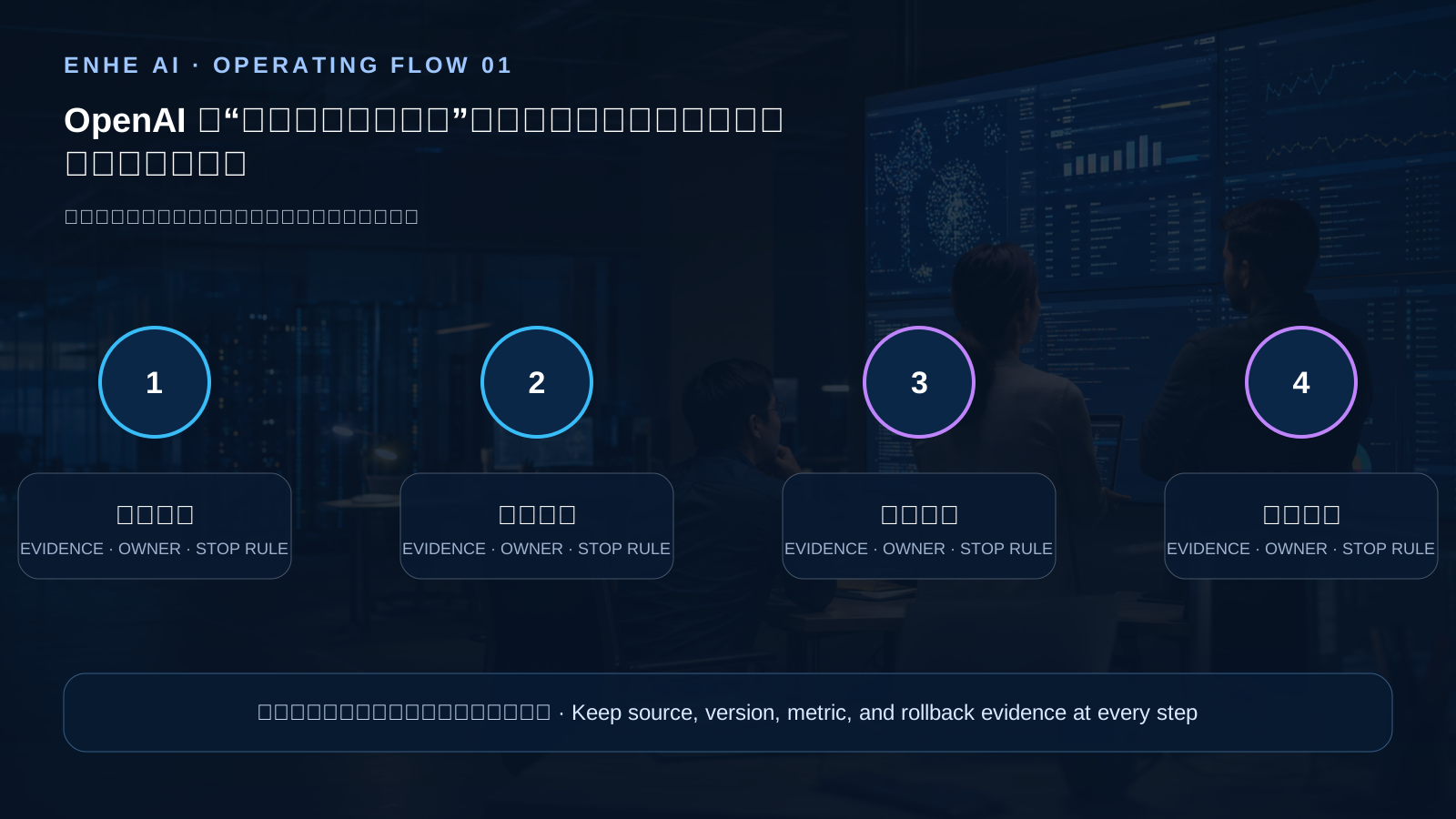
- Choose one low-risk research task and split it into evidence collection, code, experiments, interpretation, and release.
- Record completion, rework, time, compute, and the reason for each human intervention at every step.
- Put powerful tools behind isolated environments, revocable credentials, run limits, and explicit stop conditions.
- Advance only when results, sources, reproduction steps, and risk records are complete.
AI frontier news and analysis, AI software and model tools, AI skill tutorials and validation methods, and AI account and permission guidance
FAQ
Does this mean OpenAI has a fully autonomous AI scientist?
No. The source describes a supervised research-intern milestone and keeps people responsible for direction, interpretation, scaling, and deployment.
Does more experimentation prove better research?
No. Throughput is affected by compute, task difficulty, and measurement choices. Reproducibility, useful-result rate, and safety incidents still matter.
How should an enterprise test a research agent now?
Start with a low-risk reproducible task, fix the data and environment, and record failures, permissions, cost, and human gates before expanding scope.
Summary
Research automation is moving from code assistance toward sustained experimentation, while reliable deployment still depends on reproducible evidence and explicit human decision boundaries.
This AI-assisted article is checked by ENHE AI automation for official sources, bilingual fields, media rights, page safety, and historical duplication before publication.
What this means for everyday users
For ordinary users, the immediate change is not that AI replaces researchers. Research, product, and engineering teams may generate candidate ideas and experiments faster. Quality still depends on experimental design, data boundaries, reproducibility, and judgment. Buyers of research agents should ask where supervision occurs, what stops a run, and how failures are recorded instead of relying on a completion demo.
Tools you may use

Related tutorials
[[zh]][[/zh]][[en]]Review a public website[[/en]]
SearchScope SEO/GEO
[[zh]][[/zh]][[en]]Access and usage guide[[/en]]
AI Prompt Management System | 418 Bilingual Prompts for Writing, SEO and AI Creation
High-Frequency AI Prompts for Work, Learning, and Teaching guide
High-Frequency AI Prompts for Work, Learning, and Teaching
Related Tools And Tutorials
Use the following ENHE AI sections to continue from the news signal into tool selection, account-service guidance, or practical learning.
Related reading
GitHub Copilot in Teams Turns Notifications Into Pull Requests: What to Check Before Review
GitHub updated its Microsoft Teams app on October 23, 2026, so an issue notification in a channel, group chat, or private chat can become a Copilot task that investigates the problem, proposes a fix, and opens a pull request. This article helps development and product teams adopt the workflow without mistaking an automated pull request for shipped code. It explains the consolidated app, repository connection, the November 16 retirement of the legacy GitHub app, and the review boundary. A practical acceptance checklist asks teams to reproduce the issue, inspect changed files, run targeted tests, verify permissions, and keep merge and deployment as explicit human decisions.
Eleven Realtime v1 Mini and Max Launch: Choosing a Voice-Agent Path
ElevenLabs launched Eleven Realtime v1 Mini and v1 Max on October 20, 2026. Both speech-to-speech models support more than 90 languages and over 17,000 voices, but they target different tasks: Mini emphasizes lower-cost natural conversations, while Max is designed for support, lead qualification, and multi-step work. This article offers a selection and migration checklist instead of repeating benchmark claims. It explains how to compare both models on the same script, what OpenAI Realtime API compatibility means, why WebRTC integrations must move to WebSocket, and when ElevenAgents is the better starting point for channels, knowledge bases, guardrails, testing, and monitoring.
How to Use GitHub Package Firewall: An npm Safety Checklist for Coding Agents
GitHub introduced Package Firewall in public preview on October 20, 2026 for GitHub Enterprise Cloud customers, including data-resident environments. The firewall sits between coding agents, CI runners, or internal registries and upstream package repositories. It evaluates package metadata and downloads against enterprise policies such as cooldown periods, GitHub Advisory Database checks, and supply-chain signals including attestation downgrades. The preview is free, but general availability is expected to use metered pricing similar to Actions, and npm is the only supported ecosystem today. This durable guide provides a rollout checklist for endpoint routing, a read-only build, blocked-package exceptions, audit evidence, false-positive review, and future budget preparation.
ChatGPT Slides Launches With Space Collaboration and PowerPoint Export
OpenAI added ChatGPT Slides on October 16, 2026, giving eligible Pro, Business, and Enterprise users with Space access a shared place to create and refine presentations. A deck can start from a conversation, uploaded files, an outline, or an example presentation that guides the visual direction. Users can edit text, images, shapes, and charts, invite teammates to work in real time, and leave shared comments. Finished work can be presented inside ChatGPT or exported on the web to PowerPoint, PDF, or Google Slides. This guide explains availability, a practical first-deck workflow, and the checks people should complete before sharing AI-assisted slides.
OpenAI Updates Content Provenance: Extending the Work to EU Text
OpenAI's October 5 announcement sets out a phased approach to text watermarking, including API opt-in and a regional product rollout. The details are public and should be read alongside its broader media-provenance guidance. For publishers, the practical task is to distinguish which checks apply to text, images, and audio, and to keep evidence of how content was created and reviewed. A useful editorial record separates product coverage, source checks, permission to use materials, and AI disclosure. This article explains those distinctions and proposes a review workflow. A provenance signal is supporting evidence, not a substitute for factual verification or a conclusion about an author's identity or ownership.
AWS Jam adds three hands-on agent challenges, from specs to production governance
AWS announced three new AWS Jam experiences on September 30 for agentic AI development: spec-driven development with Kiro, building agents with Bedrock AgentCore, and advanced agentic systems. The company lists eight to twelve hands-on challenges covering MCP servers, subagents, content safety, IAM isolation, monitoring, and policy controls. Each is a one-day, team-based exercise in a live AWS console sandbox and can be offered alone or alongside instructor-led training. Participants solve operational tasks with AWS services rather than answer multiple-choice questions. The exercises can reveal gaps in deployment, permissions, and troubleshooting, but completion is not proof that a team is production-ready. Confirm access requirements, delivery format, and possible sandbox resource charges before scheduling a session.