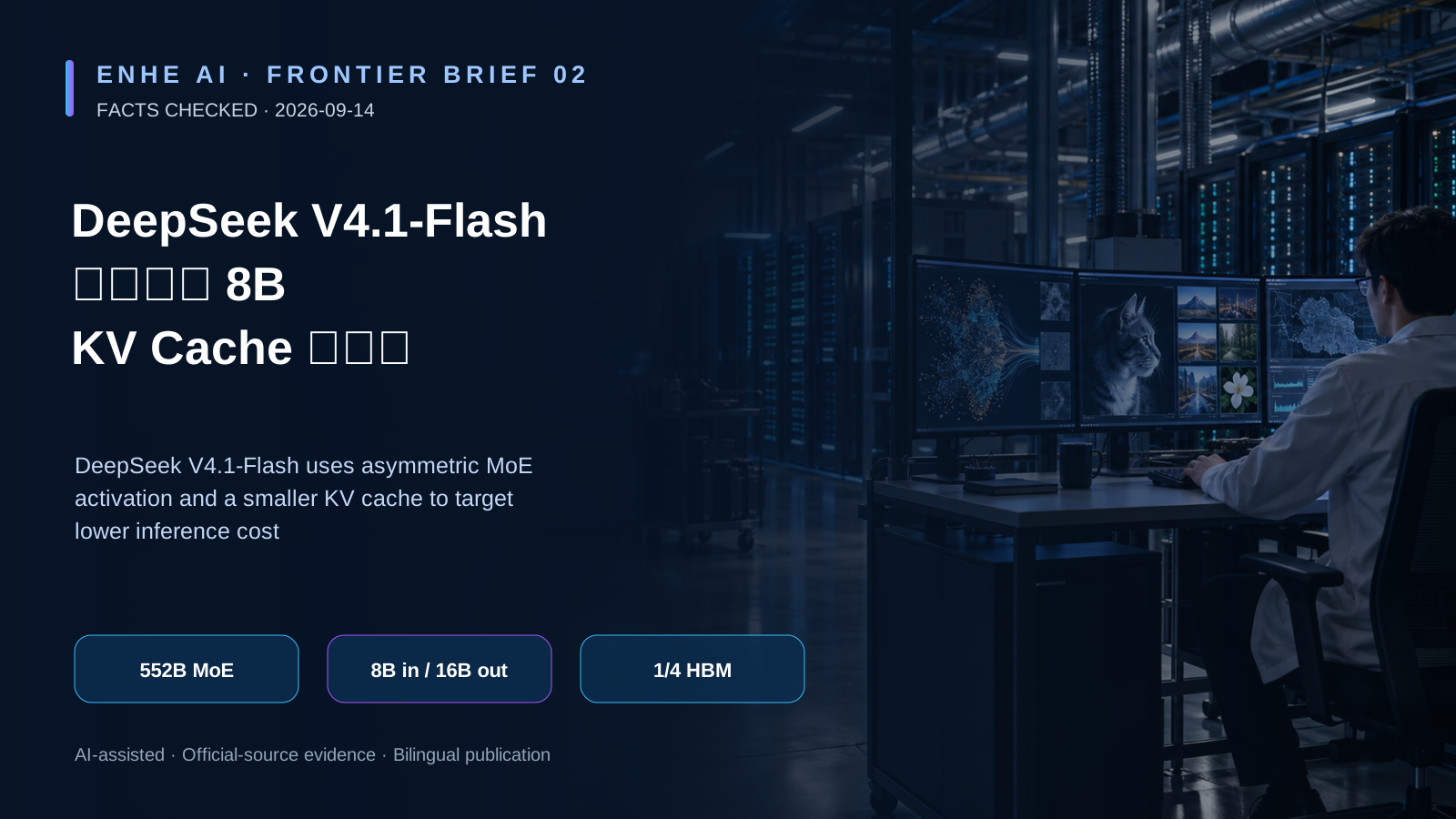
DeepSeek V4.1-Flash uses asymmetric MoE activation and a smaller KV cache to target lower inference cost
The 552B model activates 8B parameters for input and 16B for output, while the API transition temporarily reroutes retired aliases.

Key takeaways
DeepSeek introduced V4.1-Flash on September 10 as a 552-billion-parameter mixture-of-experts model with native visual understanding. Its new Causal Encoder–Decoder architecture activates 8 billion parameters while processing input and 16 billion while generating output. DeepSeek says the model needs one quarter of the HBM and one eighth of the SSD storage for KV cache compared with the previous generation. V4.1-Flash is available through the DeepSeek API as deepseek-flash, while retired V4 Flash aliases temporarily route to it for compatibility. At this batch's 06:00 Beijing run, the V4-Pro cutover was still in the future: DeepSeek scheduled all deepseek-v4-pro requests to route to V4.1-Flash from 04:00 UTC, or 12:00 Beijing time, on September 14 until V4.1-Pro launches.
Direct answer
DeepSeek introduced V4.1-Flash on September 10 as a 552-billion-parameter mixture-of-experts model with native visual understanding. Its new Causal Encoder–Decoder architecture activates 8 billion parameters while processing input and 16 billion while generating output. DeepSeek says the model needs one quarter of the HBM and one eighth of the SSD storage for KV cache compared with the previous generation. V4.1-Flash is available through the DeepSeek API as deepseek-flash, while retired V4 Flash aliases temporarily route to it for compatibility. At this batch's 06:00 Beijing run, the V4-Pro cutover was still in the future: DeepSeek scheduled all deepseek-v4-pro requests to route to V4.1-Flash from 04:00 UTC, or 12:00 Beijing time, on September 14 until V4.1-Pro launches.
Verified facts
DeepSeek describes V4.1-Flash as a 552B-parameter MoE whose Causal Encoder–Decoder activates 8B parameters for input and 16B for output.
The company says its KV cache uses one quarter of the HBM and one eighth of the SSD storage required by the previous generation, connecting the reduction to agent cache-hit cost.
The model is live as deepseek-flash with native multimodal support; retired Flash aliases temporarily point to it, and DeepSeek scheduled the V4-Pro reroute for 04:00 UTC, or 12:00 Beijing time, on September 14.
What changed
- Input understanding and output generation use different active-parameter budgets
- DeepSeek reports substantial reductions in HBM and SSD consumption for KV cache
- The primary API model name becomes deepseek-flash
- Legacy Flash aliases use temporary compatibility routing, while the V4-Pro reroute is scheduled for 04:00 UTC on September 14
Impact for AI users
Asymmetric activation means teams should measure input processing before the first token separately from sustained decoding instead of summarizing the path with one throughput number. A smaller cache may improve the economics of long-context and agent loops, but the ratios are DeepSeek's comparison with its previous generation. The more immediate operational risk is alias routing: output quality, visual-input behavior, latency, and billing can change even when application code keeps the same model string. A pinned evaluation set and an explicit rollback target are therefore essential.
Operating checklist
- Inventory every deepseek-flash, legacy V4 Flash, and deepseek-v4-pro call, recording the model and rate that each alias actually resolves to.
- Measure input processing, time to first token, decode speed, KV-cache use, and end-to-end cost separately on representative work.
- Build regression sets for text, images, long context, and tool calls, keeping vendor benchmarks separate from internal results.
- Set quality, latency, and spend thresholds for the routing window, with an explicit model configuration and executable rollback procedure.
AI frontier news and analysis, AI software and model tools, AI skill tutorials and validation methods, and AI account and permission guidance
FAQ
Does 552B mean every token uses all parameters?
No. DeepSeek describes 552B as the total MoE size, with 8B active for input and 16B active for output.
Will legacy V4 Flash API names stop working immediately?
No. DeepSeek says the old aliases temporarily route to V4.1-Flash, but the announcement does not provide an end date.
Has DeepSeek proven that every workload will be cheaper and faster?
No. The page provides architecture, cache, and vendor-test claims; quality, speed, and total cost still require workload-specific validation.
Summary
V4.1-Flash separates input, output, and cache economics at the architecture level. For API users, the urgent task is to detect alias rerouting and validate the change with their own evaluations and spend guardrails.
This AI-assisted article is checked by ENHE AI automation for official sources, bilingual fields, media rights, page safety, and historical duplication before publication.
What this means for everyday users
Asymmetric activation means teams should measure input processing before the first token separately from sustained decoding instead of summarizing the path with one throughput number. A smaller cache may improve the economics of long-context and agent loops, but the ratios are DeepSeek's comparison with its previous generation. The more immediate operational risk is alias routing: output quality, visual-input behavior, latency, and billing can change even when application code keeps the same model string. A pinned evaluation set and an explicit rollback target are therefore essential.
Tools you may use


Related tutorials
Related Tools And Tutorials
Use the following ENHE AI sections to continue from the news signal into tool selection, account-service guidance, or practical learning.
Related reading
Cohere North Small Translate is a 25B-active open-weight MoE built for translation across 50+ languages
Cohere released North Small Translate on September 10, an open-weight mixture-of-experts model dedicated to machine translation across more than 50 languages. The model has 218 billion total parameters and 25 billion active parameters, with 16K input and 16K output context. Cohere lists one B200 or two H100 GPUs at W4A4 as minimum configurations. In vendor-run evaluations using GPT-5.6-Sol as a judge, the standard model scored 83.60 across WMT26 languages and an agentic variant scored 84.36. Cohere also reports up to 1.4 times the output throughput of Gemma 4 31B under identical hardware and concurrency. The model card says the non-commercial CC BY-NC 4.0 license carries an acceptable-use addendum and requires Cohere Labs AUP compliance; commercial production requires a separate commercial license.
OpenAI Extends Zero Data Retention to Frontier Models with Private Safety Processing
OpenAI announced Private Safety Processing on August 19, 2026 to keep frontier-model safety monitoring compatible with Zero Data Retention for eligible API customers. Under the preview, customer content can remain on customer-controlled infrastructure, while automated systems analyze related interactions and return narrowly defined risk signals without giving OpenAI personnel the underlying prompts or responses. OpenAI is also developing hosted storage encrypted with customer-controlled keys. This is not an automatic setting for every API account. Teams should confirm organization and project eligibility, separate request content from administrative audit logs and other data surfaces, document legal or safety exceptions, and test the configuration with non-sensitive samples before sending regulated or confidential workloads.
OpenAI Previews GPT-5.6 Sol Ultrafast at Up to 14x Speed
OpenAI previewed GPT-5.6 Sol Ultrafast on August 13, 2026, saying the Cerebras-powered service can run up to fourteen times faster than the standard version and reach up to roughly 750 output tokens per second. The company is starting with selected API customers; it did not announce universal ChatGPT access, one public price, or a general availability date. Developers should confirm invitation status and region, then compare the same long-context, structured-output, or agent task against the standard model. Record time to first token, total latency, accepted quality, tool behavior, cost, limits, and retries. Peak throughput alone is not enough evidence to replace a production model.
GitHub Copilot Usage Metrics Adds Agent-App Activity
GitHub announced on August 7, 2026 that the Copilot Usage Metrics API now reports activity from third-party agent apps. Enterprise, organization, enterprise-user, and organization-user reports can expose the activity in one-day and 28-day windows. The new totals_by_3rd_party_agent data includes a stable agent_id and a display name that may change; the identifier should be the join key. This gives administrators a finer view of cost, permissions, and workflow adoption, but it does not automatically explain business value. Start with a read-only sample, reconcile time zones, pagination, and overlapping windows, then associate agent activity with AI credits, members, repositories, and permission changes before changing budgets or access.
Mistral and Cloudera target sovereign enterprise AI with customer-controlled training, inference, and operations
Mistral and Cloudera announced a sovereign enterprise AI partnership on September 10. The companies plan to integrate Mistral models with Cloudera's hybrid data platform across public cloud, private cloud, on-premises, and fully air-gapped environments. Mistral says enterprises will be able to train customized models on proprietary data inside controlled environments while retaining ownership of their data and resulting intelligence. The announcement addresses 30 exabytes of customer-managed data on Cloudera's platform and describes customer control over data, open weights, training, inference, infrastructure, jurisdiction, governance, observability, and the learning loop. It does not identify specific model versions, delivery dates, pricing, certifications, or measured customer outcomes, so buyers still need to translate the sovereignty language into testable contractual and technical controls.
AWS shows how AgentCore can deliver the same MCP tools and interactive widgets across compatible AI hosts
AWS published a technical walkthrough for running MCP Apps on Amazon Bedrock AgentCore on September 11. In the reference architecture, an AI host discovers MCP tools and resources, invokes a tool through WAF and AgentCore Gateway, and receives structured content from business logic implemented with Lambda and DynamoDB. When a tool points to a resource URI, the host reads self-contained widget HTML and renders it in a sandboxed iframe with the structured result injected through the MCP Apps lifecycle. AWS presents MCP Apps as a host-agnostic standard, so one server can provide the same tools and widgets to compatible AI hosts. The production guidance still requires strict argument validation, trust-boundary controls, caller restrictions, monitoring, and cost review.