
A durable Dense versus MoE model-selection checklist beyond total parameters
Compare active parameters, memory, concurrency, tail latency, quantization, and fine-tuning behavior under one repeatable workload.

Key takeaways
NVIDIA's September 15 technical article explains the central Dense versus Mixture-of-Experts tradeoff. Dense models activate all parameters for every token; MoE models keep all experts in memory but route each token through a subset, separating memory cost from compute cost. Nemotron 3.5 Lightning is cited as a 30B-total model with 3B active parameters per token. MoE can raise throughput at similar total size, while latency advantages narrow at high concurrency, fine-tuning can create router imbalance, and quantization affects routing and projection layers differently. This checklist turns those factors into a repeatable selection task using a fixed request set, target hardware, quality thresholds, concurrency steps, and cost per accepted result.
Direct answer
NVIDIA's September 15 technical article explains the central Dense versus Mixture-of-Experts tradeoff. Dense models activate all parameters for every token; MoE models keep all experts in memory but route each token through a subset, separating memory cost from compute cost. Nemotron 3.5 Lightning is cited as a 30B-total model with 3B active parameters per token. MoE can raise throughput at similar total size, while latency advantages narrow at high concurrency, fine-tuning can create router imbalance, and quantization affects routing and projection layers differently. This checklist turns those factors into a repeatable selection task using a fixed request set, target hardware, quality thresholds, concurrency steps, and cost per accepted result.
Verified facts
Dense models activate every parameter per token, while MoE keeps multiple experts in memory and selects only a subset for each token.
NVIDIA uses Nemotron 3.5 Lightning, with 30B total and 3B active parameters per token, to illustrate the memory-compute split.
The article notes concurrency-dependent throughput and latency, router imbalance during tuning, and different quantization behavior across routing and projection layers.
What changed
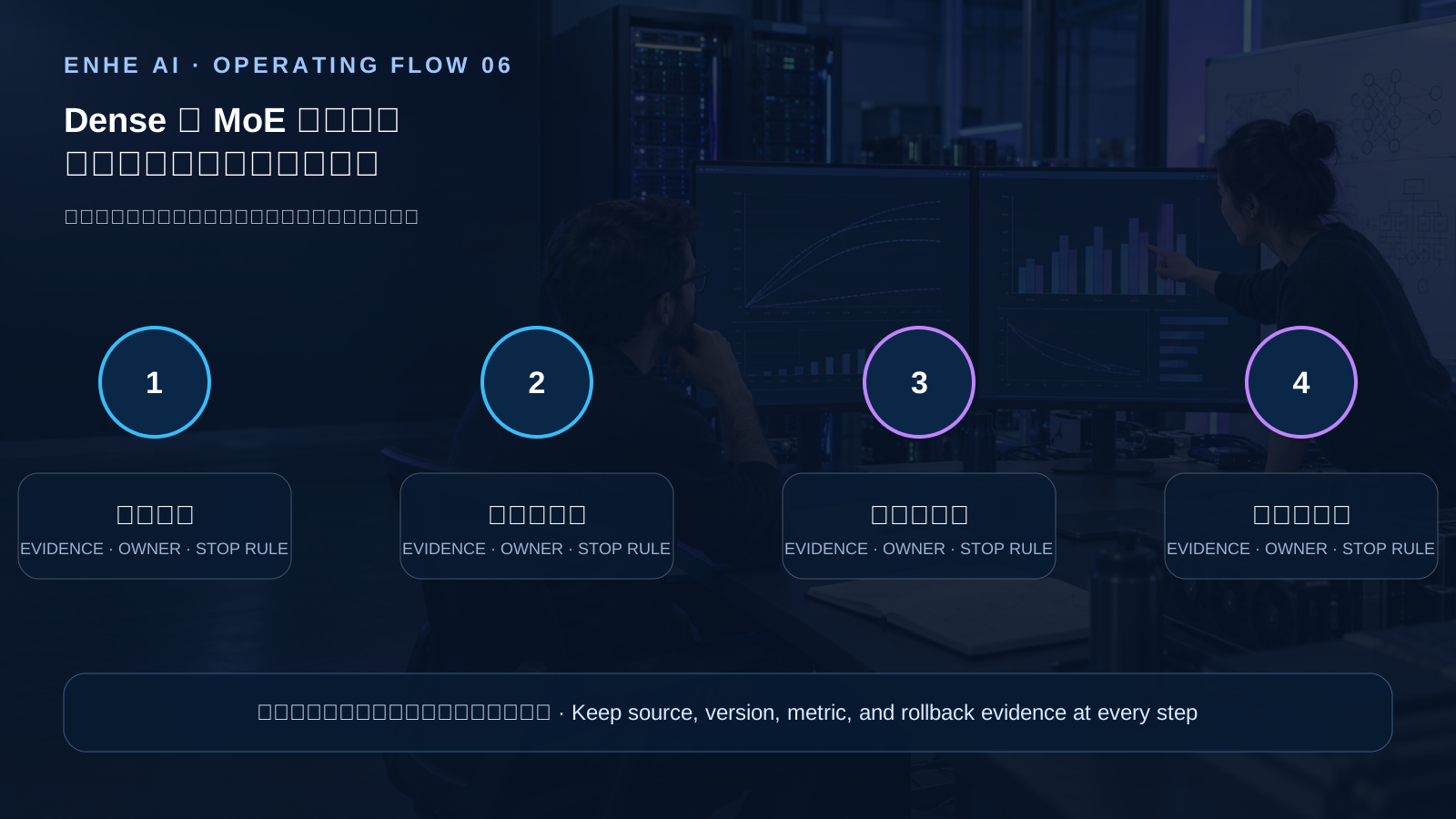
- Selection moves from total to active parameters
- Memory budget is separated from per-token compute
- Throughput and tail latency are compared across concurrency
- Fine-tuning and quantization enter pre-production acceptance
Impact for AI users
MoE is not automatically cheaper in memory, and Dense is not automatically slower. The decision depends on target hardware, request length and concurrency, serving stack, quantization, tuning plans, and failure complexity. Use the same business request set to measure quality, TTFT, inter-token latency, throughput, peak memory, and cost per accepted result.
Operating checklist
- Lock a representative request set and quality bar
- Measure memory and per-request latency on target hardware
- Raise concurrency stepwise and plot throughput and tail latency
- Choose only after adding quantization, tuning, and rollback cost
AI frontier news and analysis, AI software and model tools, AI skill tutorials and validation methods, and AI account and permission guidance
FAQ
Is an MoE model always slower because its total size is larger?
No. Only selected experts run per token, while memory and routing overhead still require target-hardware testing.
Is tokens per second enough?
No. Include quality, TTFT, tail latency, peak memory, failures, and cost per accepted result.
Summary
The right Dense or MoE choice is not a parameter-count label; it is a reproducible curve across quality, hardware, concurrency, tuning, and cost.
This AI-assisted article is checked by ENHE AI automation for official sources, bilingual fields, media rights, page safety, and historical duplication before publication.
What this means for everyday users
MoE is not automatically cheaper in memory, and Dense is not automatically slower. The decision depends on target hardware, request length and concurrency, serving stack, quantization, tuning plans, and failure complexity. Use the same business request set to measure quality, TTFT, inter-token latency, throughput, peak memory, and cost per accepted result.
Tools you may use



Related tutorials
Related Tools And Tutorials
Use the following ENHE AI sections to continue from the news signal into tool selection, account-service guidance, or practical learning.
Related reading
GitHub Introduces HydraFusion Max: When Multi-Model Review Is Worth Trying
GitHub has updated HydraFusion and introduced HydraFusion Max, an orchestration option for demanding coding work. It is not a new standalone model: the system chooses how to draft, review, or revise a response using models allowed for the account. Both options remain research previews, so access and suitability need checking before adoption. This article explains the distinction from automatic single-model selection and proposes a bounded bug-fix comparison that records tests, changes, and usage. It does not rank model quality or promise lower cost. The suggested exercise is designed for people already using an AI coding assistant who want to decide when additional review passes are worth the time and credits.
How to Choose Claude Haiku 5.5 for High-Volume AI Work
Anthropic released Claude Haiku 5.5 on October 7, 2026 for high-volume, cost-sensitive work such as summaries, compaction, classification, database queries, customer support, browser use, and coding subagents. Anthropic says the model costs about 75% less to run on average than Haiku 4.5 and adds adjustable effort, while still positioning larger Sonnet and Opus models for harder agentic coding. GitHub Copilot now offers Haiku 5.5 across multiple paid plans and clients, with usage billed at provider list pricing and gradual rollout. A durable selection decision should not rely on the word 'small' or a benchmark headline. This guide shows how to segment tasks, create a representative test set, measure correct completions, latency, tokens, tool success, and human correction, then choose a fallback for work that exceeds the small model's reliable boundary.
Google Cloud Introduces the Gemini Agent for Work
Google Cloud introduced the Gemini agent at Gemini at Work on October 8, 2026. Google describes it as a universal work agent that can use an organization's business context, plan work, call skills and tools, connect to business systems, and return completed results inside documents, inboxes, and developer environments. The announcement also highlights model selection, cost controls, security, administration, and governance. Those claims define a product direction, not automatic permission to connect every data source. Before rollout, start with one bounded workflow, list the records and tools the agent can reach, separate read from write access, cap spend, require confirmation before messages or irreversible changes, verify the destination of generated work, and keep a human owner for exceptions and acceptance.
AWS HyperPod Inference Gateway routes requests with live GPU signals
AWS announced SageMaker HyperPod Inference Gateway Tier 1 on September 18. The EKS managed add-on uses a Body-Based Router to read the model field from OpenAI-compatible requests and an Endpoint Picker that scores KV-cache use, queue depth, LoRA residency, prefix-cache hits, and running requests. AWS reports tail-latency gains across several matched-replica scenarios and summarizes up to an 82% first-token reduction, while a uniform steady workload remained comparable to round robin. Teams should repeat the comparison on their own hardware, models, and traffic. A production trial should hold replicas and requests constant, include failure and 429 behavior, and preserve the prior routing configuration for immediate rollback.
NVIDIA AIPerf rebuilds LLM inference benchmarking around multiprocess load generation
NVIDIA introduced AIPerf on September 18 as the designated successor to GenAI-Perf. It separates load generation, result processing, and coordination across multiple processes connected through ZMQ so a Python client is less likely to become the bottleneck at production concurrency. AIPerf supports more than fifteen endpoint types, public datasets, and trace replay formats from several serving systems. Engineers can choose constant, Poisson, or gamma arrival patterns, tune burstiness, and ramp concurrency or request rate. Reports include TTFT, inter-token latency, request latency, output-token throughput, percentile distributions, CSV and JSON summaries, logs, and optional GPU telemetry when DCGM or pynvml is available.
Anthropic launches Claude Fable 5.1 and Mythos 5.1 with a tighter cost and safety profile
Anthropic introduced Claude Fable 5.1 and Claude Mythos 5.1 on September 1. They share one base model but use different safeguard and access profiles. Fable is generally available and is estimated to cost 25% less for typical token workloads, with savings of up to about 45% for highly agentic workloads. Enterprise Frontier Safeguards will keep customer data in infrastructure controlled by the customer while providing misuse detection. Mythos is offered through trusted access programs for cybersecurity and life sciences. Anthropic also described software vulnerability discovery, protein binder design, and GPU kernel optimization examples. For enterprise teams, the launch makes model selection a joint decision about capability, cost, data residency, and risk controls.