
NVIDIA AIPerf rebuilds LLM inference benchmarking around multiprocess load generation
The successor to GenAI-Perf adds broader endpoints, trace replay, controlled arrival patterns, and percentile-level latency and throughput evidence.

Key takeaways
NVIDIA introduced AIPerf on September 18 as the designated successor to GenAI-Perf. It separates load generation, result processing, and coordination across multiple processes connected through ZMQ so a Python client is less likely to become the bottleneck at production concurrency. AIPerf supports more than fifteen endpoint types, public datasets, and trace replay formats from several serving systems. Engineers can choose constant, Poisson, or gamma arrival patterns, tune burstiness, and ramp concurrency or request rate. Reports include TTFT, inter-token latency, request latency, output-token throughput, percentile distributions, CSV and JSON summaries, logs, and optional GPU telemetry when DCGM or pynvml is available.
Direct answer
NVIDIA introduced AIPerf on September 18 as the designated successor to GenAI-Perf. It separates load generation, result processing, and coordination across multiple processes connected through ZMQ so a Python client is less likely to become the bottleneck at production concurrency. AIPerf supports more than fifteen endpoint types, public datasets, and trace replay formats from several serving systems. Engineers can choose constant, Poisson, or gamma arrival patterns, tune burstiness, and ramp concurrency or request rate. Reports include TTFT, inter-token latency, request latency, output-token throughput, percentile distributions, CSV and JSON summaries, logs, and optional GPU telemetry when DCGM or pynvml is available.
Verified facts
AIPerf is the designated successor to GenAI-Perf and uses multiprocess workers, separate record processors, and ZMQ coordination.
It supports more than fifteen endpoint types plus ShareGPT and trace replay formats from Mooncake, Baseten, WEKA AgentX, and others.
Core outputs include TTFT, ITL, request latency, and output-token throughput with percentile breakdowns, CSV, JSON, and logs.
What changed
- The benchmark client moves from a single process to a multiprocess architecture
- Synthetic lengths and real trace replay use one tool
- Arrival distribution and burstiness become explicit controls
- Latency, throughput, and GPU telemetry can be analyzed together
Impact for AI users
AIPerf does not automatically make a benchmark fair, but it addresses a common error: the load client saturating before the server. Teams must still pin model versions, serving configuration, input and output lengths, streaming mode, and stop conditions, while retaining commands and result files. Good TTFT with poor ITL, or higher throughput with more errors, should never be hidden behind one average.
Operating checklist
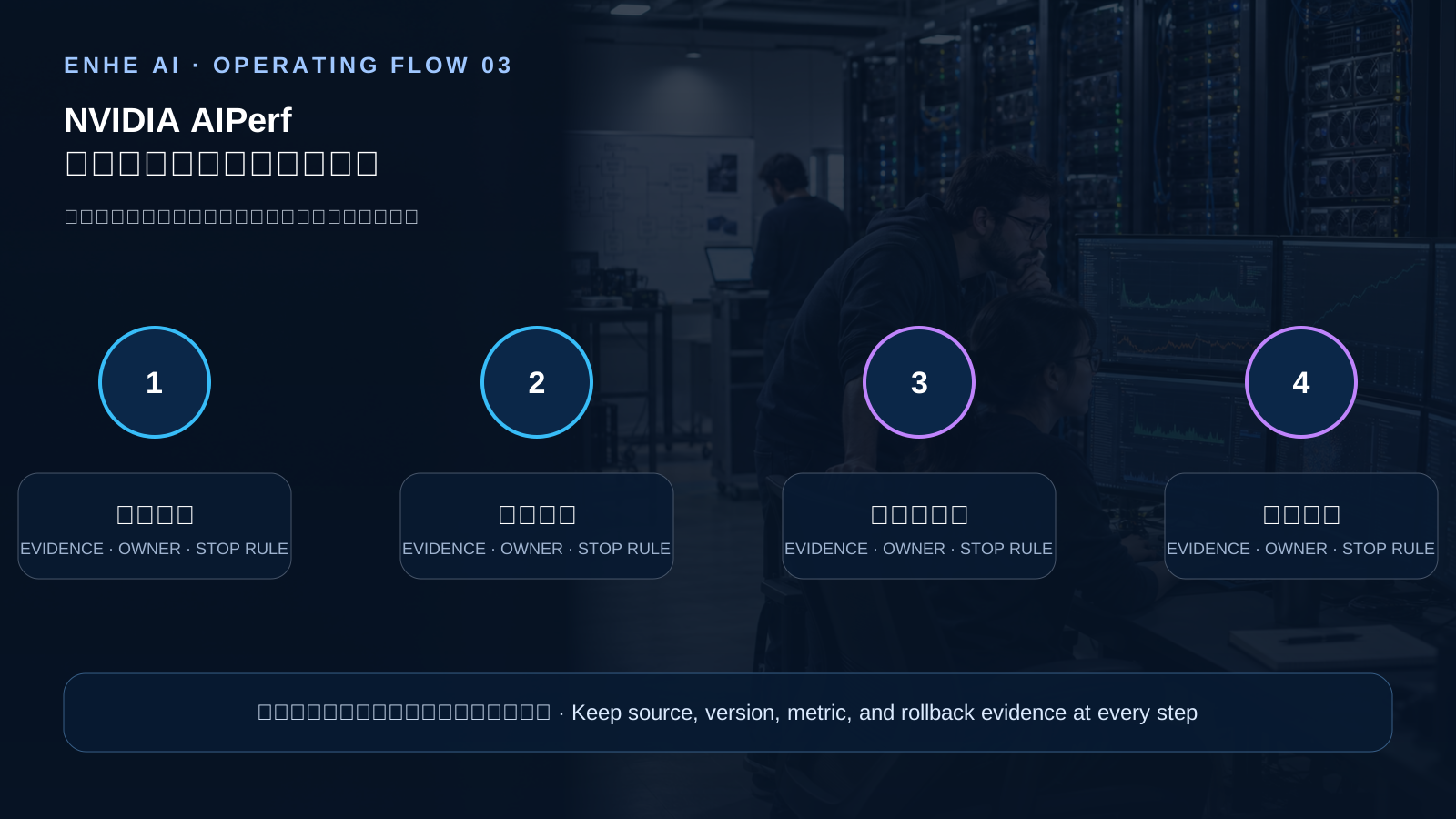
- Pin model, serving image, and dataset versions
- Calibrate request arrivals and input-output lengths
- Record percentiles, error rate, and GPU telemetry together
- Save the reproducible command and define regression thresholds
AI frontier news and analysis, AI software and model tools, AI skill tutorials and validation methods, and AI account and permission guidance
FAQ
Does AIPerf replace server-side monitoring?
No. It produces external load and results that should be interpreted with server and GPU telemetry.
Why is streaming required?
NVIDIA notes that without streaming there are no first-token or inter-token events to measure.
Summary
AIPerf puts workload shape, client capacity, and result evidence into one reproducible experiment. Reliable conclusions still depend on strict control of variables.
This AI-assisted article is checked by ENHE AI automation for official sources, bilingual fields, media rights, page safety, and historical duplication before publication.
What this means for everyday users
AIPerf does not automatically make a benchmark fair, but it addresses a common error: the load client saturating before the server. Teams must still pin model versions, serving configuration, input and output lengths, streaming mode, and stop conditions, while retaining commands and result files. Good TTFT with poor ITL, or higher throughput with more errors, should never be hidden behind one average.
Tools you may use



Related tutorials
Related Tools And Tutorials
Use the following ENHE AI sections to continue from the news signal into tool selection, account-service guidance, or practical learning.
Related reading
Eleven Realtime v1 Mini and Max Launch: Choosing a Voice-Agent Path
ElevenLabs launched Eleven Realtime v1 Mini and v1 Max on October 20, 2026. Both speech-to-speech models support more than 90 languages and over 17,000 voices, but they target different tasks: Mini emphasizes lower-cost natural conversations, while Max is designed for support, lead qualification, and multi-step work. This article offers a selection and migration checklist instead of repeating benchmark claims. It explains how to compare both models on the same script, what OpenAI Realtime API compatibility means, why WebRTC integrations must move to WebSocket, and when ElevenAgents is the better starting point for channels, knowledge bases, guardrails, testing, and monitoring.
Adobe and NVIDIA Expand Agentic Creation With RTX Spark Optimization
Adobe and NVIDIA announced an expanded collaboration on October 15, 2026. Adobe is optimizing Photoshop, Premiere, and Substance 3D for the NVIDIA RTX Spark superchip and says selected AI processing, editing, color, and effects workflows can run up to twice as fast. The companies are also continuing cloud acceleration work for Frame.io, while Adobe Brand Concierge is being optimized with NVIDIA Nemotron open models for enterprise conversational experiences. The announcement describes partnership direction and vendor performance claims; it does not establish that every project, device, application version, or region receives the same result. This article gives creators a purchase and rollout checklist covering supported versions, representative project benchmarks, quality parity, local versus cloud data paths, power and storage, licensing, total cost, collaboration compatibility, and a fallback to existing hardware before any upgrade decision.
How to Choose Claude Haiku 5.5 for High-Volume AI Work
Anthropic released Claude Haiku 5.5 on October 7, 2026 for high-volume, cost-sensitive work such as summaries, compaction, classification, database queries, customer support, browser use, and coding subagents. Anthropic says the model costs about 75% less to run on average than Haiku 4.5 and adds adjustable effort, while still positioning larger Sonnet and Opus models for harder agentic coding. GitHub Copilot now offers Haiku 5.5 across multiple paid plans and clients, with usage billed at provider list pricing and gradual rollout. A durable selection decision should not rely on the word 'small' or a benchmark headline. This guide shows how to segment tasks, create a representative test set, measure correct completions, latency, tokens, tool success, and human correction, then choose a fallback for work that exceeds the small model's reliable boundary.
NVIDIA reports faster GPT-6 Astra inference on Blackwell systems
NVIDIA’s October 1 announcement says GPT-6 Astra Ultrafast running on Blackwell systems can reach up to eight times the token-generation speed of the stated comparison configuration. “Up to” is a peak claim, not a promise for every prompt, context length, region, or concurrency level. Teams should measure time to first token, end-to-end completion time, output quality, and cost on representative tasks. Faster token generation may matter for interactive workflows, but a benchmark headline does not establish the best model or the lowest total cost for a specific organization. The source is NVIDIA’s announcement, so its performance figures should be attributed and independently tested before operational decisions.
Claude Sonnet 5.5 targets faster iteration and lower cost per completed task
Anthropic released Claude Sonnet 5.5 on September 28, describing generation as more than 30 percent faster than Sonnet 5 while keeping list prices at $2 per million input tokens and $10 per million output tokens. Anthropic says lower token use can reduce cost per completed task by up to 30 percent for most work. The model targets focused coding, bug fixes, documents, slides, spreadsheets, and design, with adjustable effort levels. Its stronger cybersecurity capability also brings safeguards and fallbacks similar to those used for higher-tier models. Migration decisions should compare completed-task quality, tool steps, wall-clock time, token consumption, and safeguard behavior rather than relying only on unit token prices or headline benchmark scores.
Condé Nast turns 140,000 videos into multimodal search with results in under two minutes
AWS published a September 29 case study describing Condé Nast's multimodal search across more than 140,000 videos. The system uses TwelveLabs Marengo through Amazon Bedrock to create embeddings spanning visuals, audio, and transcripts, indexes them in Amazon OpenSearch Service, and returns relevant clips with precise timestamps. Condé Nast reports that average discovery time fell from 250 minutes to under two minutes in a May 2026 benchmarking workshop. The architecture separates asynchronous chunking and embedding generation from the online query tier, with retries, traceability, and multi-Availability-Zone resilience. Teams adopting the pattern should evaluate recall and false matches on real editorial queries, then verify access controls, content rights, indexing cost, backfill behavior, and availability before trusting headline productivity results.