
AWS HyperPod Inference Gateway routes requests with live GPU signals
The EKS managed add-on considers queues, KV cache, adapter residency, prefix hits, and running requests without client changes.
AWS announced SageMaker HyperPod Inference Gateway Tier 1 on September 18. The EKS managed add-on uses a Body-Based Router to read the model field from OpenAI-compatible requests and an Endpoint Picker that scores KV-cache use, queue depth, LoRA residency, prefix-cache hits, and running requests. AWS reports tail-latency gains across several matched-replica scenarios and summarizes up to an 82% first-token reduction, while a uniform steady workload remained comparable to round robin. Teams should repeat the comparison on their own hardware, models, and traffic. A production trial should hold replicas and requests constant, include failure and 429 behavior, and preserve the prior routing configuration for immediate rollback.

Key takeaways
Direct answer
AWS announced SageMaker HyperPod Inference Gateway Tier 1 on September 18. The EKS managed add-on uses a Body-Based Router to read the model field from OpenAI-compatible requests and an Endpoint Picker that scores KV-cache use, queue depth, LoRA residency, prefix-cache hits, and running requests. AWS reports tail-latency gains across several matched-replica scenarios and summarizes up to an 82% first-token reduction, while a uniform steady workload remained comparable to round robin. Teams should repeat the comparison on their own hardware, models, and traffic. A production trial should hold replicas and requests constant, include failure and 429 behavior, and preserve the prior routing configuration for immediate rollback.
Verified facts
Tier 1 deploys as an EKS managed add-on built on the Kubernetes Gateway API Inference Extension, without model-server or client changes.
Endpoint Picker signals include KV-cache utilization, queue depth, LoRA residency, prefix-cache hit rate, and running requests.
AWS compares against round robin on the same replicas; mixed hardware, bursts, and shared prefixes improve, while a uniform steady workload is comparable.
What changed
- Routing moves from connection counts to GPU and model state
- One endpoint can address multiple model pools
- LoRA residency and shared prefixes become scheduling signals
- The add-on stays in the Kubernetes operations path
Impact for AI users
The gateway is most relevant to uneven fleets, mixed models, or workloads with repeatable prefixes. The headline improvement does not transfer directly to a production budget. Hold replicas, model version, and request set constant; compare TTFT P95/P99, throughput, errors, GPU use, and cost per request, then test 429 handling, pod failure, and rollback.
Operating checklist
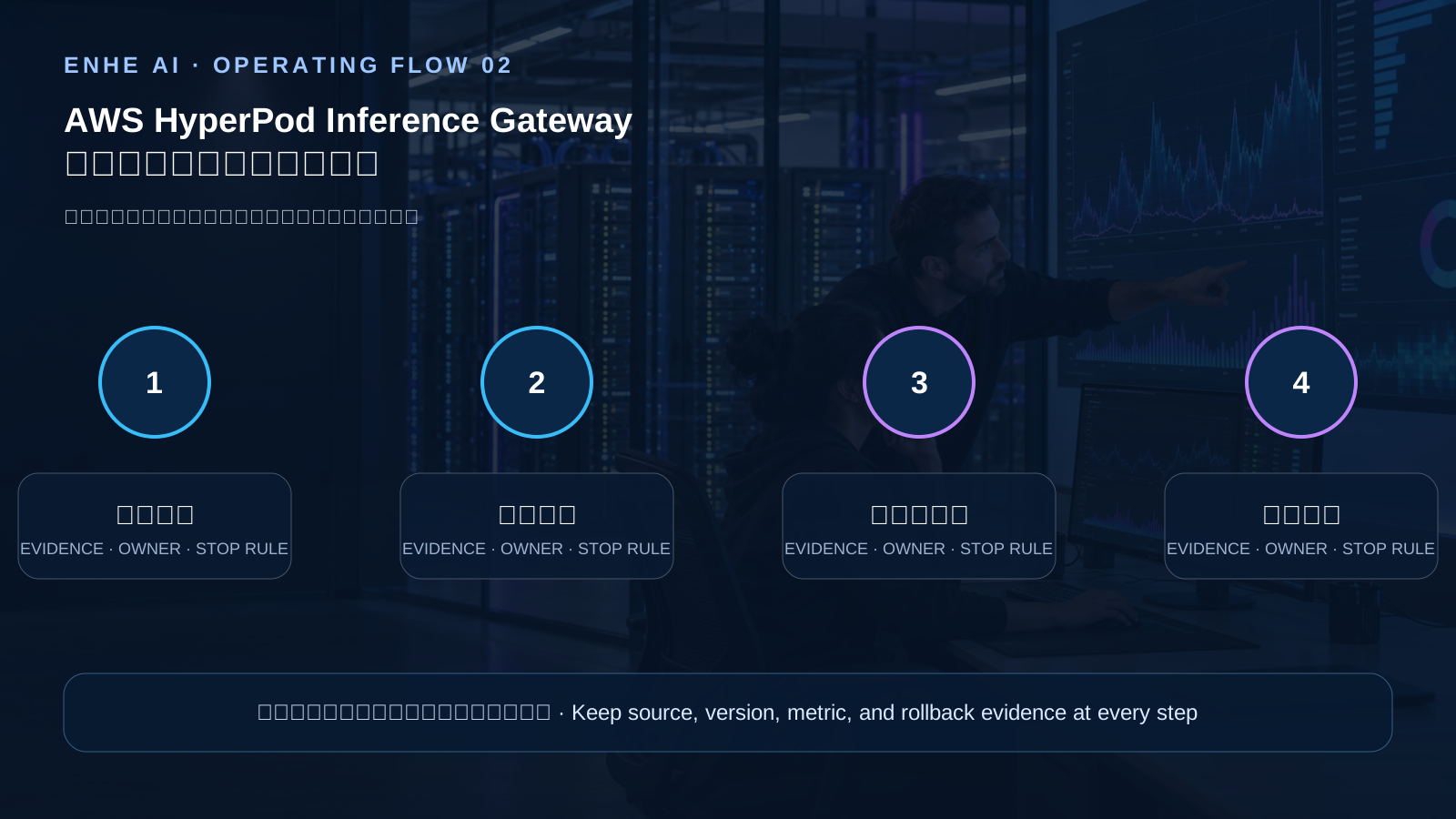
- Save the current round-robin config and rollback checklist
- Record tail latency and cost with a fixed request set
- Canary the gateway under bursty and steady traffic
- Expand model pools only after stop conditions pass
AI frontier news and analysis, AI software and model tools, AI skill tutorials and validation methods, and AI account and permission guidance
FAQ
Will every workload improve by 82%?
No. That figure summarizes AWS testing, and uniform steady traffic may remain comparable to round robin.
Must an OpenAI-compatible client change?
AWS says Tier 1 exposes a compatible endpoint and requires no client or model-server changes.
Summary
GPU-aware routing adds serving state to scheduling, but production value must be proven with the same replicas, requests, and stop conditions.
This AI-assisted article is checked by ENHE AI automation for official sources, bilingual fields, media rights, page safety, and historical duplication before publication.
What this means for everyday users
The gateway is most relevant to uneven fleets, mixed models, or workloads with repeatable prefixes. The headline improvement does not transfer directly to a production budget. Hold replicas, model version, and request set constant; compare TTFT P95/P99, throughput, errors, GPU use, and cost per request, then test 429 handling, pod failure, and rollback.
Tools you may use


Related reading
SageMaker Adds SOCI Lazy Loading: Measure the Right Baseline Before Claiming Faster Jobs
AWS announced Seekable OCI indexed images for Amazon SageMaker AI training and processing jobs on October 27, 2026. SageMaker can lazy-load an image by fetching the files needed to start the container and streaming the remaining layers while code runs. AWS says jobs can start in seconds instead of minutes. Teams can use a pre-indexed AWS Deep Learning Container or create an index for a custom image without changing the job definition, entry point, or data channels, and the capability is available across AWS Regions. This article turns the announcement into a cautious adoption test covering image size, cold-start baseline, index creation, training correctness, failure fallback, and billable time.
How to Validate Prompt Caching Savings for AI Agents on Bedrock in Four Steps
AWS published prompt-caching patterns for OpenAI models on Amazon Bedrock on October 26, 2026. An agent can reuse an identical prefix containing system instructions, tools, content, and history so a later request processes only the new portion. Bedrock supports implicit and explicit caching, while a cache key can share a reusable starting point across sessions or helper agents. AWS says cached prefixes have a minimum 30-minute time to live that is refreshed by successful reuse. This durable guide gives teams a four-step acceptance plan for stable-prefix design, cache-hit evidence, intentional invalidation after tool changes, latency measurement, and complete request cost instead of assuming every cache hit saves money.
IskayPet Connects SharePoint to a Managed Knowledge Base: Validate Permissions Before Answers
AWS published IskayPet’s corporate knowledge assistant case study on October 22, 2026. The system connects Amazon Bedrock Managed Knowledge Bases to existing SharePoint repositories and answers cited questions across retail operations, veterinary care, onboarding, and procurement in four languages and three countries. This article turns the case into a practical acceptance plan for knowledge owners. It checks source scope, inherited permissions, hybrid retrieval, duplicate and fragment removal, citation quality, feedback, and token cost before expansion. It also separates the customer’s reported production results from what another organization should expect. A managed retrieval stack reduces infrastructure work, but it does not remove content ownership, access reviews, evaluation datasets, or human verification of important answers.
When Should an AI Agent Use a Local Small Model or the Cloud? A Hybrid Routing Checklist
AWS published an Adaptive Agentic Intelligence Framework guide using Strands Agents on October 21, 2026. The reference routes routine status checks and local vision work to small models through Ollama, while complex analysis goes to Amazon Bedrock. This durable guide helps teams decide when an AI agent should stay local and when it should use a cloud model. It classifies tasks, marks data that may leave the device, establishes local and cloud quality baselines, defines timeouts and fallbacks, applies one safety policy across both paths, and measures actual routing before estimating cost. The example can run on an 8 GB Raspberry Pi, but that hardware detail is not evidence that every workload belongs on a small local model.
Bayer Shares Production Lessons From 22 Specialist Agents: HTTP Success Is Not Task Success
AWS published Bayer Crop Science’s Agentic Decision Engine case study on October 23, 2026. The production system runs 22 specialist agents over governed analytics workflows, models, logs, and visualization tools. This article turns the architecture into five reusable acceptance checks for enterprise agent teams: persist the state needed to resume work, define identity and authorization at every boundary, scope each agent’s tool catalog, distinguish transport success from task success, and release to a gated group before broader access. It also explains why Bayer’s adoption and resolution figures are evidence about one implementation, not promises for another organization. The focus is operational proof, least privilege, rollback, and observable outcomes rather than prompt polish.
How to Validate Amazon Quick Before Health-Data Use: HIPAA Eligible Does Not Mean Automatically Compliant
AWS published an Amazon Quick deployment guide for HIPAA-regulated environments on October 22, 2026. Its central distinction is durable: HIPAA eligible means the service can be used to process protected health information under the right agreement and configuration; it does not make an entire environment automatically compliant. This guide is for healthcare organizations, business associates, and technical owners working with legal, compliance, and security reviewers. It turns the source into an acceptance checklist covering the business associate addendum, data classification, irreversible key and identity choices, ACL-aware knowledge bases, least-privilege and read-only connectors, masked audit logs, adversarial access tests, and staged expansion from non-PHI work. It is operational guidance, not individualized legal advice or a substitute for professional review.