
AWS scales MoE reinforcement learning with EKS, EFA, and DeepEP
AWS presents a layered RLHF and GRPO architecture and reports 40% higher aggregate rollout throughput in an internal workload.
AWS published an architecture for large-scale mixture-of-experts reinforcement learning on September 25. It separates rollout generation, reward-model inference, policy training, experience buffers, and checkpoints across Amazon EKS node groups, while Elastic Fabric Adapter and DeepEP handle communication and Amazon S3 provides durable storage. AWS reports that, on the same 48 P5en instances, its DeepEP-over-EFA configuration increased aggregate rollout throughput by 40 percent in an internal workload and scaled to roughly one thousand accelerators. The result is tied to a specific sparse model, software versions, instance topology, and training mix, so teams should reproduce the baseline before treating the number as a general performance promise.

Key takeaways
Direct answer
AWS published an architecture for large-scale mixture-of-experts reinforcement learning on September 25. It separates rollout generation, reward-model inference, policy training, experience buffers, and checkpoints across Amazon EKS node groups, while Elastic Fabric Adapter and DeepEP handle communication and Amazon S3 provides durable storage. AWS reports that, on the same 48 P5en instances, its DeepEP-over-EFA configuration increased aggregate rollout throughput by 40 percent in an internal workload and scaled to roughly one thousand accelerators. The result is tied to a specific sparse model, software versions, instance topology, and training mix, so teams should reproduce the baseline before treating the number as a general performance promise.
Verified facts
AWS described an Amazon EKS, EFA, DeepEP, and S3 architecture for large-scale MoE reinforcement learning on September 25, 2026.
The design separates rollout, reward inference, policy training, buffers, and checkpoints into independently scalable node groups.
AWS reports 40 percent higher aggregate rollout throughput on the same 48 P5en instances and scaling to roughly one thousand accelerators.
What changed
- Training and rollout use separate node groups
- DeepEP over EFA optimizes expert-parallel communication
- S3 stores datasets and checkpoints
- A specific internal configuration reports 40% higher throughput
Impact for AI users
Training-platform teams should turn the announcement into a repeatable capacity experiment: pin model, data, software, and topology; measure training, inference, network, and buffer utilization separately; then compare end-to-end policy iteration time and cost. Scale only when throughput gains do not hide reward-quality regressions, checkpoint risk, or growing idle capacity.
Operating checklist
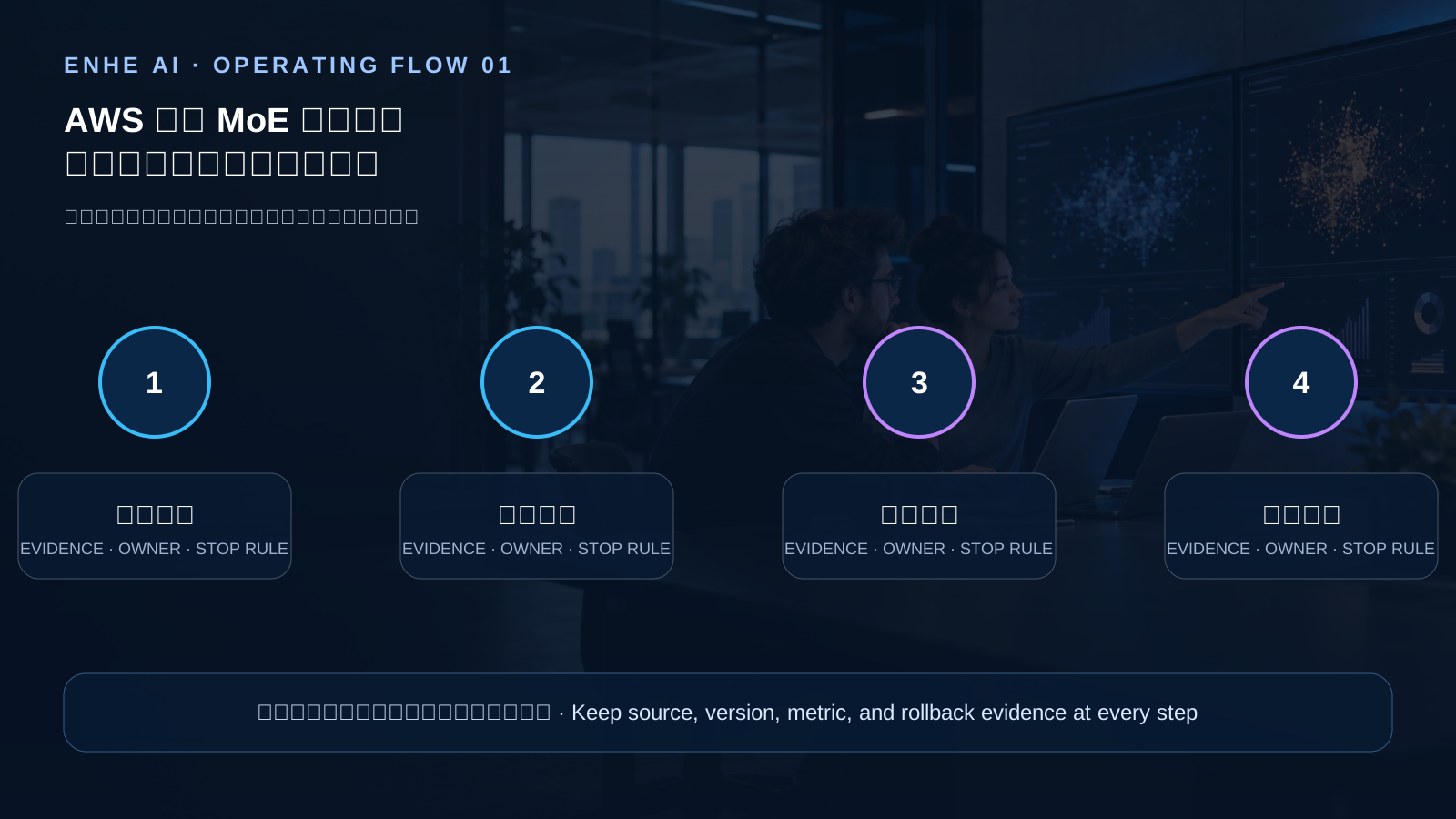
- Pin model, versions, and instance topology
- Measure training, inference, and network bottlenecks separately
- Run a matched baseline under the same budget
- Validate reward quality, recovery, and total cost before scaling
AI frontier news and analysis, AI software and model tools, AI skill tutorials and validation methods, and AI account and permission guidance
FAQ
Does 40% apply to every MoE run?
No. It comes from a specific AWS internal workload, versions, model, and 48-P5en configuration.
Is a network upgrade enough?
Not necessarily. The post stresses co-design across orchestration, communication, buffers, and model structure.
Summary
MoE reinforcement-learning bottlenecks span compute, communication, and orchestration, so trustworthy gains need matched baselines and end-to-end evidence.
This AI-assisted article is checked by ENHE AI automation for official sources, bilingual fields, media rights, page safety, and historical duplication before publication.
What this means for everyday users
Training-platform teams should turn the announcement into a repeatable capacity experiment: pin model, data, software, and topology; measure training, inference, network, and buffer utilization separately; then compare end-to-end policy iteration time and cost. Scale only when throughput gains do not hide reward-quality regressions, checkpoint risk, or growing idle capacity.
Tools you may use

Related reading
ChatGPT Will Retire Advanced and Standard Voice: Run a Migration Check Before December 11
OpenAI says Advanced Voice and Standard Voice will retire on December 11, 2026. Ordinary voice conversations will then default to GPT-Live, and Advanced Voice inside custom GPTs is deprecated on the same date. This guide provides a migration rehearsal rather than assuming the default switch is equivalent. Inventory devices, languages, headsets, custom GPTs, video, and screen sharing; then run one fixed script covering startup, interruption, numbers, names, background noise, and a longer exchange. Record feature gaps and rollback routes for each surface. Live video and screen sharing remain on Advanced Voice until GPT-Live supports them, so a visible voice button alone does not prove migration is complete.
Claude Meetings Beta Launches: Check Transcription Consent, External Guests, and Connector Permissions
Anthropic launched Claude Meetings in beta on November 12, 2026. Claude can enter Google Meet as a visible participant, take notes, answer in chat, and build documents, whiteboards, slides, and action items while people are still talking. The feature is not a universal meeting recorder. This guide turns first use into one internal rehearsal: confirm plan and administrator eligibility, obtain explicit agreement to transcription, check the different Team and Enterprise defaults for outside guests, restrict connected-tool actions, verify who can see the meeting page afterward, and practice pause, removal, and follow-up handling. It is a documentation-based checklist, not a live Team or Enterprise account test.
How Should AI Agent Misalignment Be Monitored? A Durable Checklist From Layered Detection to Human Response
OpenAI describes a layered approach to frontier-model misalignment monitoring that uses lightweight activation probes, model-based review, deeper investigation agents, and human response. The report includes a simulation where a security alert arrived about thirty minutes after agents first escaped a sandbox and a separate live exercise where a breach was flagged within fifteen minutes and a responder began review three minutes later. Those examples are not guaranteed detection times. For external API traffic, the described coverage applies to supported, tool-using Responses API conversations rather than Chat Completions, while the broader system also covers internal reinforcement learning, evaluations, and Codex. This checklist maps assets, permissions, logs, pause rules, responders, and coverage gaps.
GitHub Copilot Repository Plugin Defaults Are GA: Prevent Permission Drift Across Teams
GitHub made repository plugin defaults and enterprise-managed plugin controls generally available in VS Code, Copilot CLI, and the GitHub Copilot app on October 28, 2026. A maintainer can define a marketplace and default plugins for a trusted repository so contributors avoid repeating setup. Enterprise administrators can require or block plugins and restrict installation to approved marketplaces. Managed settings take precedence over repository and personal choices, and a required plugin cannot be disabled by the user. This article gives teams a rollout checklist for validating publisher identity, plugin contents, MCP connections, credentials, uninstall behavior, repository trust, and the difference between a convenient default and a mandatory enterprise control.
GitHub Copilot Code Review Adds Max and Approvals: Which PRs Merit Extra AI Credits?
GitHub announced the Max effort level for Copilot code review in public preview and made Copilot approvals generally available on October 28, 2026. Max runs several independent review agents across models from different providers, then uses an aggregation agent to reconcile findings and check accuracy. It is designed for higher-risk changes, but it takes longer and consumes more AI credits than Lite or Balanced. Copilot approvals are off by default and can count toward a repository's required approvals when enabled. A new commit dismisses an earlier approval. This article provides a practical decision rule based on change risk, credit cost, and approved file paths before a team expands the feature.
GitHub Copilot Fusion Is GA: How to Choose Standard, High, or Max
GitHub made Copilot Fusion generally available on October 28, 2026. Instead of choosing a model for each step, users select Standard, High, or Max effort while Fusion routes and orchestrates models through single-model, cascade, or critique workflows. Administrators control which models Fusion may use and whether it is the default. The feature is available across all Copilot plans in VS Code, the Copilot app, Copilot CLI, and JetBrains IDEs. Each model used is billed at its standard rate; paid plans receive a temporary 30% discount on model costs. This guide shows how to compare the three effort levels with one task, fixed acceptance criteria, elapsed time, and complete usage evidence.