
Apple brings Intelligence to Health with readiness, long-term insights, and on-device movement checks
Higher-frequency Watch sensing feeds a redesigned Health app, while camera-based movement assessments run on device without recording video.

Key takeaways
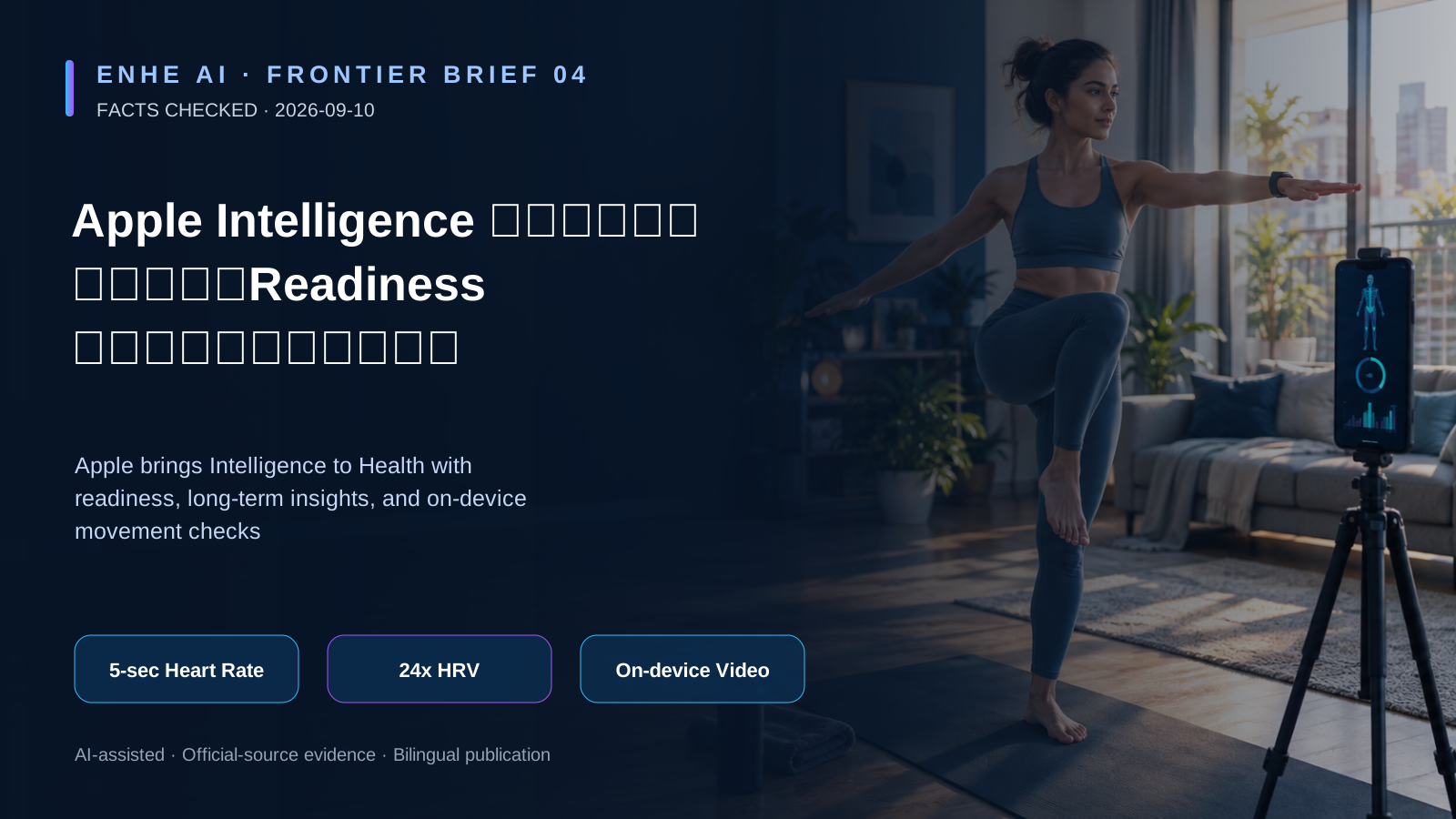
Apple announced new health and fitness capabilities on September 9. Apple Watch Series 12 and Ultra 4 measure heart rate every five seconds and heart-rate variability as often as every five minutes, while a readiness score from zero to ten updates as new activity and vital data arrive. A redesigned Health app, due later this year and starting in U.S. English, uses Apple Intelligence for daily Insights, longer-term Longevity analysis, and Health Age. Camera-based movement assessments can evaluate flexibility, strength, balance, movement mechanics, and estimated VO2 max with an iPhone and Apple Watch. Apple says this processing happens on device and no assessment video is recorded, stored, or shared. Availability varies, and wellness features should not be treated as medical diagnosis.
Direct answer
Apple announced new health and fitness capabilities on September 9. Apple Watch Series 12 and Ultra 4 measure heart rate every five seconds and heart-rate variability as often as every five minutes, while a readiness score from zero to ten updates as new activity and vital data arrive. A redesigned Health app, due later this year and starting in U.S. English, uses Apple Intelligence for daily Insights, longer-term Longevity analysis, and Health Age. Camera-based movement assessments can evaluate flexibility, strength, balance, movement mechanics, and estimated VO2 max with an iPhone and Apple Watch. Apple says this processing happens on device and no assessment video is recorded, stored, or shared. Availability varies, and wellness features should not be treated as medical diagnosis.
Verified facts
Apple Watch Series 12 and Ultra 4 can measure heart rate every five seconds all day and HRV as often as every five minutes, which Apple describes as twenty-four times more frequent.
Readiness combines recent activity, vitals, and sleep score into a zero-to-ten score with guidance, updating as new information arrives during the day.
The redesigned Health app begins with U.S. English later this year; Apple says iPhone-camera and Watch movement assessments run entirely on device without recording, storing, or sharing video.
What changed
- Wearable sampling becomes more frequent
- Readiness updates through the day
- AI explains daily and long-term patterns
- Movement assessment stays on device
Impact for AI users
Users gain more continuous trends and clearer fitness prompts, but one score should not replace symptoms, judgment, or professional diagnosis. Teams evaluating these features should separate sensor measurements, algorithmic inference, and wellness guidance; check device, age, region, and language limits; and confirm which data stays on device versus entering cloud or third-party services.
Operating checklist
- Confirm that device, software, region, language, and age meet the official availability requirements.
- Use trends rather than one Readiness or Health Age result, and record context around material anomalies.
- Review health-data sharing with third-party apps and allow only the scope needed for the task.
- Contact a qualified professional for symptoms or important health questions; do not treat wellness features as diagnostic tools.
AI frontier news and analysis, AI software and model tools, AI skill tutorials and validation methods, and AI account and permission guidance
FAQ
Does the movement assessment upload video?
Apple says the experience runs entirely on device and the assessment video is not recorded, stored, or shared.
Is Readiness a medical diagnosis?
No. It is health and fitness guidance, and Apple identifies some vital features as intended for wellness rather than medical use.
When will the redesigned Health app support more languages?
Apple says it starts in U.S. English later this year, with more languages to follow, but gives no individual dates.
Summary
The update connects frequent sensing, on-device vision, and AI explanation; useful adoption still depends on clear inference boundaries, privacy paths, availability conditions, and medical limits.
This AI-assisted article is checked by ENHE AI automation for official sources, bilingual fields, media rights, page safety, and historical duplication before publication.
What this means for everyday users
Users gain more continuous trends and clearer fitness prompts, but one score should not replace symptoms, judgment, or professional diagnosis. Teams evaluating these features should separate sensor measurements, algorithmic inference, and wellness guidance; check device, age, region, and language limits; and confirm which data stays on device versus entering cloud or third-party services.
Tools you may use



Related tutorials
[[zh]][[/zh]][[en]]Review a public website[[/en]]
SearchScope SEO/GEO
[[zh]][[/zh]][[en]]Access and usage guide[[/en]]
AI Prompt Management System | 418 Bilingual Prompts for Writing, SEO and AI Creation
High-Frequency AI Prompts for Work, Learning, and Teaching guide
High-Frequency AI Prompts for Work, Learning, and Teaching
Related Tools And Tutorials
Use the following ENHE AI sections to continue from the news signal into tool selection, account-service guidance, or practical learning.
Related reading
Apple Introduces HomeView, Bringing Siri AI to a Shared Home Display
Apple introduced HomeView on October 13, 2026 as a seven-inch shared home display powered by Siri AI. The device combines entertainment, FaceTime, home monitoring, and smart-home control, and Apple says it can recognize up to six household members. When paired with an Apple Intelligence-enabled iPhone or iPad, Siri AI can use personal context from Calendar, Messages, music, and other apps. Preorders began on the announcement date, with availability scheduled for November 13, but language and regional limits apply. This article turns the launch into a buying check: verify local availability, household identity separation, companion-device requirements, camera and notification access, iCloud+ dependencies, guest behavior, data deletion, outage controls, and what remains usable if a service or account stops working.
Three agents produce a track together on persistent AgentCore runtimes
On September 30, AWS published a hands-on example in which three specialized agents collaborate to render, generate, and clear a music track on Amazon Bedrock AgentCore Runtime Instances. The sample colocates agents on one GPU-backed instance, gives them persistent shared storage, and uses a shared session ID for handoffs and resumable work. AWS says Runtime Instances can host agents built with different frameworks; the walkthrough uses Strands and a file-backed session manager. It is an implementation example, not evidence of unattended production readiness. Deploying it provisions cloud resources such as runtimes, storage, and container repositories, so teams should estimate ongoing charges, narrow IAM permissions, and test cleanup and failure isolation before adapting the pattern.
NVIDIA NVCRE turns GPU cluster readiness into an attributable workflow
NVIDIA introduced the open-source Cluster Readiness Engine, or NVCRE, on September 23 as a way to validate GPU clusters before production AI workloads arrive. The Kubernetes controller runs real distributed workloads across topology-aware node groups and reports failures by node and category. Its Certification, Workflow, and Job resources can exercise NCCL communication, DCGM diagnostics, and selected NeMo workloads. NVIDIA's point is operationally simple: a cluster may pass health checks while a degraded GPU, network path, or scheduling choice still breaks a large job. Readiness becomes a repeatable, attributable workflow that can fit GitOps instead of a pile of local scripts.
Claude Opus 5.5 shifts model evaluation toward complete workflows
Anthropic released Claude Opus 5.5 on September 22 as the first model in the Claude 5.5 family. The company says typical workloads cost 40% less than Opus 5 and output is more than 30% faster. Listed prices are $4 per million input tokens, $20 per million output tokens, and $0.20 per million cache-read tokens. Anthropic also reports results for coding, long-running work, prompt-injection resistance, and behavioral audits. These are vendor measurements with stated test conditions, not a transferable guarantee. A production evaluation should replay representative tasks and measure final quality, total tokens, tool calls, elapsed time, human rework, safety interventions, and rollback readiness before changing the default model.
How to Audit AI Discoverability with Cloudflare Agent Readiness and AEO
Cloudflare announced Agent Readiness and Answer Engine Optimization tools on August 6, 2026. Agent Readiness checks whether agents can discover, read, and call a site, while AEO measures whether assistants recommend or cite it for realistic category questions. This guide turns the announcement into six repeatable checks: inspect robots and sitemaps, publish machine-readable facts and sources, document APIs or agent interfaces, run unbranded customer prompts, record citations and competitor mentions, and change one variable at a time. The metrics are diagnostic samples, not search rankings or guaranteed market share; preserve model, prompt, date, and page-version evidence. Repeat the scan after each material content or access change.
How to Choose Physical AI and Enterprise Agent Tools
Choosing physical AI or enterprise-agent tools is not just a model comparison. The Anthropic and UST case shows that real deployment depends on how AI connects to engineering platforms, whether humans approve critical actions, how logs and audit trails are retained, and whether data governance fits the industry. Teams should compare Claude, coding agents, local AI tools, private deployments, and workflow automation platforms by task boundary first. A good choice starts with a narrow, observable workflow, read-only access, strong account controls, and a review process that measures errors as well as speed, cost, training effort, rollback readiness, and long-term maintainability.