
NVIDIA NVCRE turns GPU cluster readiness into an attributable workflow
NVIDIA's Cluster Readiness Engine runs real distributed workloads on Kubernetes and attributes failures to nodes and test categories.

Key takeaways
NVIDIA introduced the open-source Cluster Readiness Engine, or NVCRE, on September 23 as a way to validate GPU clusters before production AI workloads arrive. The Kubernetes controller runs real distributed workloads across topology-aware node groups and reports failures by node and category. Its Certification, Workflow, and Job resources can exercise NCCL communication, DCGM diagnostics, and selected NeMo workloads. NVIDIA's point is operationally simple: a cluster may pass health checks while a degraded GPU, network path, or scheduling choice still breaks a large job. Readiness becomes a repeatable, attributable workflow that can fit GitOps instead of a pile of local scripts.
Direct answer
NVIDIA introduced the open-source Cluster Readiness Engine, or NVCRE, on September 23 as a way to validate GPU clusters before production AI workloads arrive. The Kubernetes controller runs real distributed workloads across topology-aware node groups and reports failures by node and category. Its Certification, Workflow, and Job resources can exercise NCCL communication, DCGM diagnostics, and selected NeMo workloads. NVIDIA's point is operationally simple: a cluster may pass health checks while a degraded GPU, network path, or scheduling choice still breaks a large job. Readiness becomes a repeatable, attributable workflow that can fit GitOps instead of a pile of local scripts.
Verified facts
NVCRE is an open-source Kubernetes controller for workload-driven GPU cluster validation.
Certification, Workflow, and Job resources connect targets, categories, workloads, and results.
The initial catalog covers NCCL communication, DCGM diagnostics, and selected NeMo pretraining workloads with node-level attribution.
What changed
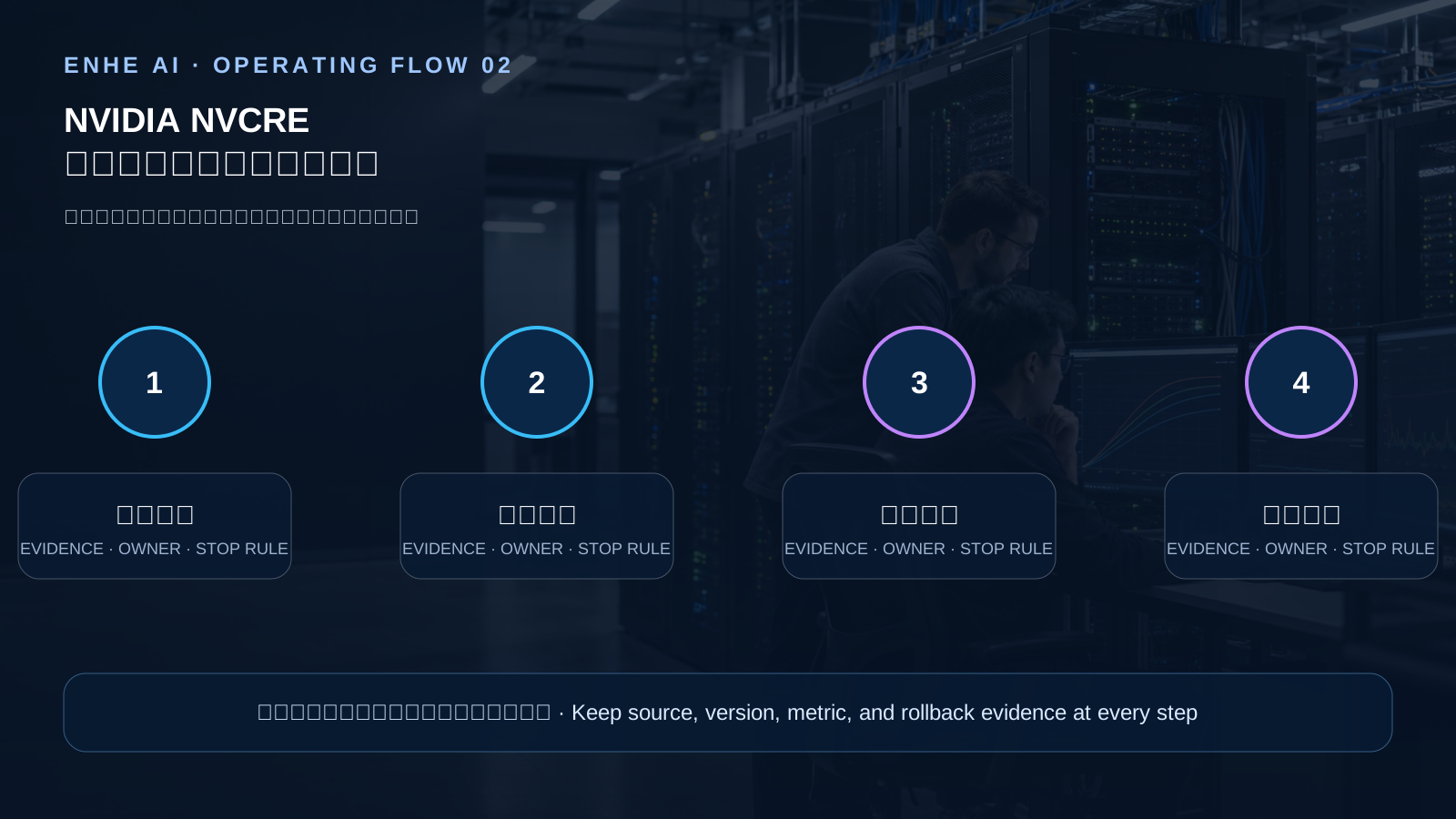
- Real workloads complement ordinary health checks
- Three resource layers aggregate validation results
- Adaptive isolation narrows suspect nodes
- The workflow can connect to GitOps and monitoring
Impact for AI users
The approach changes cluster health from static telemetry to workload evidence. Platform teams can stage communication, training, scheduling, and quota checks, then repeat them after capacity, driver, or hardware changes. Because validation consumes real compute, teams need time and budget limits, isolated targets, and stop conditions, with reports attached to the change record.
Operating checklist
- Define acceptance categories for communication and training
- Start with small node groups to validate scheduling and fabric
- Record failed nodes, runtimes, and retries
- Repeat the baseline after driver or hardware changes
AI frontier news and analysis, AI software and model tools, AI skill tutorials and validation methods, and AI account and permission guidance
FAQ
Does passing GPU health checks prove readiness?
No. Real distributed jobs can reveal fabric, scheduling, or single-GPU performance problems.
Is NVCRE only for training?
The catalog includes training and communication, and WorkloadRun can support additional workloads.
Summary
NVCRE's value is making readiness repeatable, attributable, and auditable rather than adding another health dashboard.
This AI-assisted article is checked by ENHE AI automation for official sources, bilingual fields, media rights, page safety, and historical duplication before publication.
What this means for everyday users
The approach changes cluster health from static telemetry to workload evidence. Platform teams can stage communication, training, scheduling, and quota checks, then repeat them after capacity, driver, or hardware changes. Because validation consumes real compute, teams need time and budget limits, isolated targets, and stop conditions, with reports attached to the change record.
Tools you may use



Related tutorials
Related Tools And Tutorials
Use the following ENHE AI sections to continue from the news signal into tool selection, account-service guidance, or practical learning.
Related reading
Microsoft and NVIDIA Publish an Open-Weight Model Risk Guide With Five Risk Categories
Microsoft and NVIDIA published their first joint resource for enterprise open-weight model risk management on October 16, 2026. The guidance organizes discussion into five broad categories: cybersecurity, data protection, content, human-AI interaction, and bias. Its central point is that weight openness alone does not determine risk; the model, intended use, deployment architecture, users, data, tools, and safeguards all shape the actual system. It also distinguishes model access from deployment choice and warns that self-operated deployments can transfer controls from a managed provider to the enterprise. This article turns the framework into a practical selection, ownership, evaluation, and review checklist for ordinary teams.
Adobe and NVIDIA Expand Agentic Creation With RTX Spark Optimization
Adobe and NVIDIA announced an expanded collaboration on October 15, 2026. Adobe is optimizing Photoshop, Premiere, and Substance 3D for the NVIDIA RTX Spark superchip and says selected AI processing, editing, color, and effects workflows can run up to twice as fast. The companies are also continuing cloud acceleration work for Frame.io, while Adobe Brand Concierge is being optimized with NVIDIA Nemotron open models for enterprise conversational experiences. The announcement describes partnership direction and vendor performance claims; it does not establish that every project, device, application version, or region receives the same result. This article gives creators a purchase and rollout checklist covering supported versions, representative project benchmarks, quality parity, local versus cloud data paths, power and storage, licensing, total cost, collaboration compatibility, and a fallback to existing hardware before any upgrade decision.
NVIDIA Expands DGX Spark With 64GB: Evaluate a Local AI Workstation
On October 2, NVIDIA announced a 64GB unified-memory DGX Spark configuration and said partner availability would begin October 23 at a starting price of $4,999. NVIDIA says one unit can run models up to 100 billion parameters and that two systems can pool 128GB; it reports up to 1.7x performance in its own Qwen 3.8 27B test. Availability is forward-looking, and performance figures are vendor results. Model choice, quantization, context length, and concurrency change outcomes. This article offers a practical evaluation checklist for teams comparing local inference with cloud services. Teams should check applicability against their own environment, record assumptions, and validate decisions with representative operational evidence.
AWS brings Isaac Lab into a managed cloud robotics workflow
AWS described a cloud reference setup for NVIDIA Isaac Lab that combines Isaac Sim, Isaac Lab, remote visualization, and services such as SageMaker AI and MLflow. Teams can configure an individual workstation or a fleet for simulation and policy experiments. This can make compute and experiment tracking easier to provision, but it does not remove the sim-to-real gap. A policy that performs well in simulation still needs controlled testing on the target robot, with safety limits, latency, sensor differences, and a rollback path checked before any production use. Availability and setup details should be confirmed with the AWS account team because the post describes a particular deployment path rather than a universal turnkey service.
NVIDIA reports faster GPT-6 Astra inference on Blackwell systems
NVIDIA’s October 1 announcement says GPT-6 Astra Ultrafast running on Blackwell systems can reach up to eight times the token-generation speed of the stated comparison configuration. “Up to” is a peak claim, not a promise for every prompt, context length, region, or concurrency level. Teams should measure time to first token, end-to-end completion time, output quality, and cost on representative tasks. Faster token generation may matter for interactive workflows, but a benchmark headline does not establish the best model or the lowest total cost for a specific organization. The source is NVIDIA’s announcement, so its performance figures should be attributed and independently tested before operational decisions.
Amazon Bedrock and OpenCode make multi-model coding agents auditable
AWS described on September 23 how to use open-weight models in OpenCode through Amazon Bedrock. OpenCode is a terminal-native Go agent that supports more than 75 model providers; the example uses Kimi K3, GPT-OSS 120B, and NVIDIA Nemotron 3 Super 120B while keeping inference in the customer’s AWS account. IAM, CloudTrail, PrivateLink, encryption, and model routing provide controls that fit existing delivery practices. As a durable task, teams should pin model and permission versions, isolate the workspace, log tool calls and cost, and place real-service verification after local tests before allowing an agent patch into release. Teams should verify the vendor claims against their own workloads, controls, and operating context before making a production decision.