
Claude Opus 5.5 shifts model evaluation toward complete workflows
Anthropic's first Claude 5.5 model combines lower listed prices with faster output and new long-task evaluations, but production gains still require local testing.

Key takeaways
Anthropic released Claude Opus 5.5 on September 22 as the first model in the Claude 5.5 family. The company says typical workloads cost 40% less than Opus 5 and output is more than 30% faster. Listed prices are $4 per million input tokens, $20 per million output tokens, and $0.20 per million cache-read tokens. Anthropic also reports results for coding, long-running work, prompt-injection resistance, and behavioral audits. These are vendor measurements with stated test conditions, not a transferable guarantee. A production evaluation should replay representative tasks and measure final quality, total tokens, tool calls, elapsed time, human rework, safety interventions, and rollback readiness before changing the default model.
Direct answer
Anthropic released Claude Opus 5.5 on September 22 as the first model in the Claude 5.5 family. The company says typical workloads cost 40% less than Opus 5 and output is more than 30% faster. Listed prices are $4 per million input tokens, $20 per million output tokens, and $0.20 per million cache-read tokens. Anthropic also reports results for coding, long-running work, prompt-injection resistance, and behavioral audits. These are vendor measurements with stated test conditions, not a transferable guarantee. A production evaluation should replay representative tasks and measure final quality, total tokens, tool calls, elapsed time, human rework, safety interventions, and rollback readiness before changing the default model.
Verified facts
Opus 5.5 launched on September 22 as the first Claude 5.5 family model, with the API identifier claude-opus-5-5.
Anthropic lists $4 input, $20 output, and $0.20 cache-read pricing per million tokens and reports a 40% typical-workload cost reduction versus Opus 5 at default settings.
The company reports more than 30% faster output, external pre-release evaluation, and an automated behavioral audit; outcomes still depend on tasks, tools, and test configuration.
What changed
- The Claude 5.5 family starts with the Opus tier
- Input, output, and cache-read prices are lower than Opus 5
- Published evaluations cover longer tasks and complete workflows
- Safety findings are reported alongside capability results
Impact for AI users
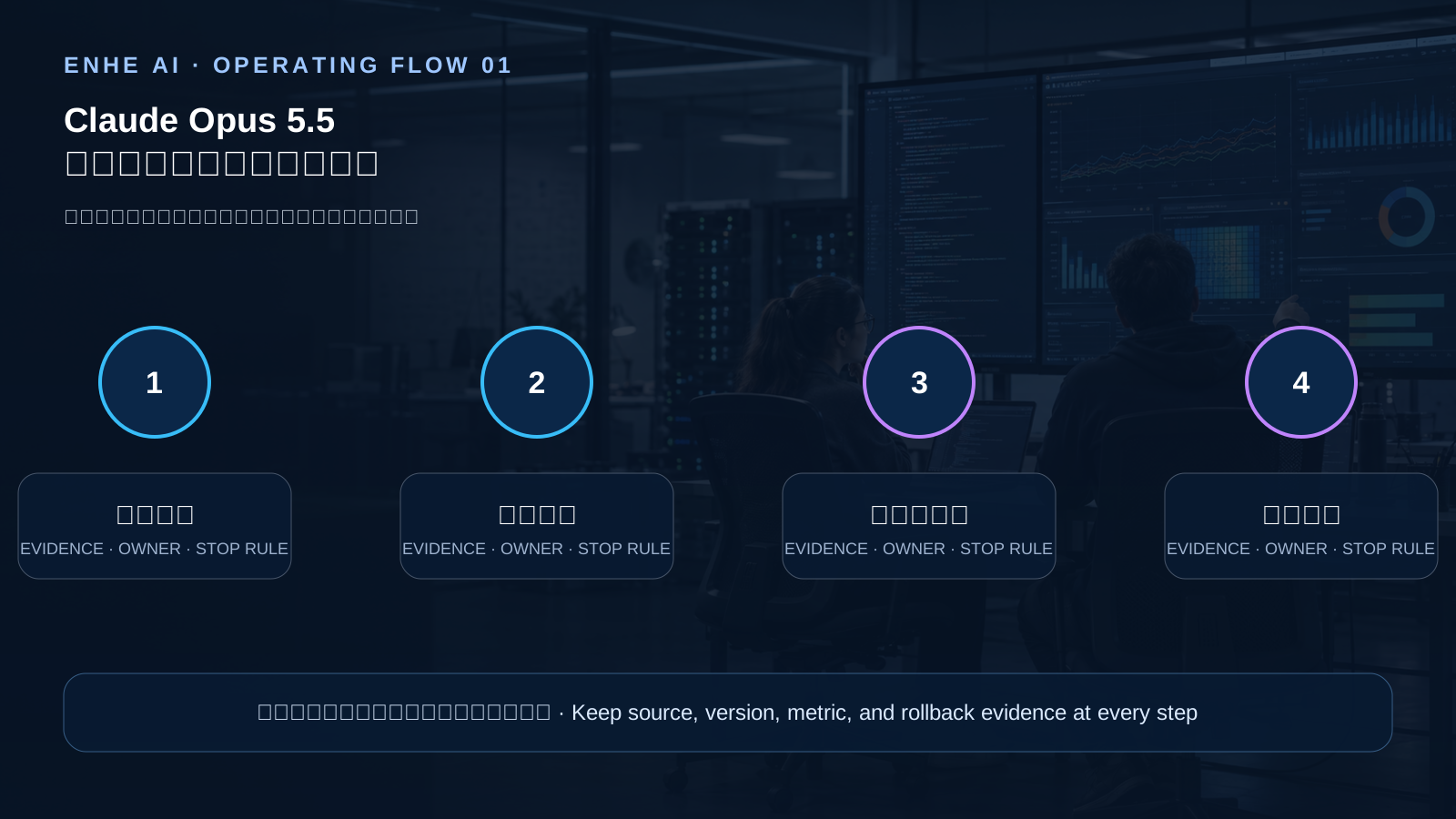
A lower token rate does not automatically make an end-to-end workflow cheaper. Tool calls, retries, expanding context, and human review can change total cost on long jobs. Before migration, freeze the task set, permissions, stop conditions, and scoring rubric; compare against the current model and record completion rate, rework, latency, total tokens, and unexpected actions.
Operating checklist
- Select ten representative long tasks and remove sensitive data
- Fix tool permissions, budgets, and stop conditions
- Run repeated trials with the current model and Opus 5.5
- Canary the change only after quality and total-cost gates pass
AI frontier news and analysis, AI software and model tools, AI skill tutorials and validation methods, and AI account and permission guidance
FAQ
Does the 40% cost reduction apply to every task?
No. It is Anthropic's summary for typical workloads at default settings; task shape, effort, caching, and tool use change the result.
Should teams immediately replace their production model?
A release announcement is insufficient. Complete a frozen-task comparison, error review, and rollback rehearsal first.
Summary
Opus 5.5 moves evaluation toward the combined quality, speed, safety, and total cost of long workflows. A migration decision should rest on reproducible tests from the team's own work.
This AI-assisted article is checked by ENHE AI automation for official sources, bilingual fields, media rights, page safety, and historical duplication before publication.
What this means for everyday users
A lower token rate does not automatically make an end-to-end workflow cheaper. Tool calls, retries, expanding context, and human review can change total cost on long jobs. Before migration, freeze the task set, permissions, stop conditions, and scoring rubric; compare against the current model and record completion rate, rework, latency, total tokens, and unexpected actions.
Tools you may use

Related tutorials
Related Tools And Tutorials
Use the following ENHE AI sections to continue from the news signal into tool selection, account-service guidance, or practical learning.
Related reading
GitHub Secret Scanning Update: Fix business Field Filters Before November 12
GitHub published a group of Secret Scanning improvements on October 20, 2026. The most time-sensitive change arrives on November 12: the business field in affected audit-log events will switch from an enterprise display name to the enterprise slug. Integrations should temporarily accept both formats or use the unchanged numeric business_id. The update also expands public-preview revocation for Base64-encoded GitHub tokens in eligible private and internal repositories, adds exemption-request numbers to dismissal webhooks, and returns HTTP 422 for rejected custom-pattern arguments. This article provides a read-only inventory and test-event plan for AI coding teams so reporting, alerts, and webhook correlation do not silently lose data.
GitHub CLI Adds Expiring OAuth Tokens: Check Git, Scripts, and Extensions First
GitHub announced an opt-in public preview of expiring, automatically refreshing OAuth credentials for GitHub CLI on October 21, 2026, beginning with version 2.103.0. Users can enable the behavior with gh auth login --expiring or a global configuration setting. Git over HTTPS should use gh auth setup-git, and Git 2.46 or newer is recommended to avoid caching credentials beyond their lifetime. This article focuses on AI coding tools, scripts, and extensions that capture gh auth token output once and reuse it. It provides an inventory, migration, and verification sequence so users can gain a shorter exposure window without unexpectedly breaking long-running automation.
GitHub Introduces HydraFusion Max: When Multi-Model Review Is Worth Trying
GitHub has updated HydraFusion and introduced HydraFusion Max, an orchestration option for demanding coding work. It is not a new standalone model: the system chooses how to draft, review, or revise a response using models allowed for the account. Both options remain research previews, so access and suitability need checking before adoption. This article explains the distinction from automatic single-model selection and proposes a bounded bug-fix comparison that records tests, changes, and usage. It does not rank model quality or promise lower cost. The suggested exercise is designed for people already using an AI coding assistant who want to decide when additional review passes are worth the time and credits.
GitHub in Slack and Teams Adds Multi-Repository Work in One Conversation
GitHub’s Slack and Teams integration can now work across multiple repositories within a single conversation. That is useful when a reported problem spans a frontend and backend, but it is a different event from the original launch of the chat integrations. This article explains the change and provides a scoped investigation request that a non-programmer project owner can give a technical collaborator. It describes what evidence to request before moving from analysis to code changes and how to distinguish an issue, a proposed pull request, a merge, and a deployment. No account-level availability test or automatic resolution is claimed, and the announcement is not treated as permission to change every repository.
Microsoft and NVIDIA Publish an Open-Weight Model Risk Guide With Five Risk Categories
Microsoft and NVIDIA published their first joint resource for enterprise open-weight model risk management on October 16, 2026. The guidance organizes discussion into five broad categories: cybersecurity, data protection, content, human-AI interaction, and bias. Its central point is that weight openness alone does not determine risk; the model, intended use, deployment architecture, users, data, tools, and safeguards all shape the actual system. It also distinguishes model access from deployment choice and warns that self-operated deployments can transfer controls from a managed provider to the enterprise. This article turns the framework into a practical selection, ownership, evaluation, and review checklist for ordinary teams.
Anthropic Gives METR Deep Evaluation Access: How to Read Independent AI Reviews
Anthropic announced on October 15, 2026 that six people from the nonprofit evaluator METR had received company hardware, office space, and internal access roughly comparable to its own risk-assessment teams. METR is expected to publish analysis of Anthropic's risk levels, incidents, or practices. Anthropic says it cannot veto publication, but it may require redaction of predefined categories such as customer data, privileged legal information, and some architecture details, and Anthropic ultimately classifies those categories. The company also described three access tiers and other work with SecureBio, Accenture, Faculty, and Hugging Face. This article explains how ordinary readers can evaluate independence, scope, evidence, access limits, and publication rights.