
A durable agent-harness checklist for context, tools, and stop conditions
Google Cloud defines the agent harness as the runtime around the model, making it a useful standing engineering acceptance task.

Key takeaways
Google Cloud published an Agent Factory interview recap on September 25 that defines an agent harness as everything around the language model: intent handling, live tools, context assembly, workspace interaction, and execution control. The post argues that a gap remains between theoretical frontier-model capability and useful work extracted in production, and that teams should shift interventions left by preparing context, environments, and validation before a task begins. This makes a durable engineering checklist: whenever a model, tool, permission, or workspace changes, revalidate context provenance, tool contracts, state persistence, stop conditions, human takeover, and results in the real target environment. Teams should verify every vendor-reported result against their own workloads, controls, data boundaries, and operating environment before making a production decision.
Direct answer
Google Cloud published an Agent Factory interview recap on September 25 that defines an agent harness as everything around the language model: intent handling, live tools, context assembly, workspace interaction, and execution control. The post argues that a gap remains between theoretical frontier-model capability and useful work extracted in production, and that teams should shift interventions left by preparing context, environments, and validation before a task begins. This makes a durable engineering checklist: whenever a model, tool, permission, or workspace changes, revalidate context provenance, tool contracts, state persistence, stop conditions, human takeover, and results in the real target environment. Teams should verify every vendor-reported result against their own workloads, controls, data boundaries, and operating environment before making a production decision.
Verified facts
Google Cloud published an Agent Factory recap about agent harnesses and autonomous coding on September 25, 2026.
The post defines an agent harness as the runtime around the model that handles intent, tools, context, and workspace interaction.
It advocates shifting interventions left by preparing context, environments, and validation before execution.
What changed
- Model capability and runtime harness are separated
- The harness organizes live tools and context
- Intervention moves from post-failure to pre-execution
- Real-environment evidence determines autonomy
Impact for AI users
This task belongs permanently in the agent release process. A model upgrade can change tool choice, a tool upgrade can change parameters and permissions, and a workspace change can invalidate stop conditions. Re-run fixed tasks in a real sandbox, retain tool calls, environment changes, failure evidence, and takeover reasons, and expand autonomy only after the evidence passes.
Operating checklist
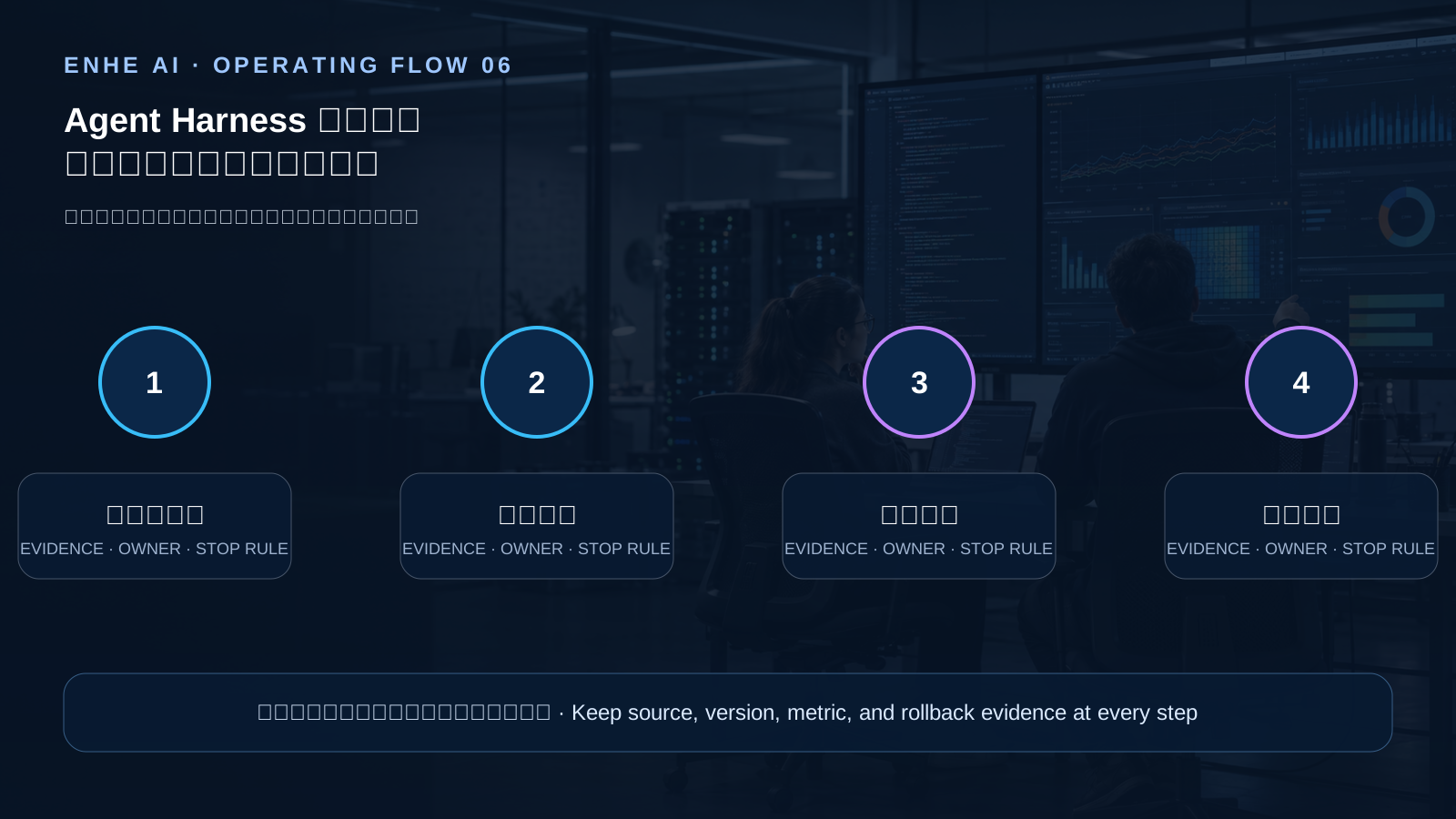
- Pin context sources and versions
- Validate every tool's parameters and permissions
- Drill state recovery, stopping, and human takeover
- Repeat a fixed task set in a real sandbox
AI frontier news and analysis, AI software and model tools, AI skill tutorials and validation methods, and AI account and permission guidance
FAQ
Can a stronger model skip harness retesting?
No. Model changes can alter tool selection, failure modes, and stopping behavior.
Are unit tests enough?
No. Tools, permissions, state, and target-environment results also need a real sandbox check.
Summary
Reliable agent capability comes from the model-harness combination, and durable maintenance keeps context, tools, state, and stop conditions verifiable.
This AI-assisted article is checked by ENHE AI automation for official sources, bilingual fields, media rights, page safety, and historical duplication before publication.
What this means for everyday users
This task belongs permanently in the agent release process. A model upgrade can change tool choice, a tool upgrade can change parameters and permissions, and a workspace change can invalidate stop conditions. Re-run fixed tasks in a real sandbox, retain tool calls, environment changes, failure evidence, and takeover reasons, and expand autonomy only after the evidence passes.
Tools you may use


Related tutorials
Related Tools And Tutorials
Use the following ENHE AI sections to continue from the news signal into tool selection, account-service guidance, or practical learning.
Related reading
Google Cloud Introduces the Gemini Agent for Work
Google Cloud introduced the Gemini agent at Gemini at Work on October 8, 2026. Google describes it as a universal work agent that can use an organization's business context, plan work, call skills and tools, connect to business systems, and return completed results inside documents, inboxes, and developer environments. The announcement also highlights model selection, cost controls, security, administration, and governance. Those claims define a product direction, not automatic permission to connect every data source. Before rollout, start with one bounded workflow, list the records and tools the agent can reach, separate read from write access, cap spend, require confirmation before messages or irreversible changes, verify the destination of generated work, and keep a human owner for exceptions and acceptance.
Google's Gemini RLFT guide puts reward design at the center of quality control
Google Cloud published a practical guide to Gemini reinforcement-learning fine-tuning on September 25. Its managed RLFT service lets teams provide prompts and a reward function while the platform handles training infrastructure and proprietary model internals. Google says the method fits tasks that are difficult to demonstrate but easy to score, and only when the base model already succeeds some of the time. Prompting and supervised fine-tuning should be exhausted first. The reward function is the main control surface, so teams need offline tests for malformed outputs, length bias, reward hacking, and train-evaluation leakage, then should stop at validation saturation rather than automatically choosing the last checkpoint.
Google Cloud Storage Intelligence brings proactive governance to fast-growing AI data
Google Cloud announced general availability for Storage Intelligence advisor and expanded Cloud Storage batch operations on September 25. Google says AI training and inference pipelines create data quickly and change access patterns often, so problems may surface only after they appear on a bill. The advisor analyzes inventory and access behavior to produce actionable recommendations, while batch operations can apply remediations across large object sets. Teams should not turn every recommendation directly into an automated command. Confirm the affected objects, regions, retention policies, compliance obligations, and estimated cost, test on a limited scope, and retain audit evidence for misclassification, access disruption, and rollback.
Gemini Live Avatar reaches general availability for enterprise real-time agents
Google Cloud announced general availability for Gemini 3.8 Live with Live Avatar in Gemini Enterprise on September 24. The service combines native speech-to-speech dialogue, synchronized video avatars, live camera or screen understanding, and background tool calls in one real-time session, with support for 97 languages. Google says curated avatars are available, while custom-avatar creation still requires enterprise allowlisting and identity verification. Generated audio and video streams carry SynthID watermarks. Enterprise pilots still need permission for a person's image and voice, clear disclosure that users are interacting with AI, and tests for interruption, weak networks, tool failure, language switching, and human takeover.
AlloyDB introduces PostgreSQL for agents with isolated real-time access
Google Cloud announced a preview of PostgreSQL for agents in AlloyDB on September 24. The architecture can provision isolated sandbox database instances in seconds and give them up-to-date read-only access to production data, absorbing bursty query loops from agent workloads before scaling down when the work ends. Google also highlights IAM authentication, VPC Service Controls, customer-managed encryption, and auditing. Preview capacity, latency, cost, and consistency still need measurement with representative queries. Read-only access reduces write risk but does not replace sensitive-field controls, tenant isolation, query budgets, or stopping rules for a looping agent. Teams should verify every vendor-reported result against their own workloads, controls, data boundaries, and operating environment before making a production decision.
Google Cloud maps the AI stack startups need for sustainable delivery
Google Cloud wrote on September 24 that fast-growing startups are assembling AI stacks around more than a single model. The company says teams are adopting Gemini Enterprise while mixing Gemini and third-party models according to price, performance, and task fit. GPU and TPU choices shape training, inference, and cost, while BigQuery, GKE, agent tools, and production engineering determine whether a prototype can become a dependable product. The practical signal is architectural: startups need a repeatable way to choose models, place data, control access, observe spend, and move from experiments to delivery without locking every workload to one vendor. Teams should verify the vendor claims against their own workloads, controls, and operating context before making a production decision.