
Gemini Live Avatar reaches general availability for enterprise real-time agents
Google Cloud combines real-time speech, visual understanding, tool calls, and SynthID watermarking in an enterprise agent service.

Key takeaways
Google Cloud announced general availability for Gemini 3.8 Live with Live Avatar in Gemini Enterprise on September 24. The service combines native speech-to-speech dialogue, synchronized video avatars, live camera or screen understanding, and background tool calls in one real-time session, with support for 97 languages. Google says curated avatars are available, while custom-avatar creation still requires enterprise allowlisting and identity verification. Generated audio and video streams carry SynthID watermarks. Enterprise pilots still need permission for a person's image and voice, clear disclosure that users are interacting with AI, and tests for interruption, weak networks, tool failure, language switching, and human takeover.
Direct answer
Google Cloud announced general availability for Gemini 3.8 Live with Live Avatar in Gemini Enterprise on September 24. The service combines native speech-to-speech dialogue, synchronized video avatars, live camera or screen understanding, and background tool calls in one real-time session, with support for 97 languages. Google says curated avatars are available, while custom-avatar creation still requires enterprise allowlisting and identity verification. Generated audio and video streams carry SynthID watermarks. Enterprise pilots still need permission for a person's image and voice, clear disclosure that users are interacting with AI, and tests for interruption, weak networks, tool failure, language switching, and human takeover.
Verified facts
Google Cloud announced general availability for Gemini 3.8 Live with Live Avatar on September 24, 2026.
The service combines speech, synchronized video avatars, live visual understanding, and background tool calls across 97 languages.
Custom avatars require allowlisting and identity verification, and generated audio and video carry SynthID watermarks.
What changed
- Live Avatar becomes generally available in Gemini Enterprise
- It supports 97 languages and live visual understanding
- Background tools can run during conversation
- SynthID marks generated audio and video
Impact for AI users
Customer-facing real-time agents need more than a natural-looking avatar. Record image and voice permissions, disclose the AI identity, and restrict high-risk tools. Test interruptions, multiple speakers, noise, camera obstruction, sensitive screen content, weak networks, tool timeouts, and language switching. Claims, payments, and identity data need immediate human takeover paths.
Operating checklist
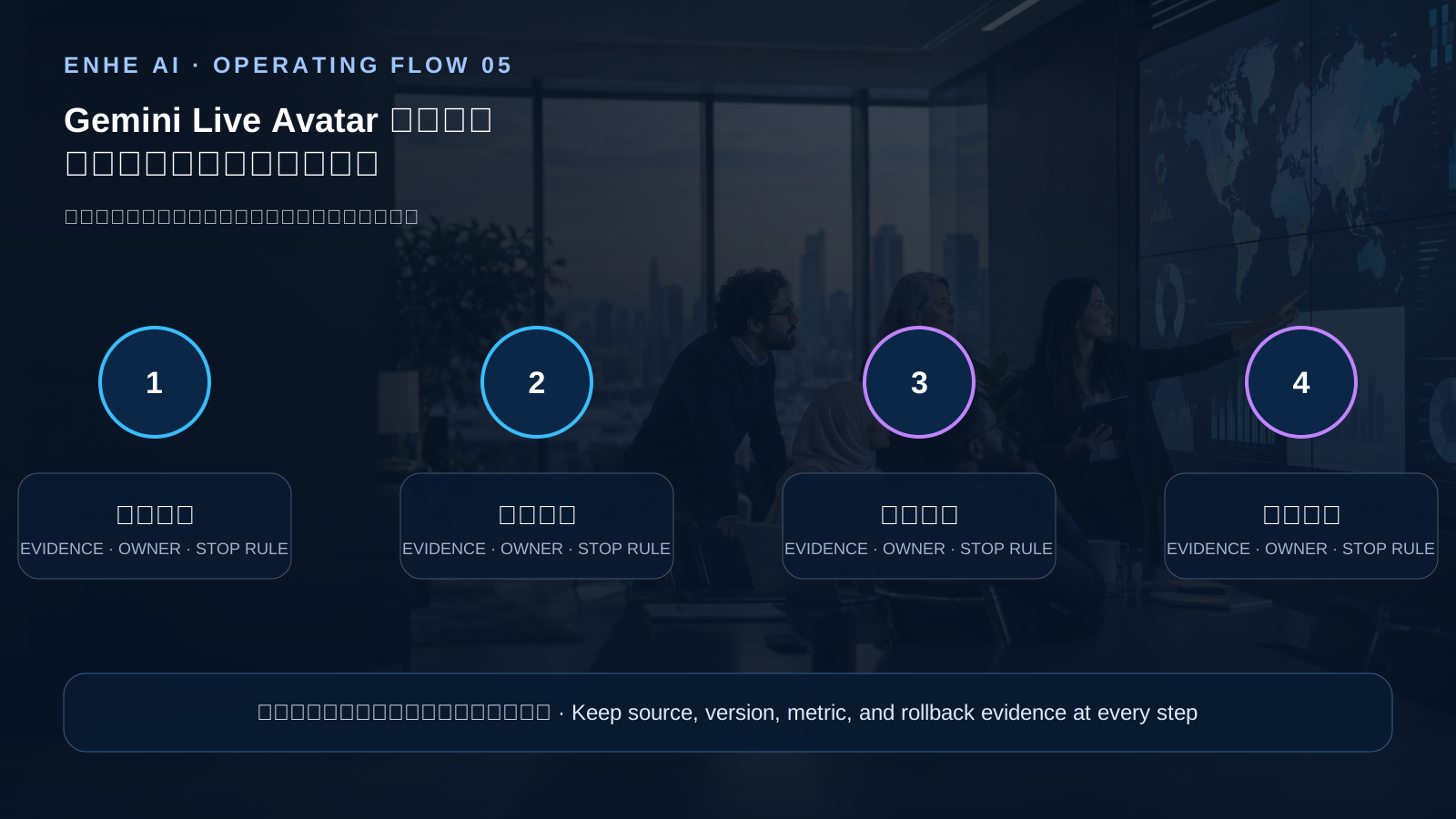
- Verify image and voice permission
- Clearly disclose the AI identity
- Restrict tools and test weak networks
- Provide human takeover for sensitive tasks
AI frontier news and analysis, AI software and model tools, AI skill tutorials and validation methods, and AI account and permission guidance
FAQ
Does general availability remove review for custom avatars?
No. Google says custom avatars still require enterprise allowlisting and identity verification.
Can SynthID replace user disclosure?
No. Watermarking supports provenance, while the product should still clearly disclose the AI interaction.
Summary
Live Avatar is production-ready as a service, while trustworthy delivery still depends on permission, disclosure, tool boundaries, and human takeover.
This AI-assisted article is checked by ENHE AI automation for official sources, bilingual fields, media rights, page safety, and historical duplication before publication.
What this means for everyday users
Customer-facing real-time agents need more than a natural-looking avatar. Record image and voice permissions, disclose the AI identity, and restrict high-risk tools. Test interruptions, multiple speakers, noise, camera obstruction, sensitive screen content, weak networks, tool timeouts, and language switching. Claims, payments, and identity data need immediate human takeover paths.
Tools you may use


Related tutorials
Related Tools And Tutorials
Use the following ENHE AI sections to continue from the news signal into tool selection, account-service guidance, or practical learning.
Related reading
Eleven Realtime v1 Mini and Max Launch: Choosing a Voice-Agent Path
ElevenLabs launched Eleven Realtime v1 Mini and v1 Max on October 20, 2026. Both speech-to-speech models support more than 90 languages and over 17,000 voices, but they target different tasks: Mini emphasizes lower-cost natural conversations, while Max is designed for support, lead qualification, and multi-step work. This article offers a selection and migration checklist instead of repeating benchmark claims. It explains how to compare both models on the same script, what OpenAI Realtime API compatibility means, why WebRTC integrations must move to WebSocket, and when ElevenAgents is the better starting point for channels, knowledge bases, guardrails, testing, and monitoring.
Google Cloud Introduces the Gemini Agent for Work
Google Cloud introduced the Gemini agent at Gemini at Work on October 8, 2026. Google describes it as a universal work agent that can use an organization's business context, plan work, call skills and tools, connect to business systems, and return completed results inside documents, inboxes, and developer environments. The announcement also highlights model selection, cost controls, security, administration, and governance. Those claims define a product direction, not automatic permission to connect every data source. Before rollout, start with one bounded workflow, list the records and tools the agent can reach, separate read from write access, cap spend, require confirmation before messages or irreversible changes, verify the destination of generated work, and keep a human owner for exceptions and acceptance.
ElevenLabs Launches Eleven v4 and v4 Turbo for Expressive Speech
ElevenLabs launched Eleven v4 and the lower-latency Eleven v4 Turbo on September 28, 2026 and updated the announcement on October 5. The company says both models support more than ninety languages, stronger emotional and audio-tag control, multi-speaker dialogue, and more consistent speaker identity across generations. They are available through ElevenAgents, ElevenCreative, and the ElevenAPI. This guide helps creators choose v4 for produced narration, dubbing, and character work or v4 Turbo for interactive voice agents where response time matters. Test pronunciation, pacing, latency, regeneration consistency, and actual credit cost with your own scripts. Obtain clear permission before cloning a real person's voice, label synthetic audio where required, and keep a human listening review before publishing or using a voice agent with customers.
OpenAI Updates Content Provenance: Extending the Work to EU Text
OpenAI's October 5 announcement sets out a phased approach to text watermarking, including API opt-in and a regional product rollout. The details are public and should be read alongside its broader media-provenance guidance. For publishers, the practical task is to distinguish which checks apply to text, images, and audio, and to keep evidence of how content was created and reviewed. A useful editorial record separates product coverage, source checks, permission to use materials, and AI disclosure. This article explains those distinctions and proposes a review workflow. A provenance signal is supporting evidence, not a substitute for factual verification or a conclusion about an author's identity or ownership.
Microsoft Announces Streaming Transcription: Voice Agents Can Respond Earlier
On October 1, Microsoft AI announced MAI-Transcribe-2-Streaming, MAI-Voice-2.1, and a Flash variant. Microsoft says the streaming transcription model supports 60 languages with continuous language detection, and that initial partials can appear just over 100 milliseconds after audio arrives. Its speech-generation models are described as supporting 23 languages and 26 locales. Rankings, accuracy, speed, and price claims come from Microsoft’s announcement and do not predict results for every workload. This article explains the interaction changes and suggests tests for latency, revisions, accents, privacy, and total cost. Teams should check applicability against their own environment, record assumptions, and validate decisions with representative operational evidence.
Google's Gemini RLFT guide puts reward design at the center of quality control
Google Cloud published a practical guide to Gemini reinforcement-learning fine-tuning on September 25. Its managed RLFT service lets teams provide prompts and a reward function while the platform handles training infrastructure and proprietary model internals. Google says the method fits tasks that are difficult to demonstrate but easy to score, and only when the base model already succeeds some of the time. Prompting and supervised fine-tuning should be exhausted first. The reward function is the main control surface, so teams need offline tests for malformed outputs, length bias, reward hacking, and train-evaluation leakage, then should stop at validation saturation rather than automatically choosing the last checkpoint.