
AlloyDB introduces PostgreSQL for agents with isolated real-time access
Google Cloud previews sandboxed database instances with current read-only production data and automatic scale-down for agent bursts.

Key takeaways
Google Cloud announced a preview of PostgreSQL for agents in AlloyDB on September 24. The architecture can provision isolated sandbox database instances in seconds and give them up-to-date read-only access to production data, absorbing bursty query loops from agent workloads before scaling down when the work ends. Google also highlights IAM authentication, VPC Service Controls, customer-managed encryption, and auditing. Preview capacity, latency, cost, and consistency still need measurement with representative queries. Read-only access reduces write risk but does not replace sensitive-field controls, tenant isolation, query budgets, or stopping rules for a looping agent. Teams should verify every vendor-reported result against their own workloads, controls, data boundaries, and operating environment before making a production decision.
Direct answer
Google Cloud announced a preview of PostgreSQL for agents in AlloyDB on September 24. The architecture can provision isolated sandbox database instances in seconds and give them up-to-date read-only access to production data, absorbing bursty query loops from agent workloads before scaling down when the work ends. Google also highlights IAM authentication, VPC Service Controls, customer-managed encryption, and auditing. Preview capacity, latency, cost, and consistency still need measurement with representative queries. Read-only access reduces write risk but does not replace sensitive-field controls, tenant isolation, query budgets, or stopping rules for a looping agent. Teams should verify every vendor-reported result against their own workloads, controls, data boundaries, and operating environment before making a production decision.
Verified facts
Google Cloud announced a preview of PostgreSQL for agents in AlloyDB on September 24, 2026.
Google says sandbox instances can start in seconds, use up-to-date read-only production data, and scale down automatically.
The design combines IAM, VPC Service Controls, customer-managed encryption, auditing, and workload isolation.
What changed
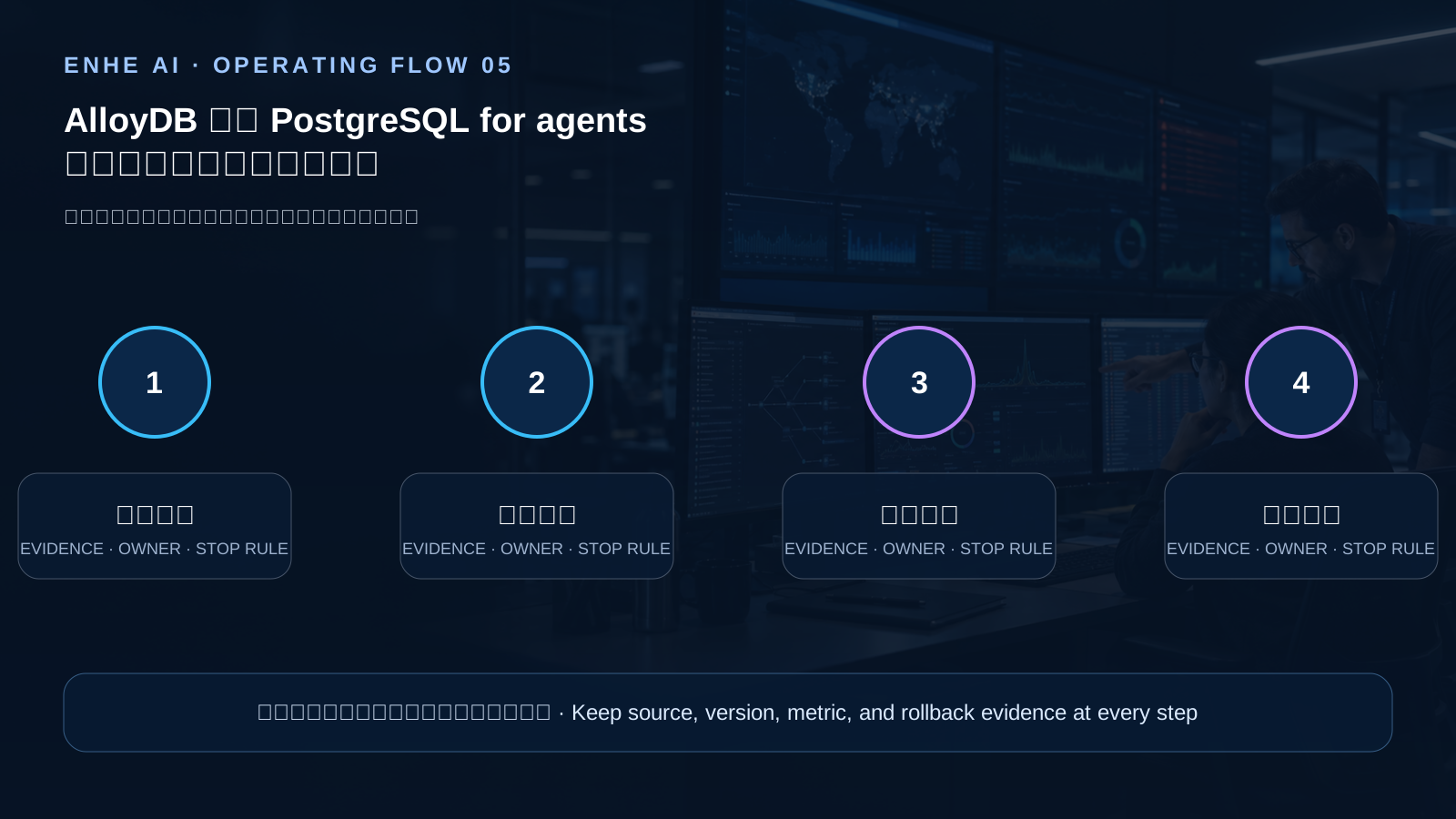
- Agent queries use isolated sandbox instances
- Read-only data stays current
- Instances start and scale down with agent bursts
- Identity, network, encryption, and audit share one control plane
Impact for AI users
Data-platform teams need separate agent identities, field filtering, tenant boundaries, concurrency and cost caps, and query-to-task traceability. Before rollout, simulate query storms, long transactions, stale replicas, and cross-tenant prompts while confirming production latency stays protected. Preview adoption also needs documented regions, quotas, support limits, and an exit path.
Operating checklist
- Create separate database identities for agents
- Limit fields, tenants, concurrency, and budget
- Simulate query storms and replica lag
- Document preview quotas, support, and exit plans
AI frontier news and analysis, AI software and model tools, AI skill tutorials and validation methods, and AI account and permission guidance
FAQ
Does read-only access remove data risk?
No. Sensitive fields, tenant isolation, query cost, and data exposure still require controls.
Can the preview go directly into critical production?
Teams should first verify regions, quotas, support, isolation, and failure behavior.
Summary
PostgreSQL for agents adds isolation and elasticity at the data layer, while safe production use still depends on query boundaries, budgets, and failure drills.
This AI-assisted article is checked by ENHE AI automation for official sources, bilingual fields, media rights, page safety, and historical duplication before publication.
What this means for everyday users
Data-platform teams need separate agent identities, field filtering, tenant boundaries, concurrency and cost caps, and query-to-task traceability. Before rollout, simulate query storms, long transactions, stale replicas, and cross-tenant prompts while confirming production latency stays protected. Preview adoption also needs documented regions, quotas, support limits, and an exit path.
Tools you may use


Related tutorials
Related Tools And Tutorials
Use the following ENHE AI sections to continue from the news signal into tool selection, account-service guidance, or practical learning.
Related reading
From Chat Boxes to Personal AI Companions: AI Assistants Are Entering the Desktop Execution Era
AI assistants are moving from answering questions toward continuing real tasks. AI agents, MCP tool ecosystems, personal memory, and local workbenches are pushing this shift together. For users, the real value is not another chat box, but less repeated context setup and more continuity from thinking to doing.
Google Open-Sources AQuA for Silent Production Agent Failures
Google published the open-source AQuA Ambient Quality Agent reference implementation on October 8, 2026. AQuA targets a production problem that ordinary uptime checks miss: an agent can return HTTP 200 and stay within latency limits while silently dropping user constraints, selecting the wrong tool, or claiming an unverified result. The reference implementation runs beside the agent rather than in the request path. It samples recent sessions, reviews them against a checklist and optional goal, clusters similar findings, uses a separate verification step, and tracks surviving issues over time. Teams considering it should begin with synthetic or redacted traces, define retention and access rules, cap sampling and model cost, measure false positives, keep diagnosis separate from automatic editing, and require a human owner to accept each issue.
Google Cloud Introduces the Gemini Agent for Work
Google Cloud introduced the Gemini agent at Gemini at Work on October 8, 2026. Google describes it as a universal work agent that can use an organization's business context, plan work, call skills and tools, connect to business systems, and return completed results inside documents, inboxes, and developer environments. The announcement also highlights model selection, cost controls, security, administration, and governance. Those claims define a product direction, not automatic permission to connect every data source. Before rollout, start with one bounded workflow, list the records and tools the agent can reach, separate read from write access, cap spend, require confirmation before messages or irreversible changes, verify the destination of generated work, and keep a human owner for exceptions and acceptance.
A Banking Agent Writes Then Reverses: AWS Describes a Demo, Not Production Trading
An October 5 AWS post describes Texas Capital Bank’s Trust-Earned Autonomy pattern, in which reviewer agreement can inform an agent’s permissions and a prior write can be reversed if trust declines. AWS explicitly says the agent pattern is still a demonstration running on demo-scale Apache Fineract with synthetic data, not a production workload or real production transaction flow. The bank’s separate document-extraction capability is described as operating in production. This article focuses on revocable authority, auditability, and system boundaries, and avoids presenting the demonstration as an already deployed autonomous banking agent. Teams should check applicability against their own environment, record assumptions, and validate decisions with representative operational evidence.
A supervisor can update a contact-center agent by voice, after strong authentication
AWS described a voice-activated supervisor agent for Amazon Connect Customer and Bedrock on September 30. A supervisor calls from an approved number, verifies a PIN, and then uses MCP tools to manage customer-facing AI agents. The example includes nine tools for configuration, rollback, and testing; its system prompt requires confirmation before destructive actions and a test report after each change. Secrets Manager stores authentication data, and failed PIN attempts trigger rate limits and lockout. Voice reduces console navigation, but it also creates a path from spoken requests to production changes. Before deployment, teams need to verify identity controls, least-privilege tool access, approval rules, rollback, and alerting. The AWS example is an architecture pattern, not a substitute for an organization’s security review.
Google Cloud Storage Intelligence brings proactive governance to fast-growing AI data
Google Cloud announced general availability for Storage Intelligence advisor and expanded Cloud Storage batch operations on September 25. Google says AI training and inference pipelines create data quickly and change access patterns often, so problems may surface only after they appear on a bill. The advisor analyzes inventory and access behavior to produce actionable recommendations, while batch operations can apply remediations across large object sets. Teams should not turn every recommendation directly into an automated command. Confirm the affected objects, regions, retention policies, compliance obligations, and estimated cost, test on a limited scope, and retain audit evidence for misclassification, access disruption, and rollback.