
Google Cloud Storage Intelligence brings proactive governance to fast-growing AI data
Storage Intelligence advisor is generally available, while batch operations expand the scope of storage remediation.

Key takeaways
Google Cloud announced general availability for Storage Intelligence advisor and expanded Cloud Storage batch operations on September 25. Google says AI training and inference pipelines create data quickly and change access patterns often, so problems may surface only after they appear on a bill. The advisor analyzes inventory and access behavior to produce actionable recommendations, while batch operations can apply remediations across large object sets. Teams should not turn every recommendation directly into an automated command. Confirm the affected objects, regions, retention policies, compliance obligations, and estimated cost, test on a limited scope, and retain audit evidence for misclassification, access disruption, and rollback.
Direct answer
Google Cloud announced general availability for Storage Intelligence advisor and expanded Cloud Storage batch operations on September 25. Google says AI training and inference pipelines create data quickly and change access patterns often, so problems may surface only after they appear on a bill. The advisor analyzes inventory and access behavior to produce actionable recommendations, while batch operations can apply remediations across large object sets. Teams should not turn every recommendation directly into an automated command. Confirm the affected objects, regions, retention policies, compliance obligations, and estimated cost, test on a limited scope, and retain audit evidence for misclassification, access disruption, and rollback.
Verified facts
Google Cloud announced general availability for Storage Intelligence advisor on September 25, 2026.
The same release expands Cloud Storage batch operations for remediation across large object sets.
Google identifies rapid AI-data growth and shifting access patterns as major sources of storage complexity.
What changed
- Storage Intelligence advisor becomes generally available
- Recommendations use inventory and access patterns
- Batch operations cover larger object sets
- AI data becomes a key governance scenario
Impact for AI users
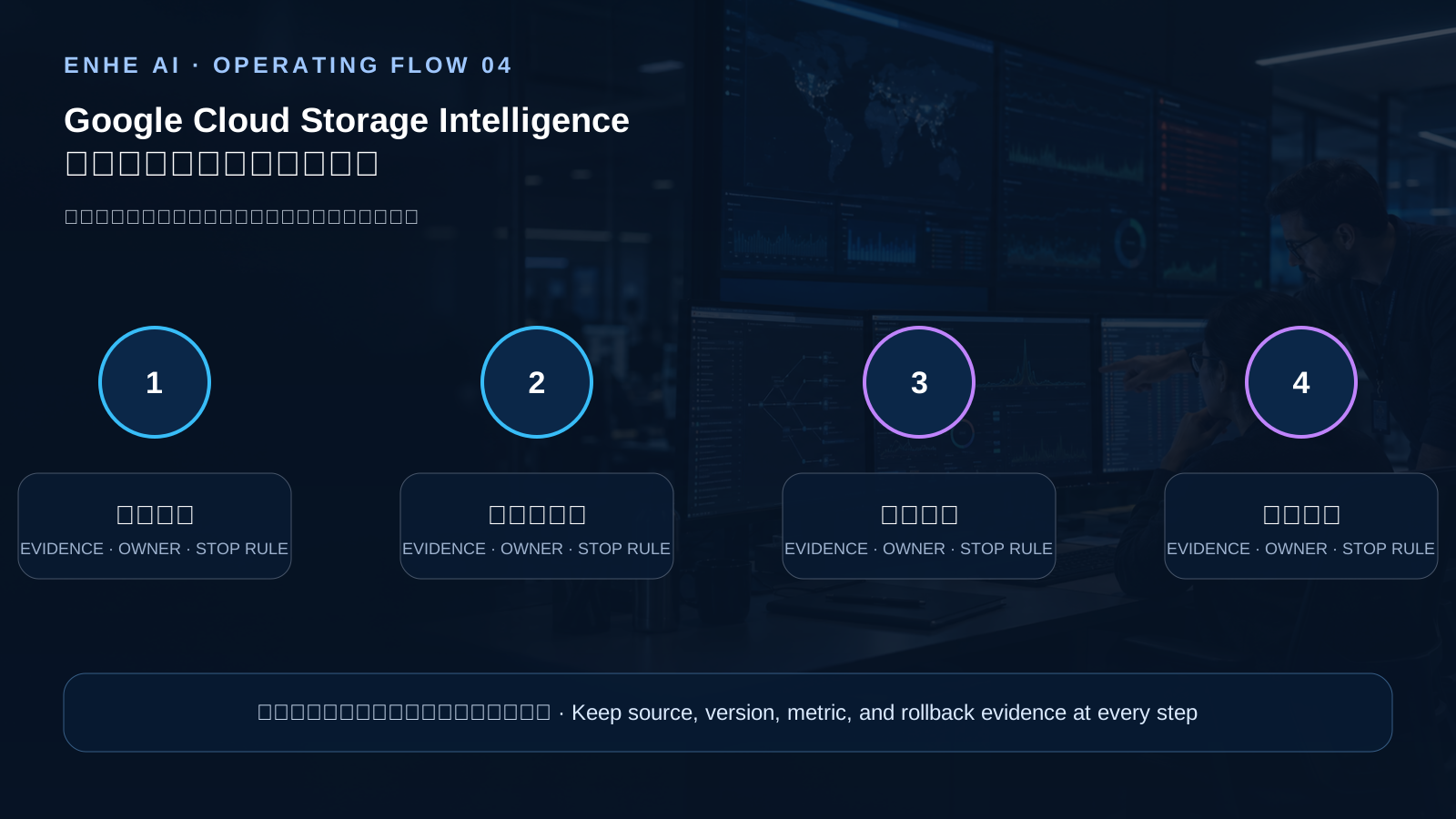
Data teams should separate recommendations into observe, dry-run, and approved execution stages. Each recommendation needs object count, location, retention, access frequency, estimated savings, and worst-case impact, followed by a representative sample. Save inventory and configuration snapshots, define stop thresholds, and verify application reads, training jobs, and compliance retention after any batch change.
Operating checklist
- Add an approval layer to recommendations
- Rehearse on representative objects
- Save inventory, configuration, and cost baselines
- Verify reads, training, and retention after changes
AI frontier news and analysis, AI software and model tools, AI skill tutorials and validation methods, and AI account and permission guidance
FAQ
Does general availability justify automatic execution of every recommendation?
No. Batch changes can affect access, retention, and compliance, so scope and approval remain necessary.
Is estimated savings enough for a decision?
No. Recovery cost, application impact, and retention duties also need review.
Summary
Storage intelligence can reveal waste and risk earlier, while batch governance still needs scope, rehearsal, stop conditions, and rollback evidence.
This AI-assisted article is checked by ENHE AI automation for official sources, bilingual fields, media rights, page safety, and historical duplication before publication.
What this means for everyday users
Data teams should separate recommendations into observe, dry-run, and approved execution stages. Each recommendation needs object count, location, retention, access frequency, estimated savings, and worst-case impact, followed by a representative sample. Save inventory and configuration snapshots, define stop thresholds, and verify application reads, training jobs, and compliance retention after any batch change.
Tools you may use


Related tutorials
Related Tools And Tutorials
Use the following ENHE AI sections to continue from the news signal into tool selection, account-service guidance, or practical learning.
Related reading
OpenAI introduces the Data agent for governed analysis and dashboards in ChatGPT Work
OpenAI introduced the Data agent for ChatGPT Work on September 10. The plugin connects approved company data sources, files, and business context so users can investigate changes in natural language, inspect evidence, and create interactive dashboards that teams can edit, share, and refresh. It can also share findings through connected Slack or email tools and carry out actions that users approve. Administrators control which connections and roles are available, while queries enforce the connected account's existing table, row, and column permissions. Data is listed in the ChatGPT Work Plugins directory; teams install it, complete required account connections, and start with @Data. Before operational use, teams should verify metric definitions, evidence, data scope, and each downstream action.
GitHub's Updates Show AI Developer Tools Entering a Cost Governance Era
GitHub's July 2026 announcements point to a broader shift in global AI developer tools. Copilot CLI is easier to use inside GitHub Actions, session limits can cap AI credit use, cost centers can manage included usage caps, and GitHub Models is scheduled for retirement. Together, these updates show that AI competition is moving beyond model demos. Developers, small teams, and enterprises now need to compare permission models, budget controls, audit logs, model-access stability, and human review. For ENHE AI readers, the practical insight is that AI tooling strategy should include governance from the beginning, even when the first trial looks small.
OpenAI Adds Spend Controls and Usage Analytics to ChatGPT Enterprise
OpenAI has added spend controls and enhanced usage analytics for ChatGPT Enterprise, according to Computerworld's June 19, 2026 report. The update helps administrators monitor adoption, track usage across teams, and understand ChatGPT and Codex credit consumption by user, product, and model.
A Banking Agent Writes Then Reverses: AWS Describes a Demo, Not Production Trading
An October 5 AWS post describes Texas Capital Bank’s Trust-Earned Autonomy pattern, in which reviewer agreement can inform an agent’s permissions and a prior write can be reversed if trust declines. AWS explicitly says the agent pattern is still a demonstration running on demo-scale Apache Fineract with synthetic data, not a production workload or real production transaction flow. The bank’s separate document-extraction capability is described as operating in production. This article focuses on revocable authority, auditability, and system boundaries, and avoids presenting the demonstration as an already deployed autonomous banking agent. Teams should check applicability against their own environment, record assumptions, and validate decisions with representative operational evidence.
Microsoft’s 2026 Defense Report: AI Is Changing the Pace of Cybersecurity
In its October 1 commentary on the 2026 Microsoft Digital Defense Report, Microsoft says threat actors are using AI in parts of existing workflows, including reconnaissance and social engineering. The post does not claim that attacks have become fully autonomous; it highlights changes in speed and scale. Identity controls, least privilege, data protection, monitoring, testing, and secure development remain central. This article separates Microsoft’s observations from independent conclusions and turns the post into a practical checklist. Teams should compare the claims with their own telemetry and incident history before changing priorities. Teams should check applicability against their own environment, record assumptions, and validate decisions with representative operational evidence.
A One-Week AI Agent Security Review Using the OWASP Risk Framework
The OWASP Gen AI Security Project published its 2026 Top 10 for Agentic Applications in December 2025 as a risk framework for systems that plan, call tools, or act across services. It is a starting point for security discussion, not a certification, compliance attestation, or guarantee of safety. This article turns it into a one-week baseline review: inventory agent identities and tools, narrow permissions, treat external content as untrusted input, record consequential actions, test shutdown and revocation, and define approval and recovery for high-impact operations. Teams should extend the checklist to match their architecture and threat model. Teams should check applicability against their own environment, record assumptions, and validate decisions with representative operational evidence.