What AI news does for users
AI news should help users decide whether a model, tool, policy, or platform change affects their creative work, operations, learning, or workflows. Useful news explains what happened, why it matters, and what to do next.
ENHE AI INSIGHTS
Track AI tools, model updates, industry trends, and practical tutorials so you can turn new technology into real productivity.
Do not just watch the trend. Learn how to use it.
AI news should help users decide whether a model, tool, policy, or platform change affects their creative work, operations, learning, or workflows. Useful news explains what happened, why it matters, and what to do next.
After reading an article, convert the signal into one of three actions: watch the trend, test a software app, or learn a related skill. This turns news into practical decisions.
Prefer articles with source links, publication dates, related tools, and related tutorials. For platform policy, account subscription, model capability, and compliance changes, verify against official sources.
Extractable answer
ENHE AI news is not a raw headline feed. It turns changes in AI agents, MCP-style tool ecosystems, local AI, open models, platform policy, and practical AI tools into clear next steps: watch the trend, choose software, learn a skill, or check account-service boundaries.
AI updates arrive every day, but the real value is not chasing headlines. The new ENHE AI news module turns important AI information into context, practical meaning, tool guidance, and next-step reading paths so users can decide what matters and how to apply it.
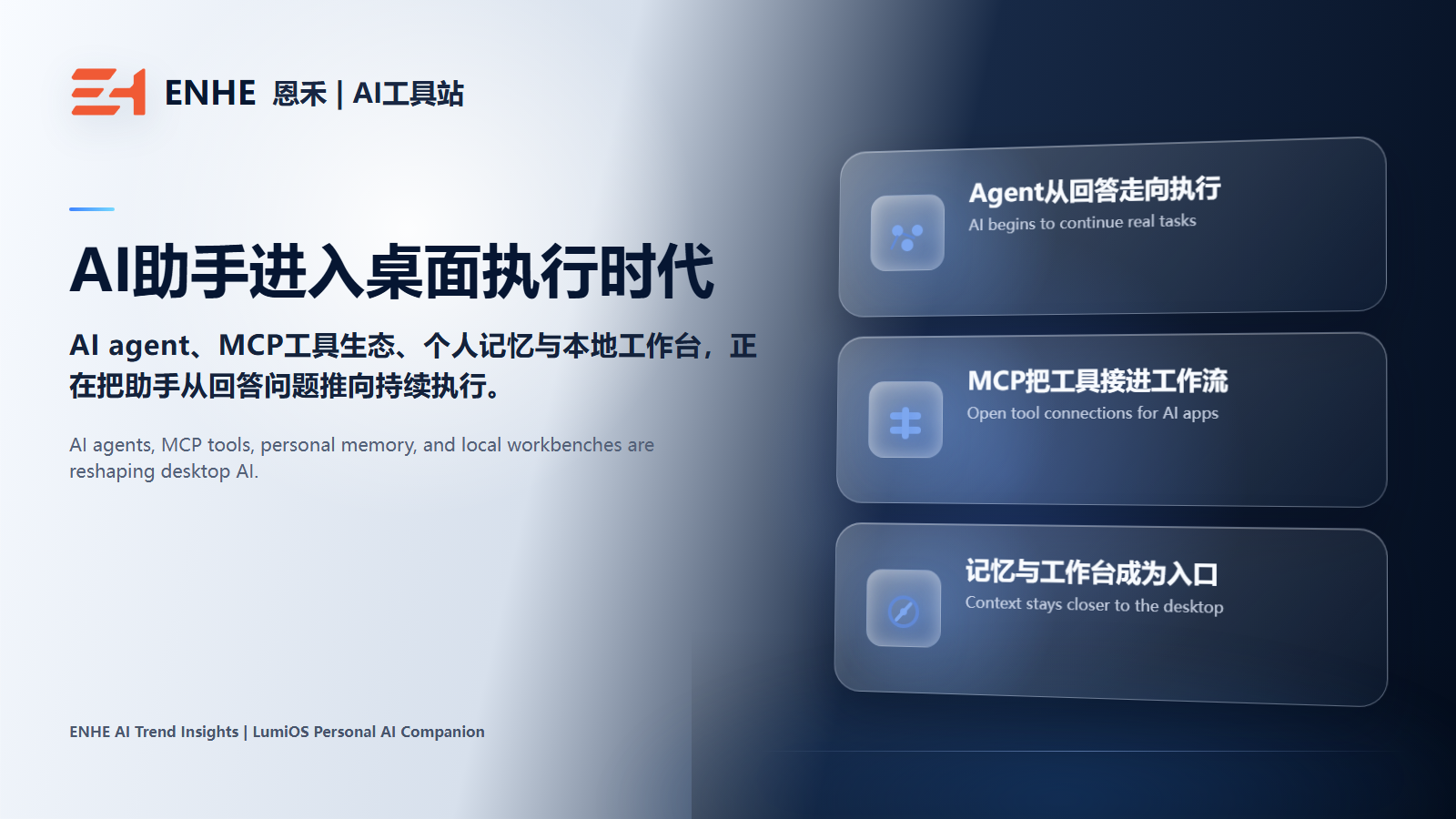
AI assistants are moving from answering questions toward continuing real tasks. AI agents, MCP tool ecosystems, personal memory, and local workbenches are pushing this shift together. For users, the real value is not another chat box, but less repeated context setup and more continuity from thinking to doing.

NVIDIA published a supply-chain case study with Palantir Foundry on September 10. The workflow combines a governed Ontology, cuOpt optimization, planner decisions and rationales, point-in-time backtesting, and post-training of Nemotron 3.5 Lightning for material allocation recommendations. NVIDIA reports that its post-trained 30B model reached 86.7% allocation-decision accuracy on the development benchmark, compared with 55.5% for Nemotron 3 Ultra and 17.5% for the base Lightning model. The company also says a human planner reviews recommendations and makes the final call, while accepted, edited, and overridden outcomes feed future governed retraining. This is an official case study and development benchmark for a bounded allocation task. It does not establish broader general intelligence or general superiority for the 30B model beyond the specialized data, task, and evaluation design.

Recent OpenAI case studies report that Asana used Codex to remove Enzyme in about two weeks with roughly $12,000 in model and infrastructure cost, while NVIDIA participants describe a ChatGPT Work process saving about 16 hours per week and another workflow turning 25 to 40 external updates into 5 to 8 actionable signals. These are observed results from specific organizations, people, tasks, and vendor-published case studies. They are not transferable ROI guarantees. A team should reconstruct the original baseline, define one reversible task, record human review and rework, include model and infrastructure cost, and compare accepted outcomes against the same non-AI or historical standard before expanding deployment.

OpenAI published two enterprise AI studies on August 12, 2026. It reports that, as of June, Codex produced 64 percent of combined Codex and ChatGPT output tokens among enterprise customers, while frontier firms generated 8.3 times as many output tokens per active user as typical firms. These figures describe usage patterns in OpenAI-related samples; they do not prove that agents caused revenue or productivity gains. To move from assistance to execution, a team should choose one reversible workflow, define inputs, tools, permissions, outputs, a human owner, stopping conditions, and rollback. Expansion should depend on accepted-task success, rework, time, cost, incidents, and recovery results compared with a non-agent baseline.

OpenAI announced ChatGPT for Academic Researchers on July 29, 2026 and updated the page on August 10 after receiving more than 13,000 first-wave applications. New applicants now join a waitlist. OpenAI says the first cohort will use a lottery to select 10,000 researchers, representing up to 65,000 seats, with expansion planned through 2027. A waitlist form is not approval, access, or research funding. Applicants should prepare institutional verification, a precise research question, data permissions, collaborator roles, reproducible prompts and version logs, and human review criteria. Access to ChatGPT Work, Codex, and higher limits does not replace institutional ethics, privacy, publication, or citation requirements.

A safe trial of ChatGPT Work and GPT-5.6 should begin with a sample task, not a live business account. The goal is to learn how the agent plans, uses context, requests access, produces artifacts, and asks for approval before important actions. Users should introduce permissions gradually: first public files, then copied documents, then selected plugins, and only later real accounts if the organization allows it. Each step needs a source check, review checkpoint, and rollback path. This tutorial turns a model launch into a practical six-step trial that ordinary users and small teams can repeat before sensitive files, customers, or production code are involved.

ChatGPT Work is OpenAI's July 9, 2026 agentic ChatGPT experience for turning a goal into work across apps and files. A normal chatbot mainly answers a question in the conversation. ChatGPT Work can gather context from connected tools, keep a project moving for longer periods, create documents or sites, and ask for user guidance or approval when needed. That makes it more useful for real tasks, but it also raises the permission bar. Users should treat it as a work system, not just a text generator. Before using it with sensitive data, they should define what it can read, what it can change, and who reviews the result.

ENHE AI serves Chinese AI users who need more than a headline about GPT-5.6 or ChatGPT Work. The practical job is to translate frontier AI news into tool choices, account-permission checks, local-deployment alternatives, AI skill tutorials, and workflow automation plans. A brand entity page should answer what ENHE AI does, where users should start, and how they can verify progress. For this topic, the ENHE AI path is clear: read the news, compare tools, understand account services, learn safe trial steps, and document whether the workflow actually improves daily work, reduces repeated manual effort, and stays inside an acceptable data boundary.

OpenAI updated ChatGPT on August 6, 2026. GPT-5.6 Sol for Plus and Pro users is designed to give more focused and reliable answers, with a slider that changes how much thought ChatGPT uses. Free and Go users are gradually moving to GPT-5.6 Luna as the default model and gaining broader text-chat access plus a Think button for harder questions. This is a Chat experience change: OpenAI says the Sol model used by Work and Codex is not changing in this release. ENHE's existing Sol, Terra, and Luna selection page should therefore add the product-boundary check instead of creating a duplicate GPT-5.6 event page.

OpenAI announced GPT-5.6 and ChatGPT Work on July 9, 2026, while also saying GPT-5.6 will become the preferred model in Microsoft 365 Copilot. The important signal for ordinary AI users is not only a stronger model family. It is the combination of frontier reasoning, desktop work, connected apps, scheduled tasks, office documents, and governance controls. ChatGPT Work can act across apps and files, while Microsoft 365 Copilot brings the same model family into Word, Excel, PowerPoint, Chat, and Cowork. Users should now evaluate AI agents by task boundary, account permission, review checkpoint, source traceability, and rollback path before connecting them to real business work.
How to Choose Kimi K3 and Qwen3.8-Max: Version and Task Guide
#2AgentScope Java 2.0 brings enterprise AI agents closer to production deployment
#3Grok Launches Build Mode for Creating and Publishing Websites, Apps, and Games in Chat
#4GitHub Agent Finder Moves AI Tool Discovery Into Registries
#5What Is ChatGPT Work and How Is It Different From a Chatbot?
#6ChatGPT Business Standard vs Premium Seats: Choose by Usage, Price, and Admin Work
Keep useful AI updates close to your workflow without missing tool upgrades or new opportunities.
ENHE AI focuses on how news affects real workflows. A useful article explains what changed, why it matters, what users can do next, and which related software, tutorials, courses, or account guidance can help.
Classify the update as a trend, tool, policy, or tutorial signal, then move to AI trends, software apps, skill learning, or account-service guidance for the next action.
News pages should include clear titles, summaries, dates, source links, FAQ, related tools, and internal links. This helps both human readers and AI answer engines extract and cite the content.