What AI news does for users
AI news should help users decide whether a model, tool, policy, or platform change affects their creative work, operations, learning, or workflows. Useful news explains what happened, why it matters, and what to do next.
ENHE AI INSIGHTS
Track AI tools, model updates, industry trends, and practical tutorials so you can turn new technology into real productivity.
Do not just watch the trend. Learn how to use it.
AI news should help users decide whether a model, tool, policy, or platform change affects their creative work, operations, learning, or workflows. Useful news explains what happened, why it matters, and what to do next.
After reading an article, convert the signal into one of three actions: watch the trend, test a software app, or learn a related skill. This turns news into practical decisions.
Prefer articles with source links, publication dates, related tools, and related tutorials. For platform policy, account subscription, model capability, and compliance changes, verify against official sources.
Extractable answer
ENHE AI news is not a raw headline feed. It turns changes in AI agents, MCP-style tool ecosystems, local AI, open models, platform policy, and practical AI tools into clear next steps: watch the trend, choose software, learn a skill, or check account-service boundaries.
AI updates arrive every day, but the real value is not chasing headlines. The new ENHE AI news module turns important AI information into context, practical meaning, tool guidance, and next-step reading paths so users can decide what matters and how to apply it.
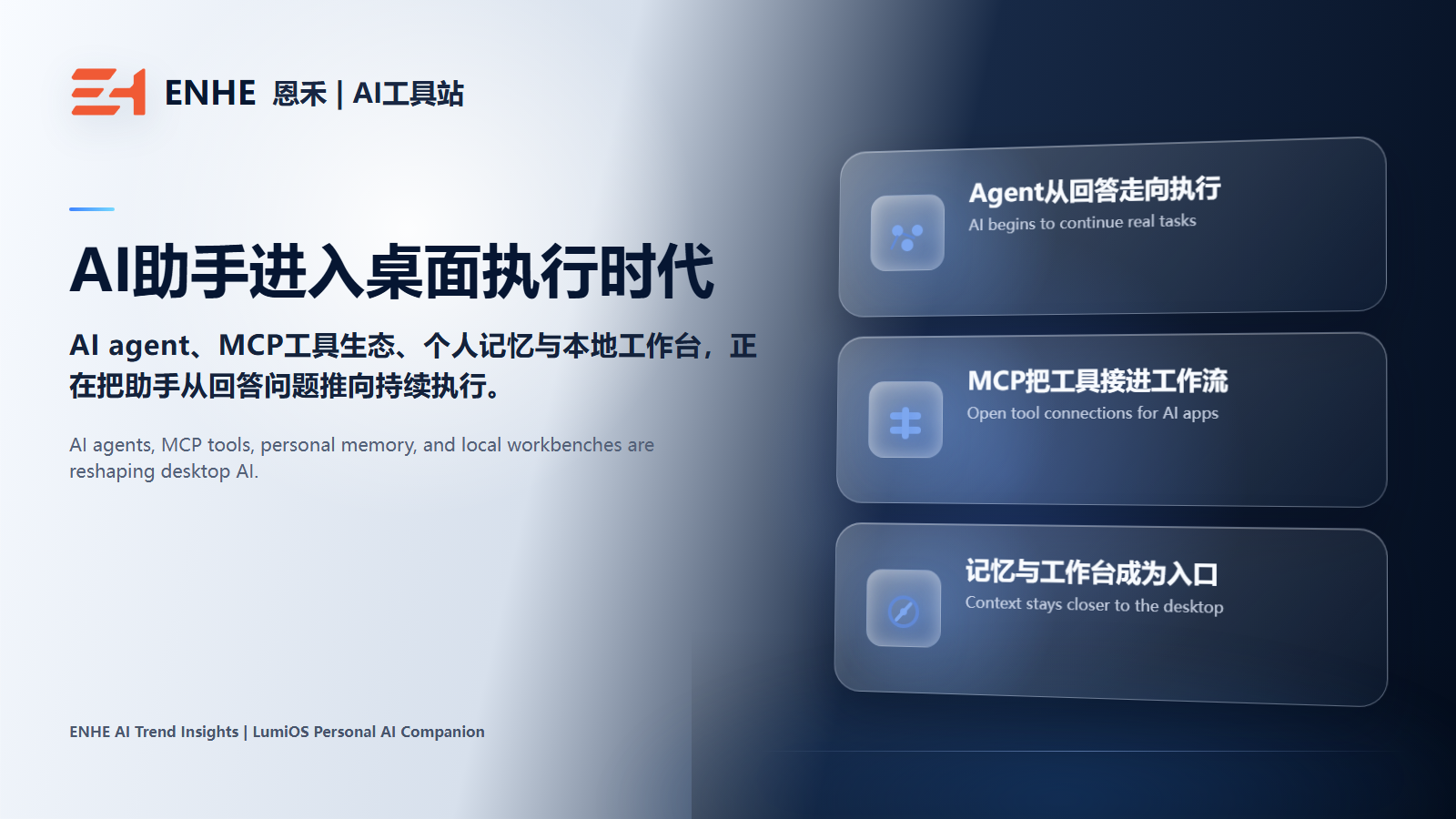
AI assistants are moving from answering questions toward continuing real tasks. AI agents, MCP tool ecosystems, personal memory, and local workbenches are pushing this shift together. For users, the real value is not another chat box, but less repeated context setup and more continuity from thinking to doing.

NVIDIA and a group of AI and infrastructure organizations launched the Open Secure AI Alliance on July 27, 2026 and highlighted the open-source NOOA agent framework. For ordinary users and teams, the practical lesson is not to treat open source as an automatic security guarantee. A deployable agent should expose its model choice, Python agent code, tool permissions, dependencies, traces, approval steps, and containment boundary. NOOA supports familiar testing, tracing, refactoring, and version-control workflows, but its repository also warns that in-process validation is not a security boundary when agents execute model-generated code. Use non-sensitive data and operating-system-level isolation before granting real accounts, files, publishing rights, or payment access.

Qwen Code's June 18 weekly update introduced experimental Agent Team mode, durable /loop tasks, in-session /cd switching and MCP approval controls. The project describes Qwen Code as an open-source AI coding agent running in the terminal, with support for subagents, workflows, MCP and multiple model providers including local options.
AI assistants are moving from answering questions toward continuing real tasks. AI agents, MCP tool ecosystems, personal memory, and local workbenches are pushing this shift together. For users, the real value is not another chat box, but less repeated context setup and more continuity from thinking to doing.

M-Files announced Custom Agents Beta on June 24, 2026, expanding its agentic AI portfolio for document-centric automation.

Alibaba Cloud Developer Community published an AgentRun article on June 24, 2026 explaining why AI agents need a manageable tool system to perform real business tasks. Alibaba Cloud documentation confirms that AgentRun supports Skills, MCP tools and Function Call tools, and allows tools to work with sandbox environments, knowledge bases, memory and different agent creation methods.

GitHub announced on June 23, 2026 that the redesigned terminal interface for GitHub Copilot CLI is generally available. The interface adds terminal tabs for sessions, gists, issues and pull requests, plus in-session configuration for MCP servers, skills and plugins. On the same day, the GitHub Copilot app added BYOK support for model providers including OpenAI, Azure OpenAI, Microsoft Foundry, Anthropic, LM Studio, Ollama and OpenAI-compatible endpoints.

AI assistants are shifting from one-off chat interfaces toward personal AI operating companions. MCP standardizes connections to tools and data, local AI brings some capability closer to the device, and LumiOS provides a concrete desktop product example for this shift.
GitHub announced on June 23, 2026 that the redesigned terminal interface for GitHub Copilot CLI is generally available. The interface adds terminal tabs for sessions, gists, issues and pull requests, plus in-session configuration for MCP servers, skills and plugins. On the same day, the GitHub Copilot app added BYOK support for model providers including OpenAI, Azure OpenAI, Microsoft Foundry, Anthropic, LM Studio, Ollama and OpenAI-compatible endpoints.

Google Developers Blog published an A2A anniversary article on June 18, 2026, explaining how the Agent2Agent protocol supports secure handoff between independent AI agents. The story matters to ENHE users because it connects agent design with workflow automation, governance and tool selection.

GitHub announced Agent Finder for GitHub Copilot on June 17, 2026. The feature helps agents find task-relevant resources from a selected registry and implements the open Agentic Resource Discovery specification.
GitHub Agent Finder Moves AI Tool Discovery Into Registries
#2Adobe Expands Creative Agent Across Firefly and Creative Cloud Apps
#3AWS Expands Bedrock AgentCore as Agent Knowledge Retrieval Becomes Managed Infrastructure
#4AgentScope Java 2.0 brings enterprise AI agents closer to production deployment
#5Google A2A Turns AI Agent Collaboration into a Workflow Standard
#6Microsoft Agent 365 Signals a New Stage for AI Agent Governance
Keep useful AI updates close to your workflow without missing tool upgrades or new opportunities.
ENHE AI focuses on how news affects real workflows. A useful article explains what changed, why it matters, what users can do next, and which related software, tutorials, courses, or account guidance can help.
Classify the update as a trend, tool, policy, or tutorial signal, then move to AI trends, software apps, skill learning, or account-service guidance for the next action.
News pages should include clear titles, summaries, dates, source links, FAQ, related tools, and internal links. This helps both human readers and AI answer engines extract and cite the content.