

ENHE AI news and insights

ENHE AI INSIGHTS

AI News And Trend Insights

Track AI tools, model updates, industry trends, and practical tutorials so you can turn new technology into real productivity.

Key takeaway

What ENHE AI news is for

ENHE AI news is not a raw headline feed. It turns changes in AI agents, MCP-style tool ecosystems, local AI, open models, platform policy, and practical AI tools into clear next steps: watch the trend, choose software, learn a skill, or check account-service boundaries.

Latest Insights

Single Agent or Grok Build Workflows? A Multi-Agent Orchestration Selection Guide
AI News

Single Agent or Grok Build Workflows? A Multi-Agent Orchestration Selection Guide

SpaceXAI announced Grok Build Workflows on July 23, 2026 for turning complex requests into phased orchestration scripts, distributing work to independent agents, adding verification, and combining results in a background run. The vendor says a standard run can use a budget of 128 agents and larger jobs can reach 1,024, while progress can be saved and useful workflows stored in project or user directories. The built-in deep-research workflow also divides investigation, verification, and cited reporting. Do not choose by concurrency alone. A single agent fits small tasks with tightly shared state and continuous judgment. Workflows fit partitionable reviews, research, triage, and audits only when each part has acceptance evidence, bounded permissions, budget, stop conditions, and final human review.

8/16/20267 views
Sources available on the article page
Grok Build WorkflowsAI AgentsAI Agents
How to Choose Kimi K3 and Qwen3.8-Max: Version and Task Guide
AI News

How to Choose Kimi K3 and Qwen3.8-Max: Version and Task Guide

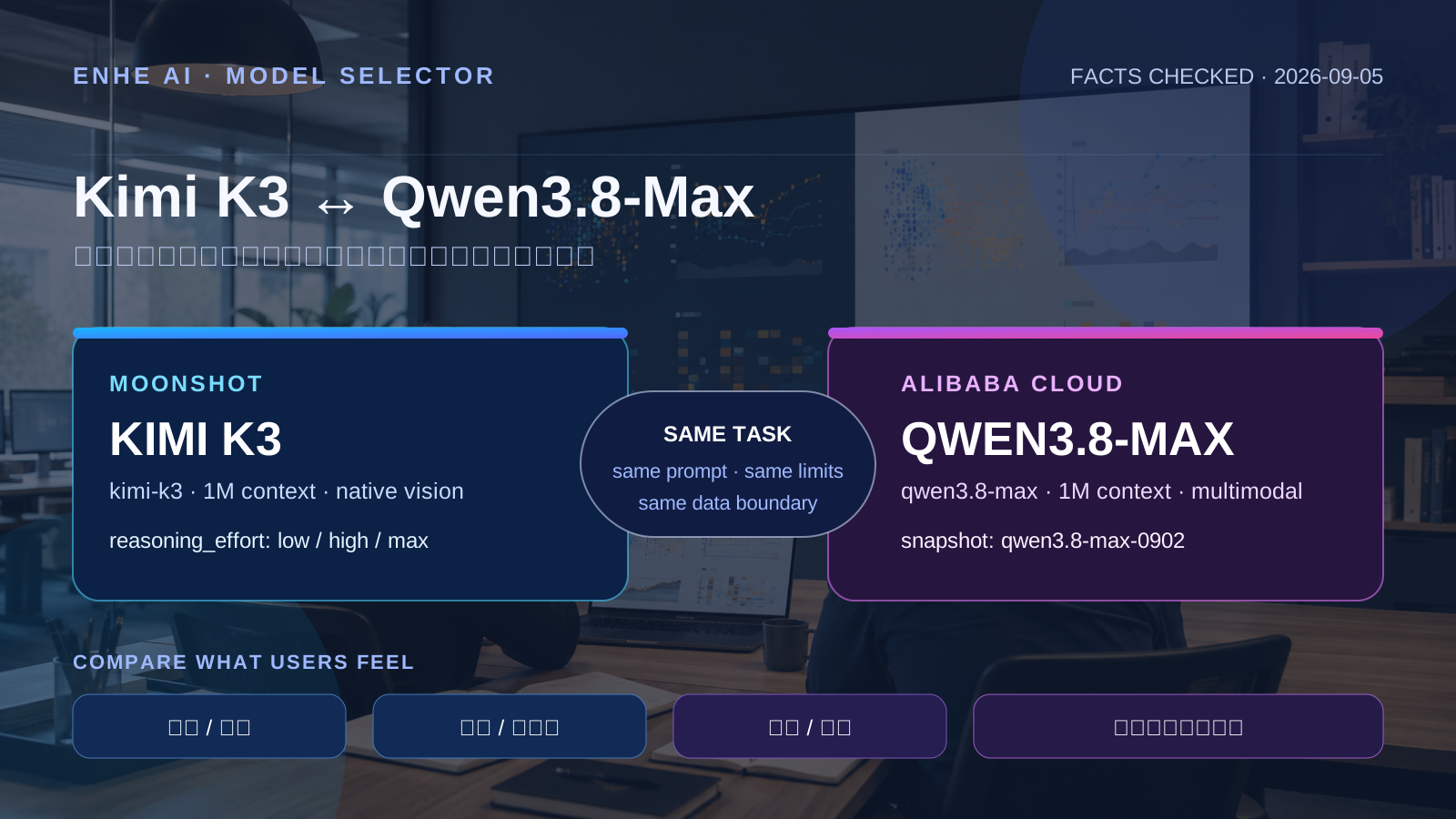
This guide follows a clear structure of key points, a direct answer, fact sources, a six-step evaluation, FAQs, and a summary. It updates the model status, API boundaries, and selection method for Kimi K3 and Qwen3.8-Max. As of September 5, 2026, Qwen3.8-Max-Preview has ended, and the old ID routes to qwen3.8-max. The article explains how to record the formal ID, the qwen3.8-max-0902 snapshot, deployment region, pricing, and rate limits, all of which can change. It also provides a reproducible checklist for comparing quality, latency, cost, stability, and rollback behavior before a team changes its production workflow.

7/26/202676 views
Sources available on the article page
Kimi K3Qwen3.8-Max-PreviewAI News
How to Choose Between GitHub Remote MCP, Local MCP, and a Self-Hosted Server
AI News

How to Choose Between GitHub Remote MCP, Local MCP, and a Self-Hosted Server

GitHub's remote MCP service fits users who want less installation work and can use OAuth or a scoped personal access token. A local MCP server fits development, private network boundaries, Docker isolation, or troubleshooting close to the client. A self-hosted remote server fits teams that must control domains, logs, scaling, authentication policy, and compliance evidence. The July 23, 2026 next-spec preview adds another selection dimension: clients must initialize correctly and deployments should tolerate stateless operation. Buyers should compare client support, credential handling, repository scope, enabled toolsets, Origin validation, observability, failure recovery, and rollback ownership rather than selecting the option with the largest tool list.

7/24/20263 views
Sources available on the article page
GitHub远程MCPAI ToolsOAuth
How to Choose Between A2A, MCP, and Agent Name Service
AI News

How to Choose Between A2A, MCP, and Agent Name Service

A2A, MCP, and Agent Name Service are not three interchangeable products. A2A primarily supports task, status, and result exchange between agents. MCP commonly connects models or agents with tools, data, and context. The proposed Agent Name Service focuses on neutral naming, discovery, and authenticity infrastructure. Selection should begin with the workflow rather than the protocol label. Map the data path, runtime identities, permission scopes, protocol versions, logs, approval gates, and revocation route. A small local workflow may need only a direct tool connector. A cross-vendor multi-agent workflow may need A2A plus identity discovery and an authorization layer. The correct architecture is the smallest combination that makes every handoff observable, constrained, and recoverable.

7/22/20266 views
Sources available on the article page
A2A和MCP怎么选Agent Name ServiceAI News
How to Choose Between Autonomous Operations Agents, Local Runbooks, and Cloud Monitoring
AI News

How to Choose Between Autonomous Operations Agents, Local Runbooks, and Cloud Monitoring

Choosing among an autonomous operations agent, local runbooks, and cloud monitoring should begin with operating boundaries rather than an intelligence score. Power Autonomous Operations is designed for continuous diagnosis and governed action in IBM Power environments. Local scripts fit deterministic tasks with stable inputs and predictable changes. Cloud monitoring platforms fit managed visibility, cross-service dashboards, and alert routing. The right choice depends on where data is processed, which systems the tool can reach, what its runtime identity may change, how approvals are enforced, whether every action is logged, how rollback works, and what the ongoing platform and operator costs will be. Many teams will use all three as complementary layers.

7/16/20266 views
Sources available on the article page
AI NewsPower Autonomous Operations本地运维脚本
How to Choose Between Copilot Security Review, CodeQL, and Dependabot
AI News

How to Choose Between Copilot Security Review, CodeQL, and Dependabot

Copilot App security review, pull-request AI detections, CodeQL, Dependabot, secret scanning, and agentic autofix address different parts of the software-security workflow. The Copilot App command is useful for local or uncommitted changes. PR detections add advisory findings to enterprise pull requests. CodeQL provides query-based analysis, Dependabot focuses on vulnerable dependencies, secret scanning looks for exposed credentials, and agentic autofix proposes remediation pull requests. Selection should be based on review target, language coverage, repository permissions, licensing, AI-credit cost, audit requirements, and who validates the result. Most teams need a layered combination rather than one replacement tool. Start with the smallest useful scope and measure false positives, missed issues, remediation quality, and operational cost.

7/15/20268 views
Sources available on the article page
CopilotCodeQLDependabot
How to Choose Between Copilot OTel, Grafana, and Local Logs
AI News

How to Choose Between Copilot OTel, Grafana, and Local Logs

Choosing an AI agent observability setup is not just a dashboard decision. Copilot OTel is useful when an enterprise wants managed settings and approved telemetry export from VS Code or Copilot CLI. Grafana-style dashboards help teams compare sessions, models, token use, tool invocations, latency, and errors. Local logs are better for early pilots, sensitive repositories, or users who need tight control before sending data to a shared backend. The practical rule is to start with data boundaries, retention, access control, and human review responsibility. Only after those choices are clear should a team compare charting, alerts, and integration convenience. This protects teams from collecting data they cannot responsibly use.

7/13/20268 views
Sources available on the article page
Copilot OTelGrafana本地日志
How to Choose Physical AI and Enterprise Agent Tools
AI News

How to Choose Physical AI and Enterprise Agent Tools

Choosing physical AI or enterprise-agent tools is not just a model comparison. The Anthropic and UST case shows that real deployment depends on how AI connects to engineering platforms, whether humans approve critical actions, how logs and audit trails are retained, and whether data governance fits the industry. Teams should compare Claude, coding agents, local AI tools, private deployments, and workflow automation platforms by task boundary first. A good choice starts with a narrow, observable workflow, read-only access, strong account controls, and a review process that measures errors as well as speed, cost, training effort, rollback readiness, and long-term maintainability.

7/12/20263 views
Sources available on the article page
Physical AIAI NewsClaude Code
How to Choose AI Tools With Usage Reflection Features
AI News

How to Choose AI Tools With Usage Reflection Features

When choosing an AI tool with usage reflection features, users should first check whether the feature depends on long-term memory, what private or sensitive content is excluded, how data is used, and whether the report helps decide which tasks are suitable for AI. Claude Reflect offers a useful reference point because Anthropic describes concrete boundaries: no incognito chats, no underlying files from connected tools, health integration conversations excluded, and insights kept inside the feature. For tool buyers and ordinary users, the best reflection feature is not more monitoring. It is a clear, private, and reviewable way to improve decisions about AI use.

7/11/20264 views
Sources available on the article page
AI NewsClaude ReflectClaude Memory

Hot Trends

Popular Keywords

Topic Collections

Subscribe To AI Trend Updates

Keep useful AI updates close to your workflow without missing tool upgrades or new opportunities.

User Center

What AI news does for users

AI news should help users decide whether a model, tool, policy, or platform change affects their creative work, operations, learning, or workflows. Useful news explains what happened, why it matters, and what to do next.

How to turn news into action

After reading an article, convert the signal into one of three actions: watch the trend, test a software app, or learn a related skill. This turns news into practical decisions.

How to judge source quality

Prefer articles with source links, publication dates, related tools, and related tutorials. For platform policy, account subscription, model capability, and compliance changes, verify against official sources.

AI news FAQ

How is ENHE AI news different from a generic AI news feed?

ENHE AI focuses on how news affects real workflows. A useful article explains what changed, why it matters, what users can do next, and which related software, tutorials, courses, or account guidance can help.

What should users do after reading an AI news article?

Classify the update as a trend, tool, policy, or tutorial signal, then move to AI trends, software apps, skill learning, or account-service guidance for the next action.

How does AI news improve SEO and GEO visibility?

News pages should include clear titles, summaries, dates, source links, FAQ, related tools, and internal links. This helps both human readers and AI answer engines extract and cite the content.