What AI news does for users
AI news should help users decide whether a model, tool, policy, or platform change affects their creative work, operations, learning, or workflows. Useful news explains what happened, why it matters, and what to do next.
ENHE AI INSIGHTS
Track AI tools, model updates, industry trends, and practical tutorials so you can turn new technology into real productivity.
Do not just watch the trend. Learn how to use it.
AI news should help users decide whether a model, tool, policy, or platform change affects their creative work, operations, learning, or workflows. Useful news explains what happened, why it matters, and what to do next.
After reading an article, convert the signal into one of three actions: watch the trend, test a software app, or learn a related skill. This turns news into practical decisions.
Prefer articles with source links, publication dates, related tools, and related tutorials. For platform policy, account subscription, model capability, and compliance changes, verify against official sources.
Extractable answer
ENHE AI news is not a raw headline feed. It turns changes in AI agents, MCP-style tool ecosystems, local AI, open models, platform policy, and practical AI tools into clear next steps: watch the trend, choose software, learn a skill, or check account-service boundaries.
AI updates arrive every day, but the real value is not chasing headlines. The new ENHE AI news module turns important AI information into context, practical meaning, tool guidance, and next-step reading paths so users can decide what matters and how to apply it.

AI assistants are moving from answering questions toward continuing real tasks. AI agents, MCP tool ecosystems, personal memory, and local workbenches are pushing this shift together. For users, the real value is not another chat box, but less repeated context setup and more continuity from thinking to doing.
GitHub released enterprise-managed permissions for Copilot agent operations on September 9. Administrators can centrally set shell commands, file reads and writes, and access to network domains to blocked, approval required, or allowed without a prompt. User preferences, workspace settings, automatic approval, and earlier approvals cannot make the enterprise policy less restrictive. GitHub says the controls are generally available in the Copilot app, Copilot CLI, and Visual Studio Code sessions that use Agent Host for Copilot Business and Enterprise customers. Security and platform teams should begin with a minimum-permission baseline, test representative repositories, and expand only the operations that have a clear owner, audit trail, and rollback path.
M-Files announced Custom Agents Beta on June 24, 2026, expanding its agentic AI portfolio for document-centric automation.
Alibaba Cloud introduced ANOLISA, Alibaba Cloud Linux 4 Agentic Edition, as an agent-first operating system for AI agents. The system brings natural-language shell interaction, OS Skills, security, observability, token optimization and workspace rollback into the operating-system layer.
Z.ai released GLM-5.2 on June 17, 2026, describing it as a flagship long-horizon model with 1M-token context, stronger coding capability, flexible reasoning effort and an MIT open-source license. The model weights are listed on Hugging Face and ModelScope, with deployment support noted for frameworks such as SGLang, vLLM, Transformers, KTransformers and Unsloth.
NVIDIA introduced Agent Toolkit on June 23, 2026, describing an open foundation made of models, tools, skills and a secure runtime for specialized enterprise AI agents. The related BioNeMo Agent Toolkit announcement shows how domain skills can turn agents into executable scientific workflows.
Claude Code Artifacts show how AI coding tools are moving from personal terminal assistants toward team-facing deliverables with access control, audit logs, and retention policies.
JetBrains announced on June 17, 2026 that Junie, its AI coding agent, is leaving beta. The release focuses on plan-first coding, debugger-driven diagnosis, project-aware PR review, long-running tasks, model choice and local runtime support.
HPE announced new HPE Private Cloud AI and AI Factory capabilities with NVIDIA on June 16, 2026. The updates target production AI agents with secure local agent registration, NVIDIA Agent Toolkit, Nemotron models, OpenShell runtime, Zerto rollback capabilities, data pipelines and confidential computing.
PaddleOCR v3.7.0 was released on GitHub on June 11, 2026, while PaddleOCR-VL-1.6 is available on Hugging Face with document parsing, layout, table, formula and chart tags. For ENHE users, the practical angle is local document processing for RAG, knowledge bases and AI agent workflows.
Alibaba Cloud Native Community published an article on June 10, 2026 introducing LoongSuite's AI agent observability and audit data collection approach. For coding agents, LoongSuite Pilot acts as a local telemetry collector that records model calls, tool execution, code changes, token usage and task activity.
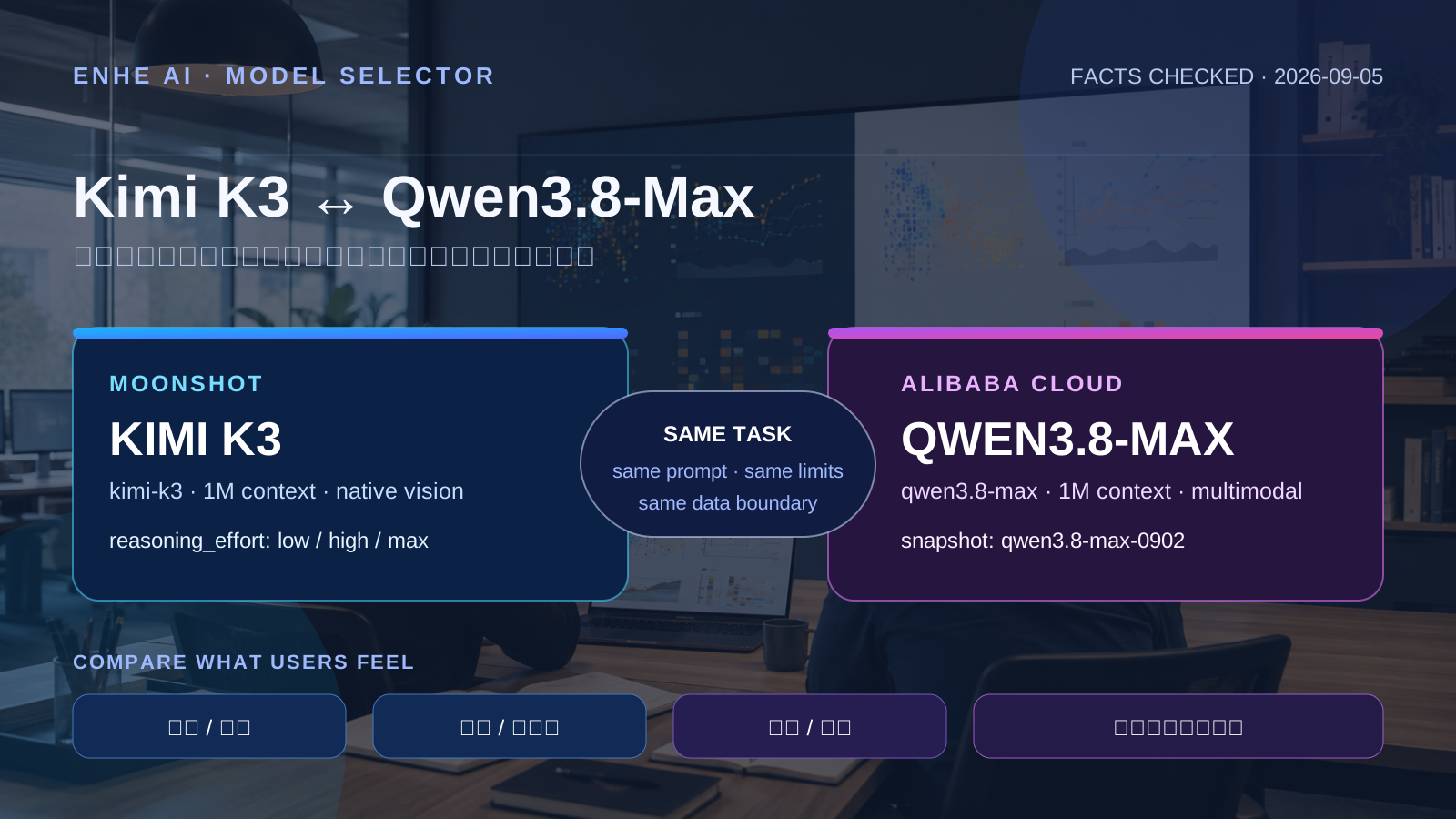
How to Choose Kimi K3 and Qwen3.8-Max: Version and Task Guide
#2AgentScope Java 2.0 brings enterprise AI agents closer to production deployment
#3Grok Launches Build Mode for Creating and Publishing Websites, Apps, and Games in Chat
#4GitHub Agent Finder Moves AI Tool Discovery Into Registries
#5What Is ChatGPT Work and How Is It Different From a Chatbot?
#6ChatGPT Business Standard vs Premium Seats: Choose by Usage, Price, and Admin Work
Keep useful AI updates close to your workflow without missing tool upgrades or new opportunities.
ENHE AI focuses on how news affects real workflows. A useful article explains what changed, why it matters, what users can do next, and which related software, tutorials, courses, or account guidance can help.
Classify the update as a trend, tool, policy, or tutorial signal, then move to AI trends, software apps, skill learning, or account-service guidance for the next action.
News pages should include clear titles, summaries, dates, source links, FAQ, related tools, and internal links. This helps both human readers and AI answer engines extract and cite the content.