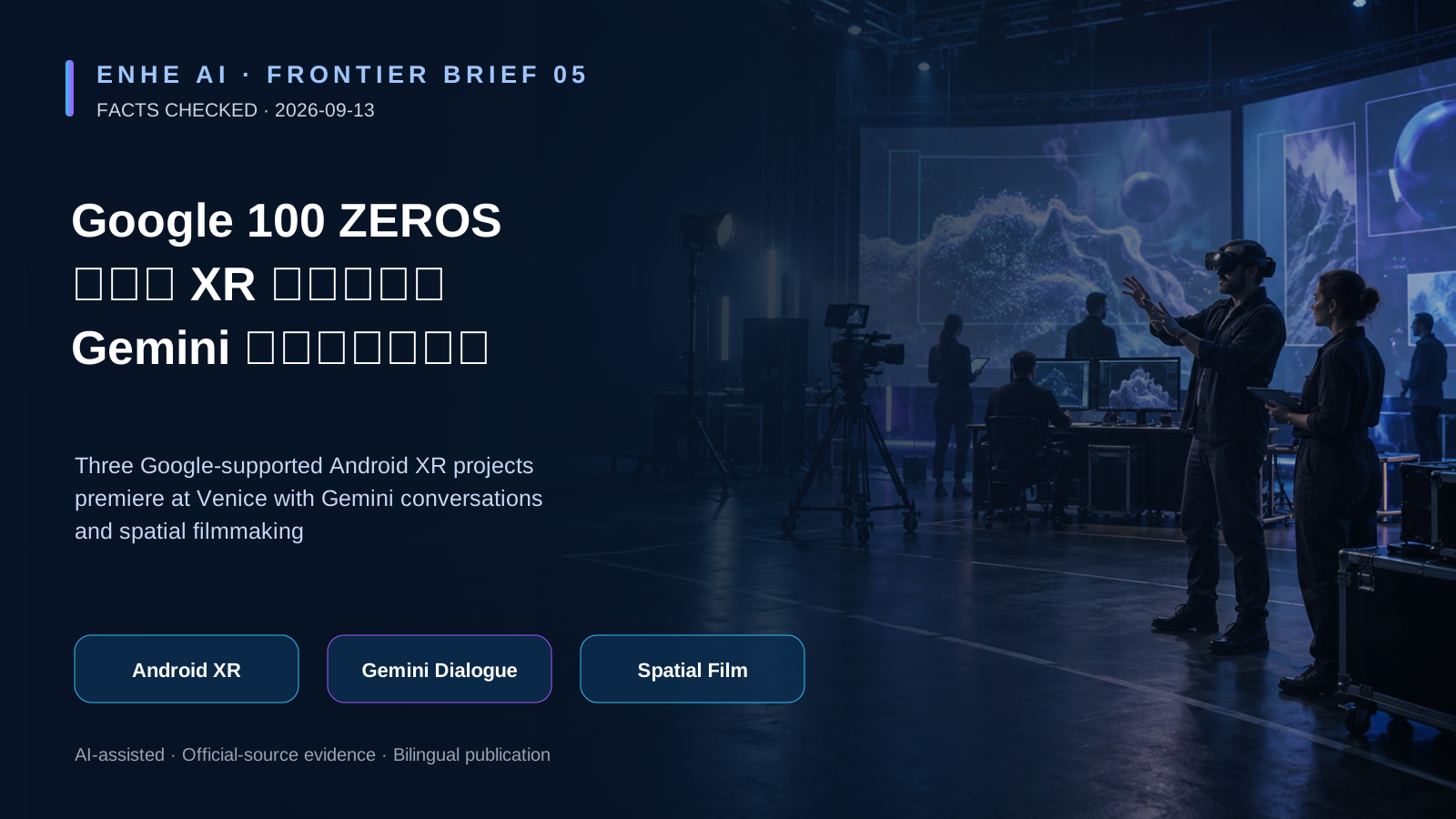
Three Google-supported Android XR projects premiere at Venice with Gemini conversations and spatial filmmaking
NEVATARS, Galápagos: The Last Eden, and Sedona combine conversational AI, stereoscopic depth, and 2D-to-3D spatialization.

Key takeaways
Google highlighted three projects supported by its 100 ZEROS filmmaking initiative on September 11. The projects premiered during the 83rd Venice International Film Festival and are designed for Android XR. NEVATARS, a mixed-reality animated short directed by Andy Serkis, includes Gemini-powered conversations and interactive moments. Galápagos: The Last Eden is an immersive journey narrated by Margot Robbie that lets viewers interact with a Gemini-powered digital Charles Darwin. Sedona, a psychological-thriller teaser from Asylm Studios, uses Google's 2D-to-3D XR auto-spatialization technology for a YouTube experience. Google says the broader lineup uses conversational AI powered by Gemini and Vertex AI, spatial film, and stereoscopic depth while keeping human creativity at the center. The announcement presents creative experiments rather than evidence that AI tools replace writers, directors, performers, or audience testing.
Direct answer
Google highlighted three projects supported by its 100 ZEROS filmmaking initiative on September 11. The projects premiered during the 83rd Venice International Film Festival and are designed for Android XR. NEVATARS, a mixed-reality animated short directed by Andy Serkis, includes Gemini-powered conversations and interactive moments. Galápagos: The Last Eden is an immersive journey narrated by Margot Robbie that lets viewers interact with a Gemini-powered digital Charles Darwin. Sedona, a psychological-thriller teaser from Asylm Studios, uses Google's 2D-to-3D XR auto-spatialization technology for a YouTube experience. Google says the broader lineup uses conversational AI powered by Gemini and Vertex AI, spatial film, and stereoscopic depth while keeping human creativity at the center. The announcement presents creative experiments rather than evidence that AI tools replace writers, directors, performers, or audience testing.
Verified facts
Google's 100 ZEROS team supported three projects premiering during the 83rd Venice International Film Festival, all intended for Android XR and using tools such as Gemini, Vertex AI, spatial film, or stereoscopic depth.
NEVATARS is a mixed-reality animated short directed by Andy Serkis with Gemini-powered conversations and interactions; Galápagos lets viewers interact with a digital Charles Darwin.
Sedona is a psychological-thriller teaser by Asylm Studios that uses Google's 2D-to-3D XR auto-spatialization technology for a YouTube experience.
What changed
- Conversational AI moves from a backstage tool into characters that audiences can directly engage
- Spatial film and stereoscopic depth become part of narrative design
- Existing 2D material can enter XR presentation through auto-spatialization
- The showcase keeps creative judgment and human agency at the center
Impact for AI users
For film, exhibition, and branded-experience teams, the projects demonstrate three distinct XR entry points: interactive characters, immersive nature storytelling, and spatialized versions of existing 2D content. Real production cost also includes device coverage, comfort and accessibility testing, performer and asset rights, conversational safety boundaries, and a fallback for live presentation. A festival premiere shows that a concept can be exhibited; it does not establish readiness for every audience, headset, or distribution channel.
Operating checklist
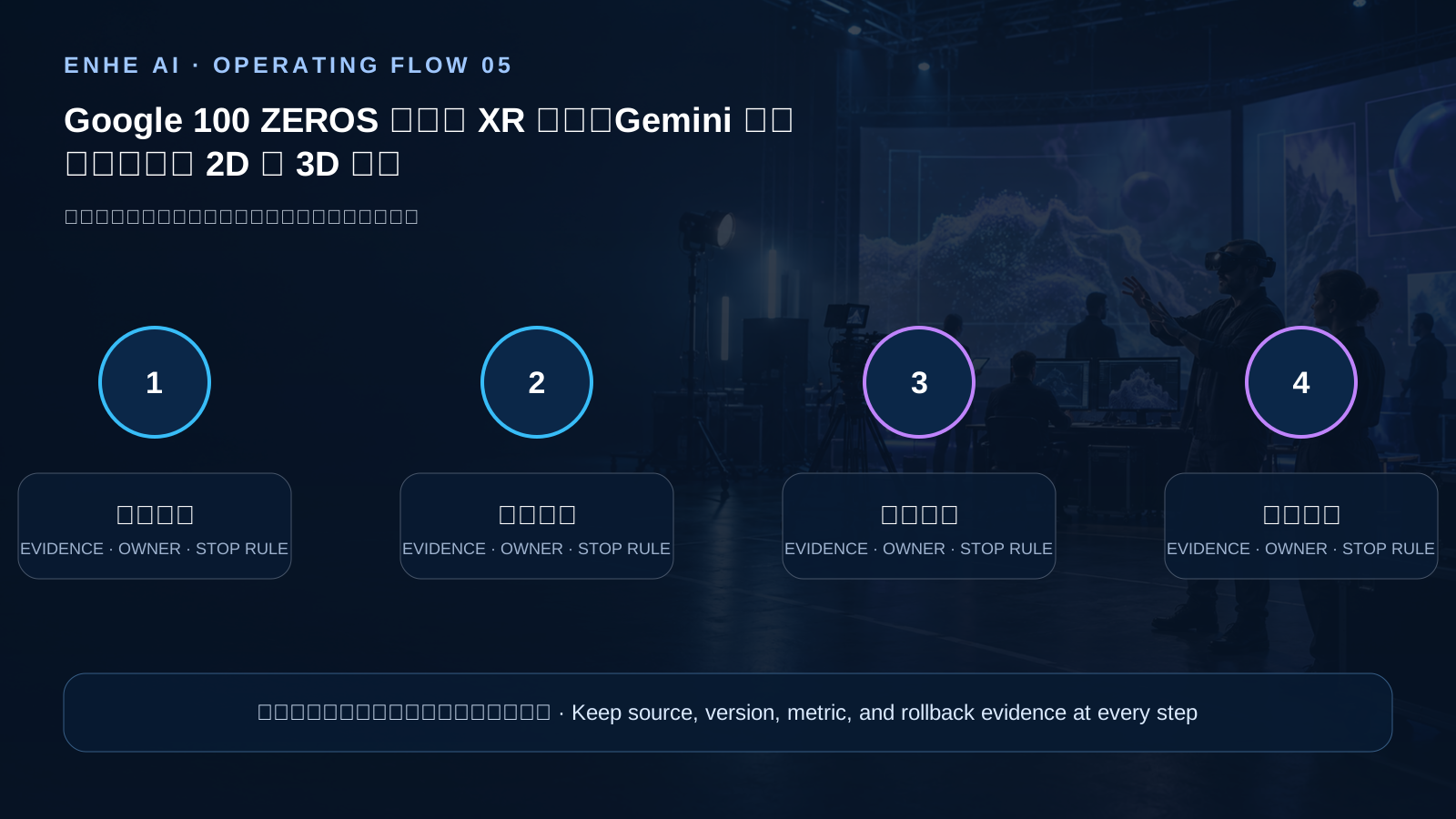
- Define the experience's narrative purpose first, then choose live conversation, native spatial capture, or 2D auto-spatialization without letting the tool rewrite the goal.
- Version the character brief, allowed topics, refusals, session limit, and human stop conditions, preserving representative test conversations.
- Test frame rate, depth, comfort, captions, audio description, and seated alternatives on the target Android XR devices.
- Document rights for performers, voices, footage, training or reference assets, and distribution channels, and prepare a non-XR fallback.
AI frontier news and analysis, AI software and model tools, AI skill tutorials and validation methods, and AI account and permission guidance
FAQ
Do all three projects use the same AI technique?
No. NEVATARS and Galápagos emphasize Gemini-powered interactions, while Sedona centers on 2D-to-3D XR auto-spatialization.
Which device platform are the projects intended for?
Google says all three are meant to be experienced on Android XR; specific device and public-access conditions should be checked separately.
Does Google claim AI replaced the filmmakers?
No. The announcement explicitly describes expanding the storytelling canvas while keeping human creativity at the center.
Summary
The three Venice XR premieres show AI serving different roles in character interaction, spatial production, and format conversion. A strong work still depends on narrative purpose, a clear rights chain, audience experience, and creator judgment.
This AI-assisted article is checked by ENHE AI automation for official sources, bilingual fields, media rights, page safety, and historical duplication before publication.
What this means for everyday users
For film, exhibition, and branded-experience teams, the projects demonstrate three distinct XR entry points: interactive characters, immersive nature storytelling, and spatialized versions of existing 2D content. Real production cost also includes device coverage, comfort and accessibility testing, performer and asset rights, conversational safety boundaries, and a fallback for live presentation. A festival premiere shows that a concept can be exhibited; it does not establish readiness for every audience, headset, or distribution channel.
Tools you may use


Related tutorials
[[zh]][[/zh]][[en]]Review a public website[[/en]]
SearchScope SEO/GEO
[[zh]][[/zh]][[en]]Access and usage guide[[/en]]
AI Prompt Management System | 418 Bilingual Prompts for Writing, SEO and AI Creation
High-Frequency AI Prompts for Work, Learning, and Teaching guide
High-Frequency AI Prompts for Work, Learning, and Teaching
Related Tools And Tutorials
Use the following ENHE AI sections to continue from the news signal into tool selection, account-service guidance, or practical learning.
Related reading
Gemini Launches a Small-Business Hub for Brand Assets, Connected Apps, and Finance
Google has introduced a dedicated business landing page in the Gemini app for small-business tasks such as brand building, marketing, finance analysis, and customer insights. The announcement also lists connections to Google Business Profile, Ads, Workspace, and third-party apps including Canva, Shopify, Xero, and others. This article explains the global rollout wording and offers a practical two-part workflow: prepare a brand brief for a weekend promotion, then turn verified expense data into a reviewable chart. It emphasizes minimal app connections, source checking, and human approval before publication or financial use. The release can reduce context switching, but it does not mean every account receives the hub immediately or that generated claims, graphics, and numbers are ready to use without review.
Gemini Personal Intelligence Reaches Cars: Android Auto Access and Privacy Controls
Google has announced Personal Intelligence for Gemini in cars, adding an optional way to use information from connected Google apps while driving. The rollout covers eligible personal accounts rather than Workspace business, enterprise, or education accounts, and several regions are excluded. This article explains the October 20 announcement, the opt-in privacy control, and the difference between Android Auto timing and cars with Google built-in. It also provides a low-risk flight-gate example with a clear verification step. The goal is to help drivers decide whether the feature is available and useful without treating a spoken answer as the final source for travel changes, appointments, payments, or other consequential decisions.
Gemini Skills Begin Rolling Out as Workspace Skills Are Delayed
Google’s latest rollout update separates two things that are easy to confuse: skills in the Gemini app and skills inside Workspace. The app rollout begins gradually and is expected to finish by mid-November, while the Workspace launch is delayed pending a revised timeline. For creators, the practical opportunity is to prepare a reusable writing routine rather than assume a scheduled publishing system is already available. This article provides a bounded article-rewrite example, explains where the documented Skills entry point lives, and distinguishes reusable instructions from background scheduling. It also flags account requirements and features still promised for later. The example is a preparation checklist, not a claim of hands-on access or automatic publication.
Gemini 4 Argon Is Now Available: Where Users and Developers Can Access It
Google announced Gemini 4 Argon availability on October 13, 2026. Google AI Pro and Ultra subscribers can use it in the Gemini app, including a task mode for longer work, while developers can access the model through the paid Gemini API tier, Google AI Studio, and Android Studio. Google AI Ultra subscribers can also try it in the Antigravity agent-first development environment. The rollout spans consumer, coding, and API surfaces, but the access terms are not identical. This article separates current availability from product claims and gives users a practical test: choose one bounded task, record the entry point and model, review connected apps, require confirmation for external actions, inspect sources and outputs, and keep a manual fallback for failures.
Google Cloud Introduces the Gemini Agent for Work
Google Cloud introduced the Gemini agent at Gemini at Work on October 8, 2026. Google describes it as a universal work agent that can use an organization's business context, plan work, call skills and tools, connect to business systems, and return completed results inside documents, inboxes, and developer environments. The announcement also highlights model selection, cost controls, security, administration, and governance. Those claims define a product direction, not automatic permission to connect every data source. Before rollout, start with one bounded workflow, list the records and tools the agent can reach, separate read from write access, cap spend, require confirmation before messages or irreversible changes, verify the destination of generated work, and keep a human owner for exceptions and acceptance.
Google's Gemini RLFT guide puts reward design at the center of quality control
Google Cloud published a practical guide to Gemini reinforcement-learning fine-tuning on September 25. Its managed RLFT service lets teams provide prompts and a reward function while the platform handles training infrastructure and proprietary model internals. Google says the method fits tasks that are difficult to demonstrate but easy to score, and only when the base model already succeeds some of the time. Prompting and supervised fine-tuning should be exhausted first. The reward function is the main control surface, so teams need offline tests for malformed outputs, length bias, reward hacking, and train-evaluation leakage, then should stop at validation saturation rather than automatically choosing the last checkpoint.