
Codex Provider Switcher: AI Coding Tools Enter the Multi-Provider Workflow Era
A Windows desktop utility from ENHE AI shows why Codex users need clearer switching between official ChatGPT account mode and third-party OpenAI-compatible gateways.

Key takeaways
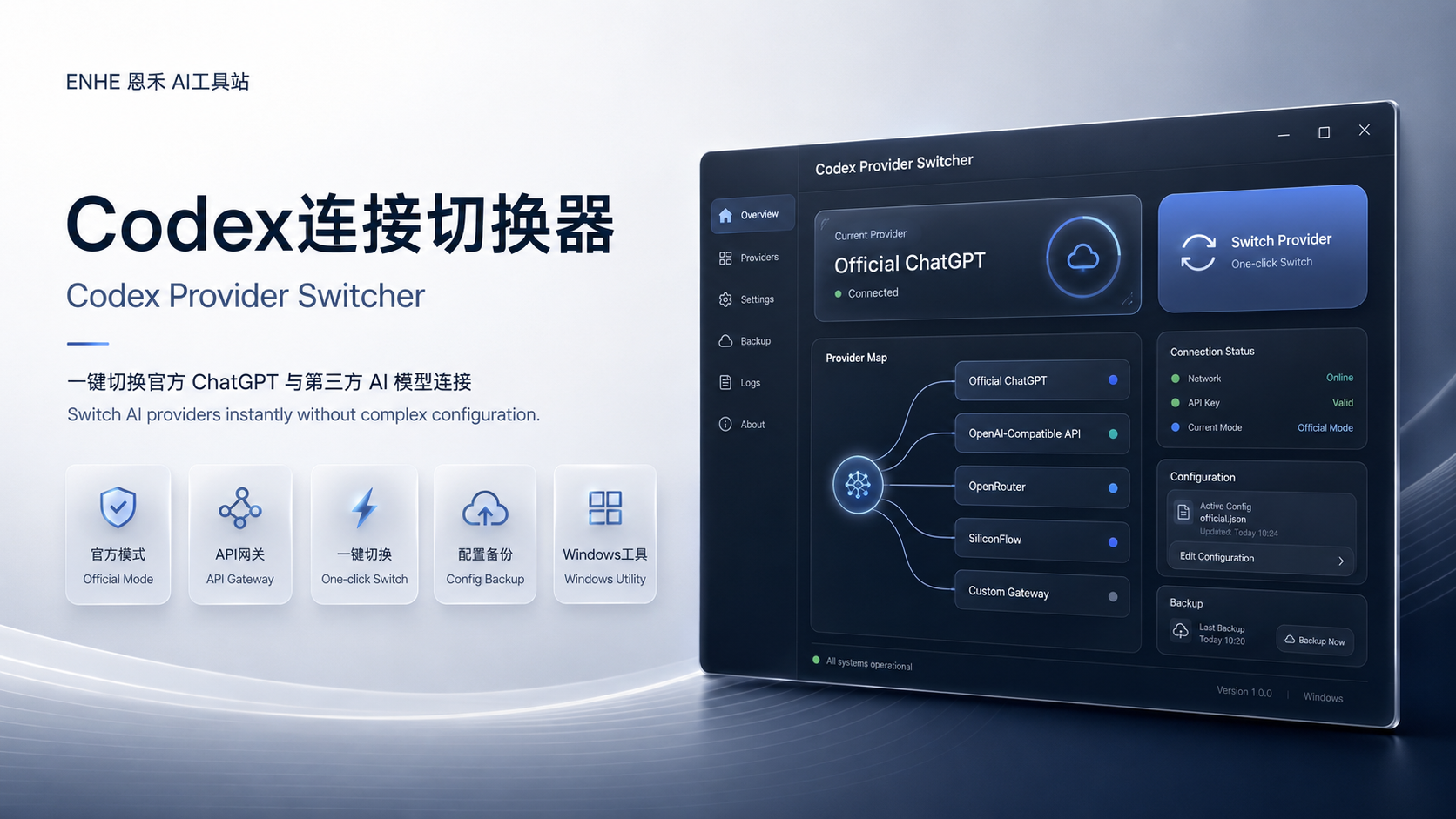
Codex Provider Switcher is an open-source Windows app developed by ENHE AI for switching Codex between official ChatGPT account mode and third-party OpenAI-compatible gateways such as CCswitch / Freemodel, OpenRouter, SiliconFlow, and custom providers.
Codex Provider Switcher addresses a practical problem for Codex users: switching between official ChatGPT account quota and third-party API-key gateways often requires editing config.toml, managing environment variables, and checking the current authentication mode.
The project turns those steps into a Windows desktop workflow. Users can check connection status, switch back to official ChatGPT mode, choose a third-party gateway, or add a new provider from templates. API keys are stored in the current Windows user environment variable instead of being written into the GitHub repository.
This reflects a broader AI coding trend. As Codex, OpenAI-compatible gateways, OpenRouter, SiliconFlow, and private endpoints become part of everyday workflows, provider management becomes part of the user experience. The product should be understood as a configuration helper, not as a guarantee that any third-party gateway will be stable or suitable for every user.
What this means for everyday users
For ENHE readers, the article connects a concrete open-source utility with the larger shift toward multi-provider AI coding workflows, helping users understand account mode, third-party gateways, API keys, model names, and local Codex configuration.
Tools you may use


Related tutorials
[[zh]][[/zh]][[en]]Review a public website[[/en]]
SearchScope SEO/GEO
[[zh]][[/zh]][[en]]Access and usage guide[[/en]]
AI Prompt Management System | 418 Bilingual Prompts for Writing, SEO and AI Creation
High-Frequency AI Prompts for Work, Learning, and Teaching guide
High-Frequency AI Prompts for Work, Learning, and Teaching
Related Tools And Tutorials
Use the following ENHE AI sections to continue from the news signal into tool selection, account-service guidance, or practical learning.
Related reading
GitHub Copilot Metrics Add OpenCode and Other Clients: Requests Are Not Prompts
GitHub added totals_by_client to the Copilot usage metrics API on October 23, 2026. Enterprise and organization reports can now show model traffic from OpenCode, Claude Code, Codex, Zed, Copilot CLI, GitHub apps, cloud agents, code review, VS Code, JetBrains, and other clients. This article helps administrators build reliable one-day and 28-day reports without confusing model calls with user prompts. It explains request, session, token, model, and selection-mode fields; separates client traffic from agent-app jobs; and adds checks for unknown identifiers, empty arrays, permissions, and coverage. The result is a governance trend report, not an exact invoice or individual productivity score.
GitHub Copilot Sessions Can Move to VS Code With Context, Diffs, and Worktree Intact
GitHub has documented a handoff from a Copilot app session to Visual Studio Code. The workflow keeps the session context, changed-file diff, and the same isolated worktree, so a developer does not need to rebuild the task history in a new chat. This article explains the prerequisites and provides a practical review sequence: open the session, inspect the diff, edit locally, run the relevant tests, and decide separately whether to push. The feature is useful when agent work needs human judgment or local tooling, but continuity is not proof that the generated changes are correct. Repository permission, the same GitHub account in both applications, and an existing session with changes are still required.
GitHub in Slack and Teams Adds Multi-Repository Work in One Conversation
GitHub’s Slack and Teams integration can now work across multiple repositories within a single conversation. That is useful when a reported problem spans a frontend and backend, but it is a different event from the original launch of the chat integrations. This article explains the change and provides a scoped investigation request that a non-programmer project owner can give a technical collaborator. It describes what evidence to request before moving from analysis to code changes and how to distinguish an issue, a proposed pull request, a merge, and a deployment. No account-level availability test or automatic resolution is claimed, and the announcement is not treated as permission to change every repository.
Replit Free Mode Uses GPT-5.6 Luna, but Free Planning Is Not Free Building
OpenAI announced on August 19, 2026 that GPT-5.6 Luna powers Replit Free Mode. The mode lets users plan, ideate, request feedback, and analyze a project without consuming usage in that mode. Replit can route work that needs stronger reasoning to GPT-5.6 Sol, then return to Luna-powered Free Mode while preserving project context. The announcement does not establish that Build Mode, deployment, databases, or third-party services are all free. Users should first define the smallest useful product and measurable acceptance criteria, then check the live Replit interface for mode, allowance, deployment, and external-service costs before authorizing code changes or publishing an application.
How to Verify AI Productivity Case Studies Before Using Their Numbers in Your ROI
Recent OpenAI case studies report that Asana used Codex to remove Enzyme in about two weeks with roughly $12,000 in model and infrastructure cost, while NVIDIA participants describe a ChatGPT Work process saving about 16 hours per week and another workflow turning 25 to 40 external updates into 5 to 8 actionable signals. These are observed results from specific organizations, people, tasks, and vendor-published case studies. They are not transferable ROI guarantees. A team should reconstruct the original baseline, define one reversible task, record human review and rework, include model and infrastructure cost, and compare accepted outcomes against the same non-AI or historical standard before expanding deployment.
OpenAI Launches Three Education Plugins: Review Apps, Skills, and Action Permissions First
OpenAI announced three education plugins on August 4, 2026 for K-12 educators, college educators, and college students. They are available through ChatGPT Edu and ChatGPT for Teachers district deployments. OpenAI defines a plugin as a package of apps, role-specific skills, instructions, and common workflows that can connect to course materials, documents, calendars, and other approved tools. Installation is not the end of a security review. Administrators should verify eligible roles, connected applications, data access, write actions, output review, logs, and revocation before launch. Teachers and students should first test lesson planning, study planning, or material creation with non-sensitive copies and keep humans responsible for accuracy, citations, privacy, and educational decisions.
Summary
Codex Provider Switcher matters because it makes provider switching easier to understand and recover from, which is becoming increasingly important as AI coding tools move beyond single-provider setups.
Sources
FAQ
What is this ENHE AI article about?
Codex Provider Switcher is an open-source Windows app developed by ENHE AI for switching Codex between official ChatGPT account mode and third-party OpenAI-compatible gateways such as CCswitch / Freemodel, OpenRouter, SiliconFlow, and custom providers.
Why is this AI update worth watching?
Codex Provider Switcher is an open-source Windows utility by ENHE AI. It separates official ChatGPT account mode from third-party API-key mode. Built-in templates cover CCswitch / Freemodel, OpenRouter, SiliconFlow, and custom gateways. API keys are saved to the local Windows user environment variable, not the repository. Backups help reduce the recovery cost of editing Codex config.toml manually.
What does it mean for everyday AI users?
For ENHE readers, the article connects a concrete open-source utility with the larger shift toward multi-provider AI coding workflows, helping users understand account mode, third-party gateways, API keys, model names, and local Codex configuration.
Where can readers continue learning on ENHE AI?
Readers can continue with ENHE AI software apps, AI skill tutorials, and AI account service guidance to turn the news signal into practical action.
Table of contents
Codex Provider Switcher: AI Coding Tools Enter the Multi-Provider Workflow Era