
Codex Cloud adds reusable team environments and cross-device task continuity
OpenAI adds cloud coding tasks, reusable environments, shared access, and admin-controlled connections for business workspaces.

Key takeaways
OpenAI's September 29 Business, Enterprise, and Edu release notes describe Codex Cloud environments that package a project's repositories, tools, and dependencies for reuse. Members can start or continue coding tasks from desktop, web, or mobile, each task receives an isolated workspace, and work can continue while the local computer sleeps. Enterprise administrators can authorize environment sharing and configure approved tool connections and recurring-task connections for teams. The convenience changes the operating boundary: organizations should define which repositories, branches, secrets, network destinations, and publishing actions are allowed in cloud environments, then retain audit evidence for each task, environment version, permission grant, and external write before broad rollout.
Direct answer
OpenAI's September 29 Business, Enterprise, and Edu release notes describe Codex Cloud environments that package a project's repositories, tools, and dependencies for reuse. Members can start or continue coding tasks from desktop, web, or mobile, each task receives an isolated workspace, and work can continue while the local computer sleeps. Enterprise administrators can authorize environment sharing and configure approved tool connections and recurring-task connections for teams. The convenience changes the operating boundary: organizations should define which repositories, branches, secrets, network destinations, and publishing actions are allowed in cloud environments, then retain audit evidence for each task, environment version, permission grant, and external write before broad rollout.
Verified facts
OpenAI added Codex Cloud to Business, Enterprise, and Edu release notes on September 29, 2026.
Reusable environments package repositories, tools, and dependencies while each task runs in an isolated workspace across devices.
Enterprise administrators can control environment sharing and approved team connections for tools and recurring tasks.
What changed
- Project environments are reusable in the cloud
- Tasks can continue across devices
- Each task gets an isolated workspace
- Admins control sharing and connections
Impact for AI users
Start with a read-only or low-privilege pilot environment that pins repository state, dependencies, and allowed network destinations. Inject secrets per task from controlled storage and keep them out of images, logs, and prompts. Gate commits, pushes, deployments, and external messages separately, recording who started each task, which environment ran, and every external write. Expand only after isolation, revocation, cost limits, and failure recovery are proven.
Operating checklist
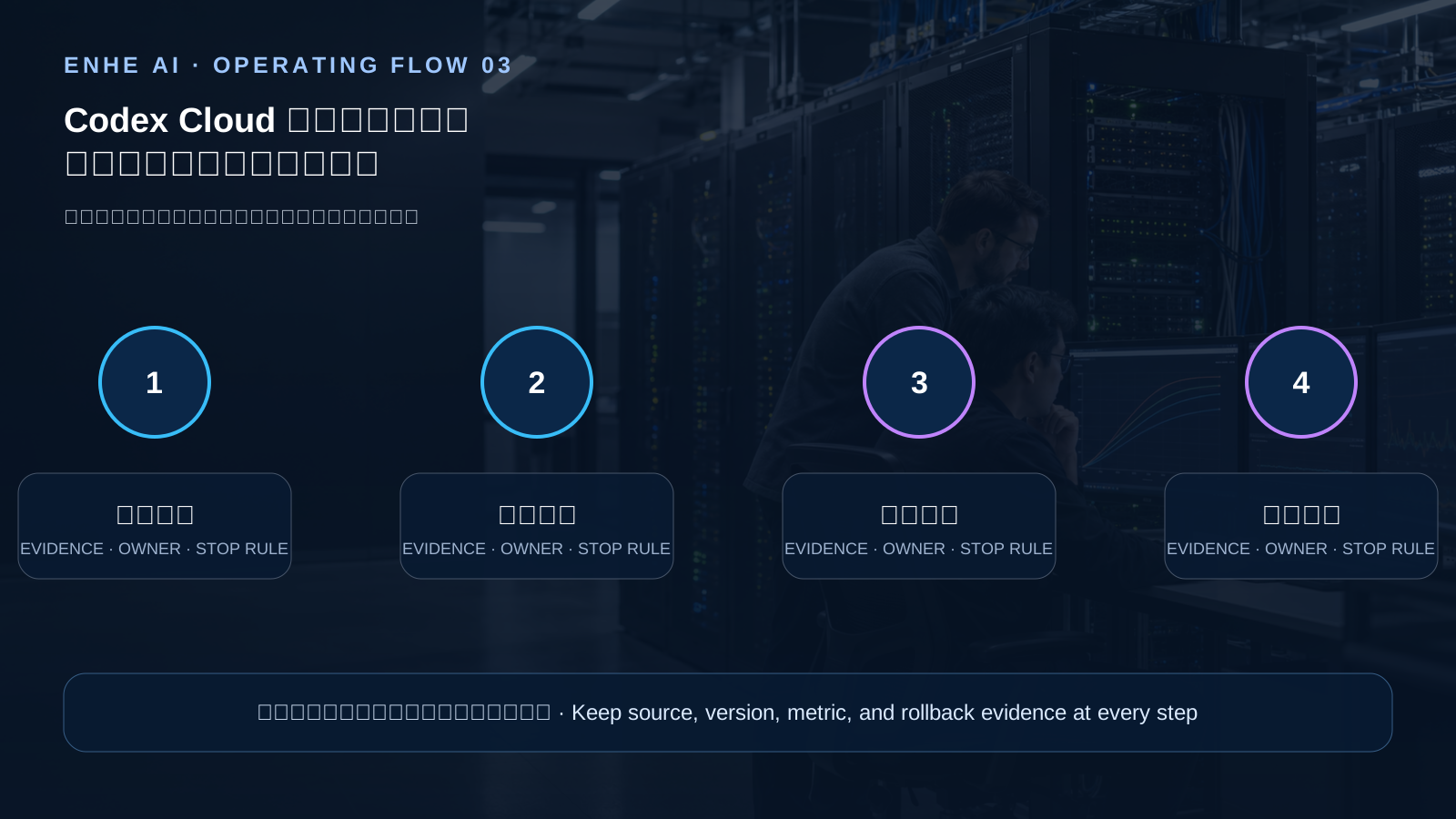
- Create a low-privilege pilot
- Pin repository, dependencies, and network boundaries
- Gate commits, pushes, and deploys separately
- Verify revocation, audit, and cost limits
AI frontier news and analysis, AI software and model tools, AI skill tutorials and validation methods, and AI account and permission guidance
FAQ
Does Codex Cloud automatically receive access to every repository?
No. Repository and tool access remains governed by workspace settings, connections, and member permissions.
Does continued cloud execution authorize automatic deployment?
No. Deployment and other external writes should remain separate permission and acceptance gates.
Summary
Reusable cloud environments reduce local setup friction, but permissions, secrets, and external writes need rules before environment sharing begins.
This AI-assisted article is checked by ENHE AI automation for official sources, bilingual fields, media rights, page safety, and historical duplication before publication.
What this means for everyday users
Start with a read-only or low-privilege pilot environment that pins repository state, dependencies, and allowed network destinations. Inject secrets per task from controlled storage and keep them out of images, logs, and prompts. Gate commits, pushes, deployments, and external messages separately, recording who started each task, which environment ran, and every external write. Expand only after isolation, revocation, cost limits, and failure recovery are proven.
Tools you may use

Related tutorials
Related Tools And Tutorials
Use the following ENHE AI sections to continue from the news signal into tool selection, account-service guidance, or practical learning.
Related reading
Eleven Realtime v1 Mini and Max Launch: Choosing a Voice-Agent Path
ElevenLabs launched Eleven Realtime v1 Mini and v1 Max on October 20, 2026. Both speech-to-speech models support more than 90 languages and over 17,000 voices, but they target different tasks: Mini emphasizes lower-cost natural conversations, while Max is designed for support, lead qualification, and multi-step work. This article offers a selection and migration checklist instead of repeating benchmark claims. It explains how to compare both models on the same script, what OpenAI Realtime API compatibility means, why WebRTC integrations must move to WebSocket, and when ElevenAgents is the better starting point for channels, knowledge bases, guardrails, testing, and monitoring.
ChatGPT Slides Launches With Space Collaboration and PowerPoint Export
OpenAI added ChatGPT Slides on October 16, 2026, giving eligible Pro, Business, and Enterprise users with Space access a shared place to create and refine presentations. A deck can start from a conversation, uploaded files, an outline, or an example presentation that guides the visual direction. Users can edit text, images, shapes, and charts, invite teammates to work in real time, and leave shared comments. Finished work can be presented inside ChatGPT or exported on the web to PowerPoint, PDF, or Google Slides. This guide explains availability, a practical first-deck workflow, and the checks people should complete before sharing AI-assisted slides.
OpenAI Updates Content Provenance: Extending the Work to EU Text
OpenAI's October 5 announcement sets out a phased approach to text watermarking, including API opt-in and a regional product rollout. The details are public and should be read alongside its broader media-provenance guidance. For publishers, the practical task is to distinguish which checks apply to text, images, and audio, and to keep evidence of how content was created and reviewed. A useful editorial record separates product coverage, source checks, permission to use materials, and AI disclosure. This article explains those distinctions and proposes a review workflow. A provenance signal is supporting evidence, not a substitute for factual verification or a conclusion about an author's identity or ownership.
GPT-6.1 Sol brings near-Astra capability to a lower-cost production tier
OpenAI made GPT-6.1 Sol available on September 29 as a lower-cost model for complex coding, computer use, and professional work with performance positioned near GPT-6 Astra. The official model page lists a 1.05-million-token context window, a 128,000-token output limit, five supported reasoning-effort levels, and Responses API tool calling. Standard API pricing is listed at $2 per million input tokens and $10 per million output tokens. A same-day safety addendum classifies cybersecurity capability as Critical and biological and chemical capability as High, with the Astra safeguard stack applied. Teams should route real tasks through a controlled comparison of quality, latency, total token use, tool success, refusals, and data-residency requirements before changing a production default.
GPT-6 Sol and Luna split complex work from high-volume tasks
OpenAI released GPT-6 Sol and GPT-6 Luna in the API on September 22. Both reasoning models accept text and image input and return text through the Responses and Chat Completions APIs. OpenAI positions Sol for complex coding and agentic workflows and Luna for focused, high-volume work. For standard processing with prompts up to 272K input tokens, listed prices per million tokens are $2 input and $10 output for Sol, and $0.10 input and $0.50 output for Luna, with separate cached-input rates. Longer prompts and other processing tiers can differ. Teams should route by task difficulty, failure cost, latency target, and quality evidence rather than choosing one model solely from the headline token price.
OpenAI research finds some cross-occupation AI tasks becoming recurring workflows
OpenAI published new Work at the Frontier research on September 16 using aggregated analysis of more than 1.5 million work-related ChatGPT messages from April through July 2026. Among roughly 6,200 consistently observed workers, previously used cross-occupation tasks rose from 13.1% to 25.9% of occupation-specific AI activity. In a matched one-month follow-up, 23.6% returned to a cross-occupation task used in the prior month versus 8.4% among comparable workers without observed prior use. The pattern suggests some experiments become routine, but it does not by itself prove causality or predict job replacement. Organizations still need workflow-level quality, rework, risk, and ownership evidence.