
How to Use an AI Coding Assistant for Multi-Branch Tasks: A Six-Step Safety Workflow
Start with a sandbox repository, split tasks, check permissions, and keep human review before merging.

Key takeaways
GitHub Desktop 3.6 brings worktrees and Copilot closer to everyday Git workflows. Beginners who want to test AI coding assistants safely should not start in production repositories. This tutorial gives a six-step process: use a sandbox repository, split tasks, create branches or worktrees, ask AI for explanations and commit drafts, review conflict suggestions, and run tests before merging. The goal is to make AI assistance reviewable and reversible before it touches important code or team repositories. It is designed for learners and small teams that need a practical checklist for permissions, diffs, tests, and human confirmation before wider adoption decisions.
How to Use an AI Coding Assistant for Multi-Branch Tasks: A Six-Step Safety Workflow
Published: June 26, 2026
Table of contents - Fact sources - Steps - Risks - Why it matters - FAQ - Source links
Fact sources GitHub Desktop 3.6 was announced on June 26, 2026 with worktrees and deeper Copilot integration. Git documentation explains that worktrees let one repository have multiple attached working trees, which can separate branches and tasks.
This tutorial is not about bypassing permissions or automatically shipping production code. It gives ordinary users a safer trial path. ENHE AI readers can continue with AI skill learning.
Steps 1. Prepare a sandbox repository instead of a production project. 2. Split work into mainline development, experiments, urgent fixes, or review tasks. 3. Create a branch or worktree for each task and confirm which directory you are editing. 4. Ask the AI assistant to explain changes and draft commit messages, but do not accept everything automatically. 5. During merge conflicts, ask AI for explanations and options, then inspect the result line by line. 6. Run tests, review the diff, and manually confirm before merging.
If you are still choosing tools, compare entry points through AI software apps.
Risks The main risks are misunderstanding the active branch, generating plausible but wrong logic, and overwriting important code during conflict resolution. Worktrees isolate task directories, but they do not prove AI suggestions are correct.
For private repositories, team organizations, or paid subscriptions, users should check account permissions, audit logs, and member rules. Related decisions belong with AI account services.
Why it matters AI coding assistants are moving from writing snippets to helping complete Git tasks. GitHub Desktop 3.6 shows that daily development tools will place AI around commits, branches, conflicts, and context management.
Beginners should build a repeatable workflow instead of asking AI ad hoc each time. Follow AI news to understand which platform changes affect daily use.
FAQ ### Can beginners let AI solve merge conflicts directly? No. AI can explain conflicts and suggest options, but users should review the final code line by line.
Is worktree required? No. Simple projects can start with ordinary branches. Worktrees are useful when parallel tasks increase.
Why use a sandbox repository? A sandbox lets users learn AI suggestions, Git state, and rollback behavior without risking important code.
Source links - [GitHub Changelog: GitHub Desktop 3.6](https://github.blog/changelog/2026-06-26-github-desktop-3-6-worktrees-and-deeper-copilot-integration/) - [Git worktree documentation](https://git-scm.com/docs/git-worktree) - [GitHub Docs: GitHub Desktop](https://docs.github.com/en/desktop) - [GitHub Copilot documentation](https://docs.github.com/en/copilot)
What this means for everyday users
This workflow helps ordinary users place AI coding assistants inside controlled boundaries instead of turning speed into code and account risk.
Tools you may use


Related tutorials
[[zh]][[/zh]][[en]]Review a public website[[/en]]
SearchScope SEO/GEO
[[zh]][[/zh]][[en]]Access and usage guide[[/en]]
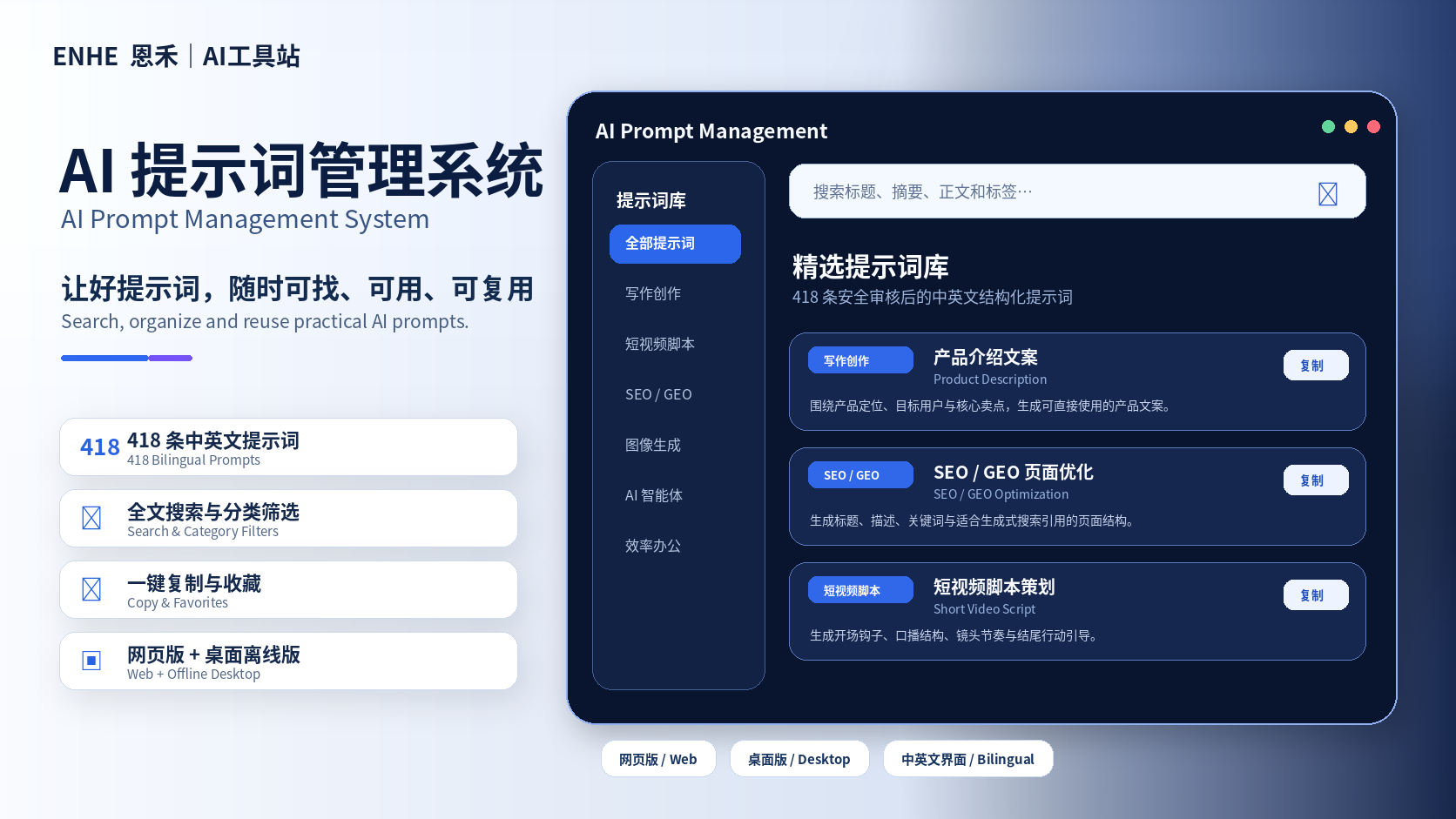
AI Prompt Management System | 418 Bilingual Prompts for Writing, SEO and AI Creation
High-Frequency AI Prompts for Work, Learning, and Teaching guide
High-Frequency AI Prompts for Work, Learning, and Teaching
Related Tools And Tutorials
Use the following ENHE AI sections to continue from the news signal into tool selection, account-service guidance, or practical learning.
Related reading
GitHub Copilot Metrics Add OpenCode and Other Clients: Requests Are Not Prompts
GitHub added totals_by_client to the Copilot usage metrics API on October 23, 2026. Enterprise and organization reports can now show model traffic from OpenCode, Claude Code, Codex, Zed, Copilot CLI, GitHub apps, cloud agents, code review, VS Code, JetBrains, and other clients. This article helps administrators build reliable one-day and 28-day reports without confusing model calls with user prompts. It explains request, session, token, model, and selection-mode fields; separates client traffic from agent-app jobs; and adds checks for unknown identifiers, empty arrays, permissions, and coverage. The result is a governance trend report, not an exact invoice or individual productivity score.
GitHub Copilot in Teams Turns Notifications Into Pull Requests: What to Check Before Review
GitHub updated its Microsoft Teams app on October 23, 2026, so an issue notification in a channel, group chat, or private chat can become a Copilot task that investigates the problem, proposes a fix, and opens a pull request. This article helps development and product teams adopt the workflow without mistaking an automated pull request for shipped code. It explains the consolidated app, repository connection, the November 16 retirement of the legacy GitHub app, and the review boundary. A practical acceptance checklist asks teams to reproduce the issue, inspect changed files, run targeted tests, verify permissions, and keep merge and deployment as explicit human decisions.
When Should an AI Agent Use a Local Small Model or the Cloud? A Hybrid Routing Checklist
AWS published an Adaptive Agentic Intelligence Framework guide using Strands Agents on October 21, 2026. The reference routes routine status checks and local vision work to small models through Ollama, while complex analysis goes to Amazon Bedrock. This durable guide helps teams decide when an AI agent should stay local and when it should use a cloud model. It classifies tasks, marks data that may leave the device, establishes local and cloud quality baselines, defines timeouts and fallbacks, applies one safety policy across both paths, and measures actual routing before estimating cost. The example can run on an 8 GB Raspberry Pi, but that hardware detail is not evidence that every workload belongs on a small local model.
GitHub Copilot Global Defaults Take Effect: Review Unconfigured Features Before October 26
GitHub began enforcing the global default policy for Copilot Business and Copilot Enterprise on October 22, 2026, with the gradual rollout continuing through October 26. Eligible generally available features that remain Unconfigured will receive the selected default: Enabled, Disabled, or Let organizations decide. This is a one-time change. Explicit feature choices are preserved, and preview features remain opt-in. This article gives administrators a practical review before the policy reaches their enterprise or organization. It separates unconfigured items from deliberate decisions, checks both Features and clients and MCP servers in Copilot, records exceptions, and defines a user-access verification. The goal is to prevent silent access changes caused by assuming that Unconfigured means disabled.
How to Validate Amazon Quick Before Health-Data Use: HIPAA Eligible Does Not Mean Automatically Compliant
AWS published an Amazon Quick deployment guide for HIPAA-regulated environments on October 22, 2026. Its central distinction is durable: HIPAA eligible means the service can be used to process protected health information under the right agreement and configuration; it does not make an entire environment automatically compliant. This guide is for healthcare organizations, business associates, and technical owners working with legal, compliance, and security reviewers. It turns the source into an acceptance checklist covering the business associate addendum, data classification, irreversible key and identity choices, ACL-aware knowledge bases, least-privilege and read-only connectors, masked audit logs, adversarial access tests, and staged expansion from non-PHI work. It is operational guidance, not individualized legal advice or a substitute for professional review.
GitHub Copilot Impact Dashboard Adds Industry Comparisons: How to Read the Median and Top Decile
GitHub added an Industry comparison section to the Copilot impact dashboard on October 22, 2026. Eligible enterprises and standalone organizations can opt in to compare agent-first or multi-agent adoption and pull-request merge-rate leverage with aggregated participating peers. When enough peers participate, scores are placed against a 28-day median and, as the group grows, a top-decile reference. This article explains how to decide whether to opt in and how to avoid overreading the result. It covers company-size and industry groups, fallback to broader peer groups when samples are small, regional separation for data-residency customers, daily refreshes, and 30-day deletion of aggregated benchmarks. The comparison is context for planning, not a complete industry census or employee ranking.
Summary
A safe AI coding workflow is not full automation. It is sandboxing, task isolation, permission checks, testing, and human review.