
ChatGPT, Gemini and Claude Account Services: A Safe Beginner's Guide
The right AI account depends on privacy, governance, workflow and team needs, not only model quality.

Key takeaways
This guide compares ChatGPT, Gemini and Claude account services through official privacy and enterprise governance materials. It explains how beginners should choose accounts for personal learning, teamwork and sensitive data workflows.
AI account services differ in model capability, ecosystem integration, privacy commitments, administrative controls and team collaboration features.
Personal accounts are usually enough for learning and light creative work. Team or enterprise accounts become more important when workflows involve members, files, internal systems or sensitive data.
Users should rely on official policy pages, avoid password sharing and keep human review in sensitive workflows.
What this means for everyday users
ENHE readers should separate personal learning, team collaboration and sensitive business workflows before choosing AI accounts.
Tools you may use

Related tutorials
[[zh]][[/zh]][[en]]Review a public website[[/en]]
SearchScope SEO/GEO
[[zh]][[/zh]][[en]]Access and usage guide[[/en]]
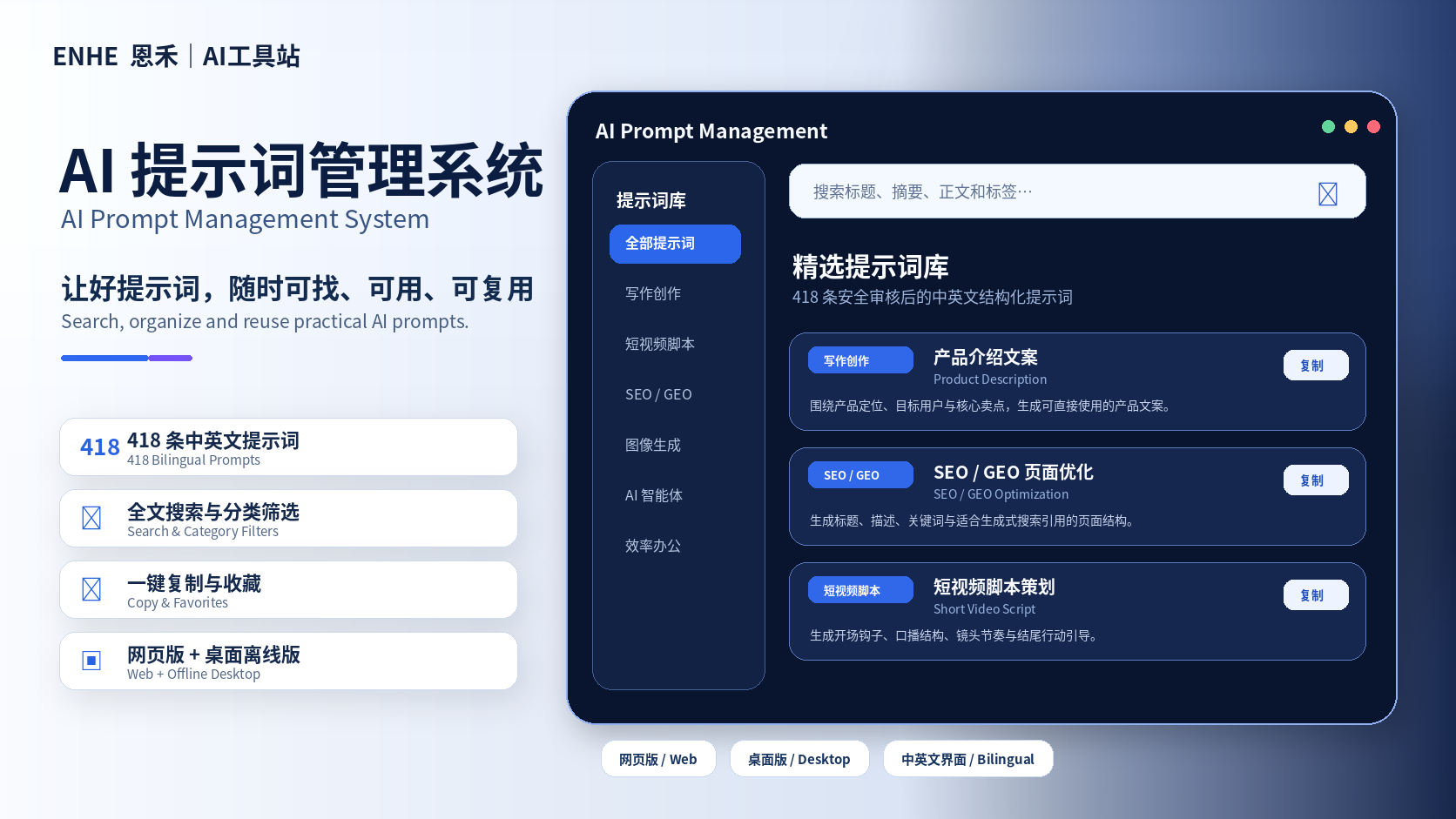
AI Prompt Management System | 418 Bilingual Prompts for Writing, SEO and AI Creation
High-Frequency AI Prompts for Work, Learning, and Teaching guide
High-Frequency AI Prompts for Work, Learning, and Teaching
Related Tools And Tutorials
Use the following ENHE AI sections to continue from the news signal into tool selection, account-service guidance, or practical learning.
Related reading
When Should an AI Agent Use a Local Small Model or the Cloud? A Hybrid Routing Checklist
AWS published an Adaptive Agentic Intelligence Framework guide using Strands Agents on October 21, 2026. The reference routes routine status checks and local vision work to small models through Ollama, while complex analysis goes to Amazon Bedrock. This durable guide helps teams decide when an AI agent should stay local and when it should use a cloud model. It classifies tasks, marks data that may leave the device, establishes local and cloud quality baselines, defines timeouts and fallbacks, applies one safety policy across both paths, and measures actual routing before estimating cost. The example can run on an 8 GB Raspberry Pi, but that hardware detail is not evidence that every workload belongs on a small local model.
How to Validate Amazon Quick Before Health-Data Use: HIPAA Eligible Does Not Mean Automatically Compliant
AWS published an Amazon Quick deployment guide for HIPAA-regulated environments on October 22, 2026. Its central distinction is durable: HIPAA eligible means the service can be used to process protected health information under the right agreement and configuration; it does not make an entire environment automatically compliant. This guide is for healthcare organizations, business associates, and technical owners working with legal, compliance, and security reviewers. It turns the source into an acceptance checklist covering the business associate addendum, data classification, irreversible key and identity choices, ACL-aware knowledge bases, least-privilege and read-only connectors, masked audit logs, adversarial access tests, and staged expansion from non-PHI work. It is operational guidance, not individualized legal advice or a substitute for professional review.
Notion AI Changes Credits and Bring-Your-Own AI: Audit Usage Before November 2
Notion announced updated AI credits and agent capabilities on October 19, 2026. The system is live for new customers, while existing customers move on November 2. Business and Enterprise seats receive monthly Standard and Select credits, personal workspaces can connect eligible ChatGPT subscriptions, and enterprise bring-your-own-model access remains a private alpha. This article turns the announcement into a practical pre-migration audit. It separates features that are available now from those that need an administrator or remain in testing, then gives users three representative tasks for measuring credit use, completion quality, and fallback behavior. Vendor performance and cost claims are clearly treated as claims, not independent ENHE AI test results.
How to Validate AI-Agent Runtime Safety: A Four-Layer OpenShell Evidence Checklist
NVIDIA launched the OpenShell Reference Architecture on October 21, 2026 for building, containing, observing, and enforcing safer agents across enterprise infrastructure and edge systems. This durable guide turns that architecture into a four-layer acceptance checklist rather than a product summary. For one low-risk agent task, teams verify build provenance, identity and tool boundaries, file and network isolation, observable action logs, policy denials, human approval, and rollback. Each layer requires evidence and a failure response. The goal is not to claim that one runtime makes an agent safe. It is to decide which actions can proceed automatically, which must stop for review, and how operators can reconstruct what happened after a failed or unexpected action.
How to Use GitHub Package Firewall: An npm Safety Checklist for Coding Agents
GitHub introduced Package Firewall in public preview on October 20, 2026 for GitHub Enterprise Cloud customers, including data-resident environments. The firewall sits between coding agents, CI runners, or internal registries and upstream package repositories. It evaluates package metadata and downloads against enterprise policies such as cooldown periods, GitHub Advisory Database checks, and supply-chain signals including attestation downgrades. The preview is free, but general availability is expected to use metered pricing similar to Actions, and npm is the only supported ecosystem today. This durable guide provides a rollout checklist for endpoint routing, a read-only build, blocked-package exceptions, audit evidence, false-positive review, and future budget preparation.
Gemini Launches a Small-Business Hub for Brand Assets, Connected Apps, and Finance
Google has introduced a dedicated business landing page in the Gemini app for small-business tasks such as brand building, marketing, finance analysis, and customer insights. The announcement also lists connections to Google Business Profile, Ads, Workspace, and third-party apps including Canva, Shopify, Xero, and others. This article explains the global rollout wording and offers a practical two-part workflow: prepare a brand brief for a weekend promotion, then turn verified expense data into a reviewable chart. It emphasizes minimal app connections, source checking, and human approval before publication or financial use. The release can reduce context switching, but it does not mean every account receives the hub immediately or that generated claims, graphics, and numbers are ready to use without review.
Summary
The safest account choice is the one that matches the task, data sensitivity and governance requirement.
Sources
FAQ
What is this ENHE AI article about?
This guide compares ChatGPT, Gemini and Claude account services through official privacy and enterprise governance materials. It explains how beginners should choose accounts for personal learning, teamwork and sensitive data workflows.
Why is this AI update worth watching?
Account differences include privacy, governance and ecosystem integration. Business and enterprise plans usually add stronger controls. Sensitive data should not be handled casually through personal accounts. Selection starts from task risk, not brand preference.
What does it mean for everyday AI users?
ENHE readers should separate personal learning, team collaboration and sensitive business workflows before choosing AI accounts.
Where can readers continue learning on ENHE AI?
Readers can continue with ENHE AI software apps, AI skill tutorials, and AI account service guidance to turn the news signal into practical action.
Table of contents
ChatGPT, Gemini and Claude Account Services: A Safe Beginner's Guide