
AI Video Generators vs Online Video Editors: How Beginners Should Choose
Generation tools create new footage, while editors organize existing media into publishable videos.

Key takeaways
AI video generation tools such as Sora and Veo focus on creating new video from prompts or images. Online editors such as Canva and CapCut focus on timelines, captions, transitions and publishing workflows.
AI video generators and online video editors serve different parts of the same workflow. A generator helps create footage when you do not have source material.
An online editor helps organize clips, add captions, align audio, apply transitions and export a publishable version.
Beginners should start from the final deliverable, then decide whether they need generation, editing or both.
What this means for everyday users
ENHE readers should map their video workflow before choosing tools: source footage, editing, subtitles, review, export and publishing all matter.
Tools you may use


Related tutorials
[[zh]][[/zh]][[en]]Review a public website[[/en]]
SearchScope SEO/GEO
[[zh]][[/zh]][[en]]Access and usage guide[[/en]]
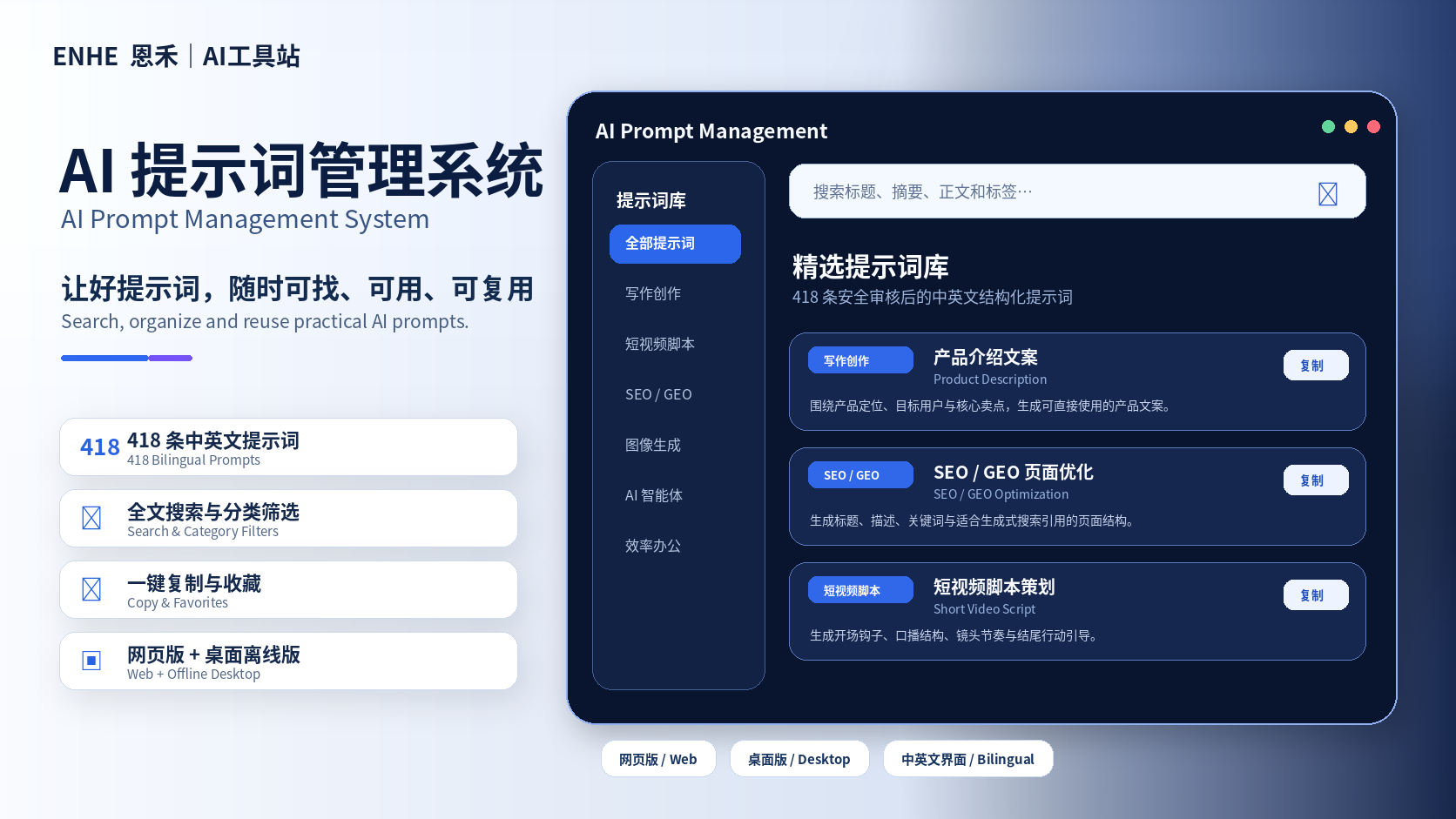
AI Prompt Management System | 418 Bilingual Prompts for Writing, SEO and AI Creation
High-Frequency AI Prompts for Work, Learning, and Teaching guide
High-Frequency AI Prompts for Work, Learning, and Teaching
Related Tools And Tutorials
Use the following ENHE AI sections to continue from the news signal into tool selection, account-service guidance, or practical learning.
Related reading
When Should an AI Agent Use a Local Small Model or the Cloud? A Hybrid Routing Checklist
AWS published an Adaptive Agentic Intelligence Framework guide using Strands Agents on October 21, 2026. The reference routes routine status checks and local vision work to small models through Ollama, while complex analysis goes to Amazon Bedrock. This durable guide helps teams decide when an AI agent should stay local and when it should use a cloud model. It classifies tasks, marks data that may leave the device, establishes local and cloud quality baselines, defines timeouts and fallbacks, applies one safety policy across both paths, and measures actual routing before estimating cost. The example can run on an 8 GB Raspberry Pi, but that hardware detail is not evidence that every workload belongs on a small local model.
How to Validate Amazon Quick Before Health-Data Use: HIPAA Eligible Does Not Mean Automatically Compliant
AWS published an Amazon Quick deployment guide for HIPAA-regulated environments on October 22, 2026. Its central distinction is durable: HIPAA eligible means the service can be used to process protected health information under the right agreement and configuration; it does not make an entire environment automatically compliant. This guide is for healthcare organizations, business associates, and technical owners working with legal, compliance, and security reviewers. It turns the source into an acceptance checklist covering the business associate addendum, data classification, irreversible key and identity choices, ACL-aware knowledge bases, least-privilege and read-only connectors, masked audit logs, adversarial access tests, and staged expansion from non-PHI work. It is operational guidance, not individualized legal advice or a substitute for professional review.
How to Validate AI-Agent Runtime Safety: A Four-Layer OpenShell Evidence Checklist
NVIDIA launched the OpenShell Reference Architecture on October 21, 2026 for building, containing, observing, and enforcing safer agents across enterprise infrastructure and edge systems. This durable guide turns that architecture into a four-layer acceptance checklist rather than a product summary. For one low-risk agent task, teams verify build provenance, identity and tool boundaries, file and network isolation, observable action logs, policy denials, human approval, and rollback. Each layer requires evidence and a failure response. The goal is not to claim that one runtime makes an agent safe. It is to decide which actions can proceed automatically, which must stop for review, and how operators can reconstruct what happened after a failed or unexpected action.
How to Use GitHub Package Firewall: An npm Safety Checklist for Coding Agents
GitHub introduced Package Firewall in public preview on October 20, 2026 for GitHub Enterprise Cloud customers, including data-resident environments. The firewall sits between coding agents, CI runners, or internal registries and upstream package repositories. It evaluates package metadata and downloads against enterprise policies such as cooldown periods, GitHub Advisory Database checks, and supply-chain signals including attestation downgrades. The preview is free, but general availability is expected to use metered pricing similar to Actions, and npm is the only supported ecosystem today. This durable guide provides a rollout checklist for endpoint routing, a read-only build, blocked-package exceptions, audit evidence, false-positive review, and future budget preparation.
When Should an AI Agent Act Autonomously? A Scope, Know, Bound, Observe Checklist
An AI agent should receive more autonomy only when its actions can be verified, not because one demonstration looked successful. AWS describes a Trust in Depth framework organized around four lifecycle questions: Scope, Know, Bound, and Observe. This durable guide turns those questions into an operational checklist for a small team. Using an internal task-status update as the example, it identifies evidence required before launch, controls during execution, records after execution, and conditions that should stop the agent and request human review. Precise rules can sometimes be tested or formally checked, while tone, sensitive context, and high-impact decisions still require judgment. The objective is bounded, reviewable autonomy rather than either constant approval or unrestricted action.
Google Meet Post-Meeting Follow-Up: A Review Checklist for Drafts and Tasks
A meeting summary is not the same as a reliable follow-up. Google Meet’s post-meeting next steps can help create an email draft or move action items into Google Tasks, but eligibility and review still matter. This durable checklist explains the documented prerequisites, the stricter conditions for drafting follow-up emails, and the difference between a generated draft and a message actually sent. It uses a fictional external-project meeting to show how to check owners, deliverables, deadlines, and recipients without inventing missing commitments. It also covers where to inspect routine activity, how to turn a routine off, and a manual fallback when the feature is absent. No meeting-account test is claimed.
Summary
For beginners, editing skills usually come first. AI video generation becomes more useful once the publishing workflow is clear.
Sources
FAQ
What is this ENHE AI article about?
AI video generation tools such as Sora and Veo focus on creating new video from prompts or images. Online editors such as Canva and CapCut focus on timelines, captions, transitions and publishing workflows.
Why is this AI update worth watching?
AI video generators create new footage from prompts or references. Online editors organize existing media into finished videos. Most creator workflows need both generation and editing. Commercial use requires attention to rights, likeness and platform terms.
What does it mean for everyday AI users?
ENHE readers should map their video workflow before choosing tools: source footage, editing, subtitles, review, export and publishing all matter.
Where can readers continue learning on ENHE AI?
Readers can continue with ENHE AI software apps, AI skill tutorials, and AI account service guidance to turn the news signal into practical action.
Table of contents
AI Video Generators vs Online Video Editors: How Beginners Should Choose