
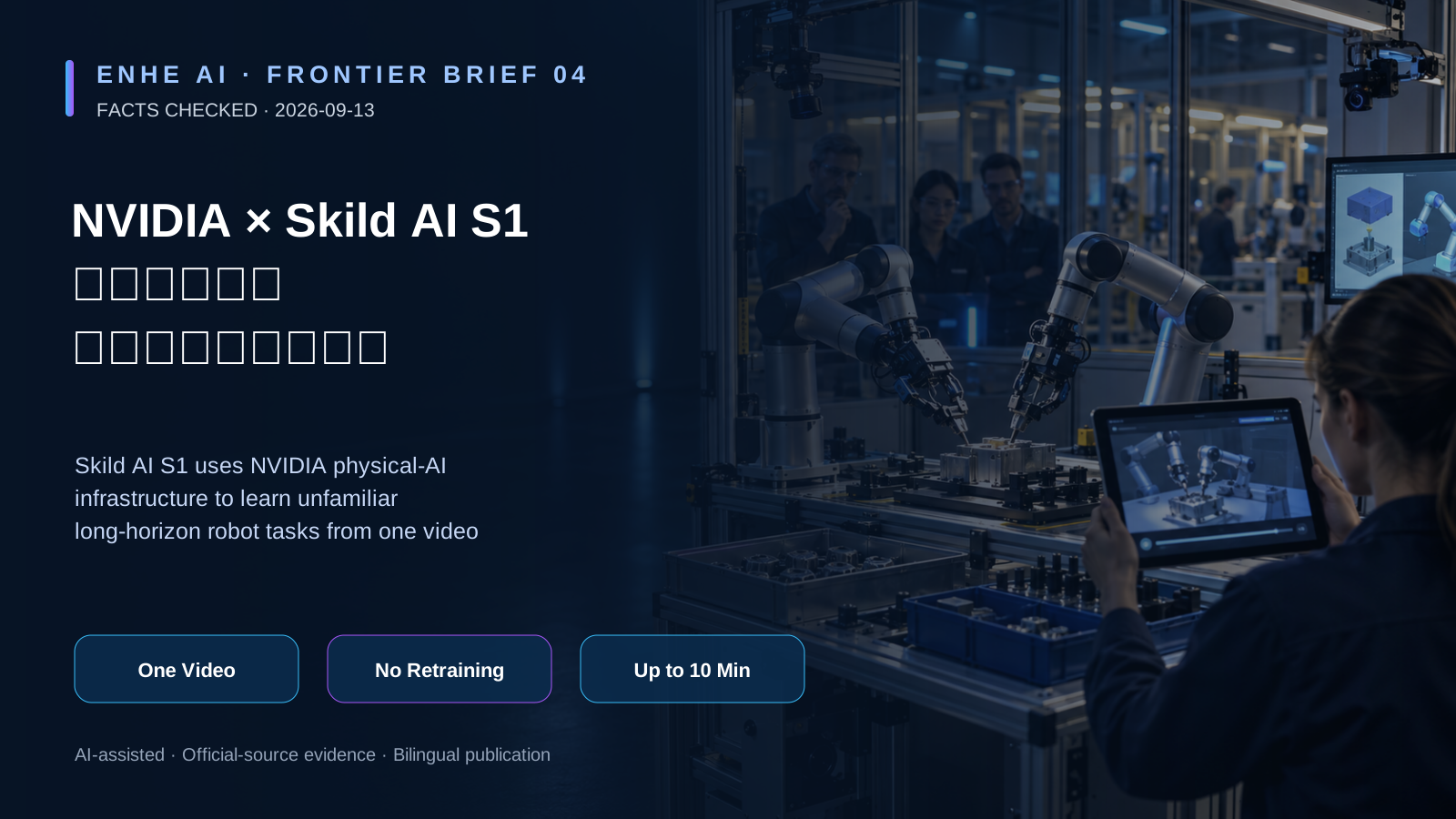
Skild AI S1 uses NVIDIA physical-AI infrastructure to learn unfamiliar long-horizon robot tasks from one video
The model uses a video demonstration as an in-context prompt without task-specific retraining, while production safety still requires independent validation.

Key takeaways
NVIDIA described Skild AI's S1 robot foundation model on September 10. An operator records a task video and uses it as a prompt; S1 interprets the demonstrated intent, objects, and sequence, then maps them into actions for the robot without updating model weights or performing task-specific post-training. NVIDIA says S1 can handle unfamiliar tasks lasting up to ten minutes, including plant potting, pancake making, pour-over coffee, and kit assembly. In tests reported by Skild, the model succeeded at about 66 percent of steps on new multistep tasks versus 9 percent for a similar system. The companies use NVIDIA infrastructure for synthetic data, training, simulation, reinforcement learning, and deployment. These are vendor-reported demonstrations and tests, not evidence that every factory can operate without supervision; deployment still requires staged safety, reliability, and recovery validation.
Direct answer
NVIDIA described Skild AI's S1 robot foundation model on September 10. An operator records a task video and uses it as a prompt; S1 interprets the demonstrated intent, objects, and sequence, then maps them into actions for the robot without updating model weights or performing task-specific post-training. NVIDIA says S1 can handle unfamiliar tasks lasting up to ten minutes, including plant potting, pancake making, pour-over coffee, and kit assembly. In tests reported by Skild, the model succeeded at about 66 percent of steps on new multistep tasks versus 9 percent for a similar system. The companies use NVIDIA infrastructure for synthetic data, training, simulation, reinforcement learning, and deployment. These are vendor-reported demonstrations and tests, not evidence that every factory can operate without supervision; deployment still requires staged safety, reliability, and recovery validation.
Verified facts
S1 takes an operator-recorded video as a prompt, interprets intent, objects, and sequence, and maps them into robot actions without updating weights or task-specific post-training.
NVIDIA says S1 handles unfamiliar tasks lasting up to ten minutes, including plant potting, pancakes, pour-over coffee, and kit assembly. A potting demo went from recording to autonomous hardware execution in eleven minutes.
In Skild-reported tests on new multistep tasks, S1 achieved about 66 percent success at each step versus 9 percent for a similar system; the post does not present these figures as cross-environment safety certification.
What changed
- One operator video can provide task context instead of starting with a dedicated dataset
- Long-horizon behavior composes learned skills and attempts recovery after disturbances
- Synthetic data, simulation, reinforcement learning, and inference optimization form one development chain
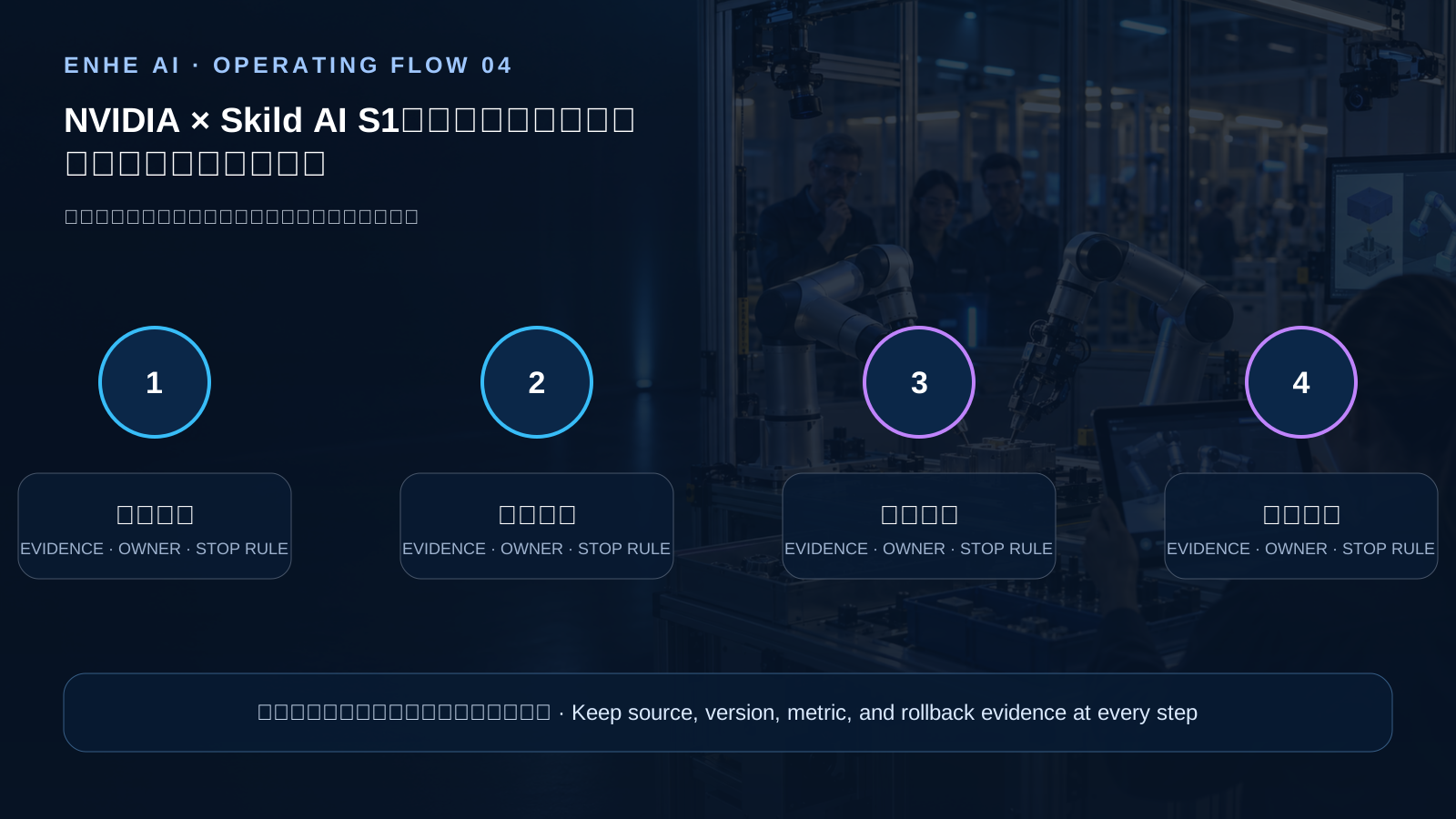
- Vendor demonstrations must become independent, station-by-station and step-by-step acceptance tests
Impact for AI users
A single video demonstration can reduce the upfront data and programming work needed to adapt a robot to a changing process. Yet errors compound across a multistep task, so a reported 66 percent per-step success rate does not translate directly into an acceptable end-to-end yield. Teams should treat demonstration learning as a way to shorten configuration, while retaining safety cages where appropriate, force and collision limits, human emergency stops, and a defined safe state after failure.
Operating checklist
- Choose one reversible task in a low-speed, low-payload isolated cell with no human entry, and version the demonstration video.
- Cover object shifts, occlusion, grasp failure, tool faults, and emergency stops in simulation, recording both per-step and end-to-end success.
- During hardware tests, limit speed, force, workspace, and continuous runtime, with an independently triggered human stop.
- Expand stations and task scope only after safety thresholds, recovery paths, and end-to-end yield all pass.
AI frontier news and analysis, AI software and model tools, AI skill tutorials and validation methods, and AI account and permission guidance
FAQ
Does S1 require retraining for every new task?
Skild says no task-specific post-training or weight update is required; the video demonstration supplies task context.
Does 66 percent per-step success mean a ten-minute workflow succeeds 66 percent of the time?
No. The post reports per-step success in Skild's tests; end-to-end success across many steps must be measured separately.
Can one-video learning replace human safety controls?
No. The article describes capabilities and recovery examples, but it does not replace site risk assessment, physical safeguards, emergency stops, or acceptance testing.
Summary
S1 shows a path for shortening robot task setup with video context. Production readiness still depends on measurable safety at every stage, acceptable end-to-end yield, and predictable recovery after failure.
This AI-assisted article is checked by ENHE AI automation for official sources, bilingual fields, media rights, page safety, and historical duplication before publication.
What this means for everyday users
A single video demonstration can reduce the upfront data and programming work needed to adapt a robot to a changing process. Yet errors compound across a multistep task, so a reported 66 percent per-step success rate does not translate directly into an acceptable end-to-end yield. Teams should treat demonstration learning as a way to shorten configuration, while retaining safety cages where appropriate, force and collision limits, human emergency stops, and a defined safe state after failure.
Tools you may use



Related tutorials
[[zh]][[/zh]][[en]]Review a public website[[/en]]
SearchScope SEO/GEO
[[zh]][[/zh]][[en]]Access and usage guide[[/en]]
AI Prompt Management System | 418 Bilingual Prompts for Writing, SEO and AI Creation
High-Frequency AI Prompts for Work, Learning, and Teaching guide
High-Frequency AI Prompts for Work, Learning, and Teaching
Related Tools And Tutorials
Use the following ENHE AI sections to continue from the news signal into tool selection, account-service guidance, or practical learning.
Related reading
NVIDIA Expands DGX Spark With 64GB: Evaluate a Local AI Workstation
On October 2, NVIDIA announced a 64GB unified-memory DGX Spark configuration and said partner availability would begin October 23 at a starting price of $4,999. NVIDIA says one unit can run models up to 100 billion parameters and that two systems can pool 128GB; it reports up to 1.7x performance in its own Qwen 3.8 27B test. Availability is forward-looking, and performance figures are vendor results. Model choice, quantization, context length, and concurrency change outcomes. This article offers a practical evaluation checklist for teams comparing local inference with cloud services. Teams should check applicability against their own environment, record assumptions, and validate decisions with representative operational evidence.
Microsoft’s 2026 Defense Report: AI Is Changing the Pace of Cybersecurity
In its October 1 commentary on the 2026 Microsoft Digital Defense Report, Microsoft says threat actors are using AI in parts of existing workflows, including reconnaissance and social engineering. The post does not claim that attacks have become fully autonomous; it highlights changes in speed and scale. Identity controls, least privilege, data protection, monitoring, testing, and secure development remain central. This article separates Microsoft’s observations from independent conclusions and turns the post into a practical checklist. Teams should compare the claims with their own telemetry and incident history before changing priorities. Teams should check applicability against their own environment, record assumptions, and validate decisions with representative operational evidence.
A One-Week AI Agent Security Review Using the OWASP Risk Framework
The OWASP Gen AI Security Project published its 2026 Top 10 for Agentic Applications in December 2025 as a risk framework for systems that plan, call tools, or act across services. It is a starting point for security discussion, not a certification, compliance attestation, or guarantee of safety. This article turns it into a one-week baseline review: inventory agent identities and tools, narrow permissions, treat external content as untrusted input, record consequential actions, test shutdown and revocation, and define approval and recovery for high-impact operations. Teams should extend the checklist to match their architecture and threat model. Teams should check applicability against their own environment, record assumptions, and validate decisions with representative operational evidence.
Microsoft Announces Streaming Transcription: Voice Agents Can Respond Earlier
On October 1, Microsoft AI announced MAI-Transcribe-2-Streaming, MAI-Voice-2.1, and a Flash variant. Microsoft says the streaming transcription model supports 60 languages with continuous language detection, and that initial partials can appear just over 100 milliseconds after audio arrives. Its speech-generation models are described as supporting 23 languages and 26 locales. Rankings, accuracy, speed, and price claims come from Microsoft’s announcement and do not predict results for every workload. This article explains the interaction changes and suggests tests for latency, revisions, accents, privacy, and total cost. Teams should check applicability against their own environment, record assumptions, and validate decisions with representative operational evidence.
A Banking Agent Writes Then Reverses: AWS Describes a Demo, Not Production Trading
An October 5 AWS post describes Texas Capital Bank’s Trust-Earned Autonomy pattern, in which reviewer agreement can inform an agent’s permissions and a prior write can be reversed if trust declines. AWS explicitly says the agent pattern is still a demonstration running on demo-scale Apache Fineract with synthetic data, not a production workload or real production transaction flow. The bank’s separate document-extraction capability is described as operating in production. This article focuses on revocable authority, auditability, and system boundaries, and avoids presenting the demonstration as an already deployed autonomous banking agent. Teams should check applicability against their own environment, record assumptions, and validate decisions with representative operational evidence.
OpenAI Updates Content Provenance: Extending the Work to EU Text
OpenAI's October 5 announcement sets out a phased approach to text watermarking, including API opt-in and a regional product rollout. The details are public and should be read alongside its broader media-provenance guidance. For publishers, the practical task is to distinguish which checks apply to text, images, and audio, and to keep evidence of how content was created and reviewed. A useful editorial record separates product coverage, source checks, permission to use materials, and AI disclosure. This article explains those distinctions and proposes a review workflow. A provenance signal is supporting evidence, not a substitute for factual verification or a conclusion about an author's identity or ownership.