
NVIDIA introduces two CUDA Rust paths for native GPU kernels, both still early-stage
cuda-oxide keeps SIMT control while cutile-rs lets the compiler manage Tile mapping; stronger memory safety is not production maturity.

Key takeaways
NVIDIA introduced two CUDA Rust paths on September 8 so developers can write GPU kernels in Rust and compile them natively to PTX. cuda-oxide targets the familiar SIMT programming model through a custom rustc backend, Pliron, and LLVM, and currently requires a pinned nightly toolchain. cutile-rs targets Tile programming on stable Rust 1.89 or later with CUDA 13.3, letting the compiler manage thread mapping and memory layout through CUDA Tile IR. NVIDIA highlights compile-time memory-safety techniques in both projects and plans interoperability with CUDA C++ and Python. The company also states that neither project is production-ready: cuda-oxide is early alpha, cutile-rs is further along, and APIs and coverage will change. Teams should isolate prototypes, reproduce kernels, compare correctness and performance, and keep an existing CUDA path for rollback.
Direct answer
NVIDIA introduced two CUDA Rust paths on September 8 so developers can write GPU kernels in Rust and compile them natively to PTX. cuda-oxide targets the familiar SIMT programming model through a custom rustc backend, Pliron, and LLVM, and currently requires a pinned nightly toolchain. cutile-rs targets Tile programming on stable Rust 1.89 or later with CUDA 13.3, letting the compiler manage thread mapping and memory layout through CUDA Tile IR. NVIDIA highlights compile-time memory-safety techniques in both projects and plans interoperability with CUDA C++ and Python. The company also states that neither project is production-ready: cuda-oxide is early alpha, cutile-rs is further along, and APIs and coverage will change. Teams should isolate prototypes, reproduce kernels, compare correctness and performance, and keep an existing CUDA path for rollback.
Verified facts
NVIDIA says CUDA Rust allows GPU kernels to be written in Rust and compiled directly to PTX instead of only launching kernels written in another language.
cuda-oxide uses a custom rustc backend for SIMT, while cutile-rs targets the Tile model on stable Rust 1.89 or later and CUDA 13.3 through CUDA Tile IR JIT compilation.
NVIDIA explicitly says neither project is production-ready: cuda-oxide is early alpha, and cutile-rs is further along but still has incomplete coverage and moving APIs.
What changed
- Rust can express GPU kernels directly
- SIMT and Tile paths develop in parallel
- Types carry part of the memory-safety argument
- The ecosystem still needs toolchain and version controls
Impact for AI users
Teams building inference engines, agent runtimes, or systems software in Rust can reduce the cross-language kernel boundary. Early toolchains add compile-time, pinned-version, debugging, and API-migration costs. Memory-safety types can reduce aliasing and bounds errors, but real hardware tests remain necessary for numerical correctness, performance, shared-memory paths, and behavior across GPU architectures.
Operating checklist
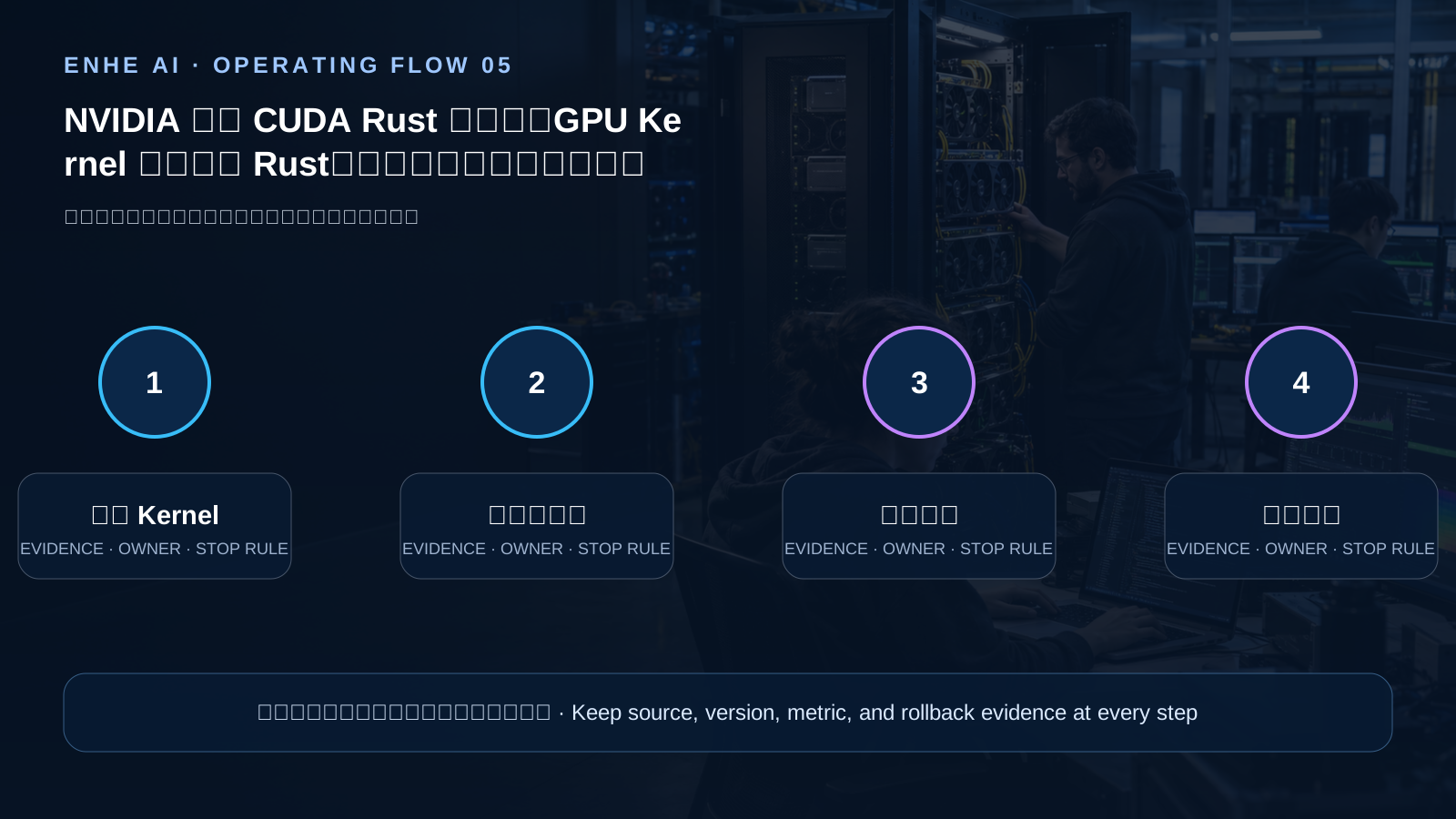
- Choose a small kernel with an existing CUDA baseline and pin every toolchain version in an isolated repository.
- Implement it with cuda-oxide or cutile-rs while retaining the current version, then compare numerical error and performance.
- Run stress, bounds, concurrency, and memory checks on at least two supported GPU configurations.
- Keep the production kernel and build chain until API stability, debugging, and coverage meet explicit gates.
AI frontier news and analysis, AI software and model tools, AI skill tutorials and validation methods, and AI account and permission guidance
FAQ
Is CUDA Rust ready for direct production use?
NVIDIA explicitly says neither project is production-ready, so the current fit is experimentation and feedback.
Why does NVIDIA suggest trying Tile first?
The compiler manages architecture mapping in the Tile model; use SIMT when fine-grained thread and memory control is required.
Does Rust eliminate GPU bugs automatically?
No. Types reduce some memory errors, while numerical behavior, synchronization, performance, and hardware compatibility still require testing.
Summary
CUDA Rust narrows the gap between Rust systems code and GPU kernels, but the right current strategy is a pinned environment, comparative benchmarks, and a mature rollback path.
This AI-assisted article is checked by ENHE AI automation for official sources, bilingual fields, media rights, page safety, and historical duplication before publication.
What this means for everyday users
Teams building inference engines, agent runtimes, or systems software in Rust can reduce the cross-language kernel boundary. Early toolchains add compile-time, pinned-version, debugging, and API-migration costs. Memory-safety types can reduce aliasing and bounds errors, but real hardware tests remain necessary for numerical correctness, performance, shared-memory paths, and behavior across GPU architectures.
Tools you may use



Related tutorials
[[zh]][[/zh]][[en]]Review a public website[[/en]]
SearchScope SEO/GEO
[[zh]][[/zh]][[en]]Access and usage guide[[/en]]
AI Prompt Management System | 418 Bilingual Prompts for Writing, SEO and AI Creation
High-Frequency AI Prompts for Work, Learning, and Teaching guide
High-Frequency AI Prompts for Work, Learning, and Teaching
Related Tools And Tutorials
Use the following ENHE AI sections to continue from the news signal into tool selection, account-service guidance, or practical learning.
Related reading
Anthropic launches Claude Fable 5.1 and Mythos 5.1 with a tighter cost and safety profile
Anthropic introduced Claude Fable 5.1 and Claude Mythos 5.1 on September 1. They share one base model but use different safeguard and access profiles. Fable is generally available and is estimated to cost 25% less for typical token workloads, with savings of up to about 45% for highly agentic workloads. Enterprise Frontier Safeguards will keep customer data in infrastructure controlled by the customer while providing misuse detection. Mythos is offered through trusted access programs for cybersecurity and life sciences. Anthropic also described software vulnerability discovery, protein binder design, and GPU kernel optimization examples. For enterprise teams, the launch makes model selection a joint decision about capability, cost, data residency, and risk controls.
NVIDIA Expands DGX Spark With 64GB: Evaluate a Local AI Workstation
On October 2, NVIDIA announced a 64GB unified-memory DGX Spark configuration and said partner availability would begin October 23 at a starting price of $4,999. NVIDIA says one unit can run models up to 100 billion parameters and that two systems can pool 128GB; it reports up to 1.7x performance in its own Qwen 3.8 27B test. Availability is forward-looking, and performance figures are vendor results. Model choice, quantization, context length, and concurrency change outcomes. This article offers a practical evaluation checklist for teams comparing local inference with cloud services. Teams should check applicability against their own environment, record assumptions, and validate decisions with representative operational evidence.
Microsoft’s 2026 Defense Report: AI Is Changing the Pace of Cybersecurity
In its October 1 commentary on the 2026 Microsoft Digital Defense Report, Microsoft says threat actors are using AI in parts of existing workflows, including reconnaissance and social engineering. The post does not claim that attacks have become fully autonomous; it highlights changes in speed and scale. Identity controls, least privilege, data protection, monitoring, testing, and secure development remain central. This article separates Microsoft’s observations from independent conclusions and turns the post into a practical checklist. Teams should compare the claims with their own telemetry and incident history before changing priorities. Teams should check applicability against their own environment, record assumptions, and validate decisions with representative operational evidence.
A One-Week AI Agent Security Review Using the OWASP Risk Framework
The OWASP Gen AI Security Project published its 2026 Top 10 for Agentic Applications in December 2025 as a risk framework for systems that plan, call tools, or act across services. It is a starting point for security discussion, not a certification, compliance attestation, or guarantee of safety. This article turns it into a one-week baseline review: inventory agent identities and tools, narrow permissions, treat external content as untrusted input, record consequential actions, test shutdown and revocation, and define approval and recovery for high-impact operations. Teams should extend the checklist to match their architecture and threat model. Teams should check applicability against their own environment, record assumptions, and validate decisions with representative operational evidence.
Microsoft Announces Streaming Transcription: Voice Agents Can Respond Earlier
On October 1, Microsoft AI announced MAI-Transcribe-2-Streaming, MAI-Voice-2.1, and a Flash variant. Microsoft says the streaming transcription model supports 60 languages with continuous language detection, and that initial partials can appear just over 100 milliseconds after audio arrives. Its speech-generation models are described as supporting 23 languages and 26 locales. Rankings, accuracy, speed, and price claims come from Microsoft’s announcement and do not predict results for every workload. This article explains the interaction changes and suggests tests for latency, revisions, accents, privacy, and total cost. Teams should check applicability against their own environment, record assumptions, and validate decisions with representative operational evidence.
A Banking Agent Writes Then Reverses: AWS Describes a Demo, Not Production Trading
An October 5 AWS post describes Texas Capital Bank’s Trust-Earned Autonomy pattern, in which reviewer agreement can inform an agent’s permissions and a prior write can be reversed if trust declines. AWS explicitly says the agent pattern is still a demonstration running on demo-scale Apache Fineract with synthetic data, not a production workload or real production transaction flow. The bank’s separate document-extraction capability is described as operating in production. This article focuses on revocable authority, auditability, and system boundaries, and avoids presenting the demonstration as an already deployed autonomous banking agent. Teams should check applicability against their own environment, record assumptions, and validate decisions with representative operational evidence.