Mistral and Cloudera target sovereign enterprise AI with customer-controlled training, inference, and operations
The partnership plans model integration across public cloud, private cloud, on-premises, and fully air-gapped environments.

Key takeaways
Mistral and Cloudera announced a sovereign enterprise AI partnership on September 10. The companies plan to integrate Mistral models with Cloudera's hybrid data platform across public cloud, private cloud, on-premises, and fully air-gapped environments. Mistral says enterprises will be able to train customized models on proprietary data inside controlled environments while retaining ownership of their data and resulting intelligence. The announcement addresses 30 exabytes of customer-managed data on Cloudera's platform and describes customer control over data, open weights, training, inference, infrastructure, jurisdiction, governance, observability, and the learning loop. It does not identify specific model versions, delivery dates, pricing, certifications, or measured customer outcomes, so buyers still need to translate the sovereignty language into testable contractual and technical controls.
Direct answer
Mistral and Cloudera announced a sovereign enterprise AI partnership on September 10. The companies plan to integrate Mistral models with Cloudera's hybrid data platform across public cloud, private cloud, on-premises, and fully air-gapped environments. Mistral says enterprises will be able to train customized models on proprietary data inside controlled environments while retaining ownership of their data and resulting intelligence. The announcement addresses 30 exabytes of customer-managed data on Cloudera's platform and describes customer control over data, open weights, training, inference, infrastructure, jurisdiction, governance, observability, and the learning loop. It does not identify specific model versions, delivery dates, pricing, certifications, or measured customer outcomes, so buyers still need to translate the sovereignty language into testable contractual and technical controls.
Verified facts
The companies plan to integrate Mistral models with Cloudera's hybrid data platform for inference in public cloud, private cloud, on-premises, and fully air-gapped environments.
Mistral says enterprises can train customized models on proprietary data inside controlled environments while retaining ownership of the data and resulting intelligence.
The announcement cites 30 exabytes of customer-managed data on Cloudera and defines sovereign AI around customer control of data, intelligence, compute, operations, jurisdiction, and the learning loop.
What changed
- Cloudera's hybrid data platform is planned to add deployable Mistral model capabilities
- The planned inference integration covers public cloud, private cloud, on-premises, and fully air-gapped environments
- Custom training in controlled environments and customer data ownership are partnership targets
- Governance, observability, and continuous improvement are included in the planned sovereignty boundary
Impact for AI users
Sovereignty becomes procurement evidence only when it maps to key ownership, administrator boundaries, telemetry egress, model and data licenses, update paths, and governing jurisdiction. The partnership offers regulated enterprises a hybrid deployment direction worth evaluating, but the announcement does not yet provide purchasable configurations or reproducible performance. Engineering, security, procurement, and legal teams should jointly validate installation, patching, audit, rollback, and support in fully isolated environments instead of treating physical deployment location as complete control.
Operating checklist
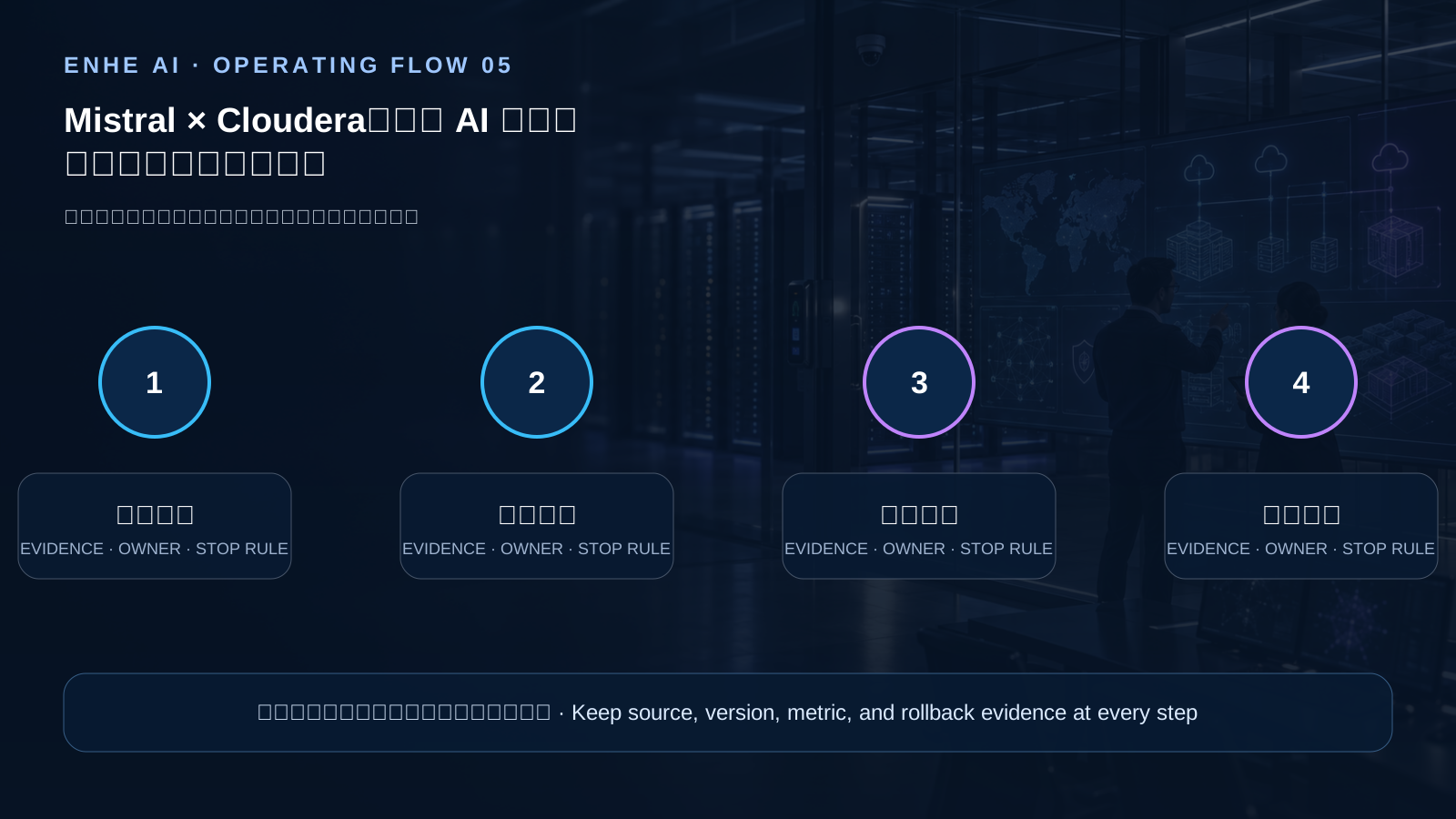
- Express sovereignty requirements as a control matrix covering residency, keys, administrators, telemetry, weights, logs, updates, and jurisdiction.
- Request the exact models, versions, topology, dependencies, support boundary, pricing, and verifiable delivery dates from the vendors.
- Exercise installation, inference, tuning, patching, backup, rollback, and incident support in an isolated test environment while inspecting every outbound connection.
- Accept the system against internal authorization, audit, latency, quality, and recovery measures, with ownership of data and derived models stated in the contract.
AI frontier news and analysis, AI software and model tools, AI skill tutorials and validation methods, and AI account and permission guidance
FAQ
Have the companies announced a directly purchasable package?
The post describes the partnership and deployment scope but gives no exact model, version, price, delivery date, or certification list.
Does an on-premises deployment automatically qualify as sovereign AI?
No. Keys, administrators, telemetry, weight licenses, updates, logs, support access, and jurisdiction also need verification.
Does 30 exabytes describe the model's training dataset?
No. It is Mistral's description of customer-managed data on Cloudera's platform, not a claim that the data trained a model.
Summary
Mistral and Cloudera plan to extend the sovereignty target from data residency to models, compute, and the learning loop. Buyers should translate each partnership claim into contractual terms and technical acceptance evidence.
This AI-assisted article is checked by ENHE AI automation for official sources, bilingual fields, media rights, page safety, and historical duplication before publication.
What this means for everyday users
Sovereignty becomes procurement evidence only when it maps to key ownership, administrator boundaries, telemetry egress, model and data licenses, update paths, and governing jurisdiction. The partnership offers regulated enterprises a hybrid deployment direction worth evaluating, but the announcement does not yet provide purchasable configurations or reproducible performance. Engineering, security, procurement, and legal teams should jointly validate installation, patching, audit, rollback, and support in fully isolated environments instead of treating physical deployment location as complete control.
Tools you may use


Related tutorials
Related Tools And Tutorials
Use the following ENHE AI sections to continue from the news signal into tool selection, account-service guidance, or practical learning.
Related reading
Mistral reports a 40,000-line Fortran-to-C++ migration built around numerical parity
Mistral published a legacy-modernization case study on September 9 involving a 300,000-line Fortran 77 reservoir simulator for an unnamed European energy operator. The first sprint migrated 40,000 lines of core functionality to C++. Before migration, the team built a numerical-parity harness that compared final outputs and critical intermediate checkpoints, then used more than one hundred agents to document the caller-callee tree. Mistral says a fully autonomous first attempt produced working code that still resembled Fortran written in C++ syntax. The successful approach divided modules into manageable units and coordinated planning, coding, testing, and review, with engineers resolving blocked work. The report supports a practical rule: create a runnable baseline and measurable parity before scaling agent activity.
AWS shows how AgentCore can deliver the same MCP tools and interactive widgets across compatible AI hosts
AWS published a technical walkthrough for running MCP Apps on Amazon Bedrock AgentCore on September 11. In the reference architecture, an AI host discovers MCP tools and resources, invokes a tool through WAF and AgentCore Gateway, and receives structured content from business logic implemented with Lambda and DynamoDB. When a tool points to a resource URI, the host reads self-contained widget HTML and renders it in a sandboxed iframe with the structured result injected through the MCP Apps lifecycle. AWS presents MCP Apps as a host-agnostic standard, so one server can provide the same tools and widgets to compatible AI hosts. The production guidance still requires strict argument validation, trust-boundary controls, caller restrictions, monitoring, and cost review.
A production gate for OpenAI webhooks: signature verification, fast acknowledgement, idempotency, and replay testing
OpenAI webhooks deliver subscribed events as HTTP POST requests to a project-level endpoint. The documentation says the signing secret appears when the endpoint is created and cannot be viewed again, so it must be stored securely for server-side verification. Official SDK helpers can unwrap and verify an event using the raw request body, request headers, and secret. A receiver should return a successful 2xx response within a few seconds and offload non-trivial processing to a background worker. Failed or slow deliveries are retried with exponential backoff for up to 72 hours, while 3xx redirects are treated as failures. Rare duplicate deliveries are possible, so webhook-id should serve as an idempotency key. A release gate should exercise invalid signatures, duplicates, backlog, replay, and recovery before enabling side effects.
Cohere North Small Translate is a 25B-active open-weight MoE built for translation across 50+ languages
Cohere released North Small Translate on September 10, an open-weight mixture-of-experts model dedicated to machine translation across more than 50 languages. The model has 218 billion total parameters and 25 billion active parameters, with 16K input and 16K output context. Cohere lists one B200 or two H100 GPUs at W4A4 as minimum configurations. In vendor-run evaluations using GPT-5.6-Sol as a judge, the standard model scored 83.60 across WMT26 languages and an agentic variant scored 84.36. Cohere also reports up to 1.4 times the output throughput of Gemma 4 31B under identical hardware and concurrency. The model card says the non-commercial CC BY-NC 4.0 license carries an acceptable-use addendum and requires Cohere Labs AUP compliance; commercial production requires a separate commercial license.
DeepSeek V4.1-Flash uses asymmetric MoE activation and a smaller KV cache to target lower inference cost
DeepSeek introduced V4.1-Flash on September 10 as a 552-billion-parameter mixture-of-experts model with native visual understanding. Its new Causal Encoder–Decoder architecture activates 8 billion parameters while processing input and 16 billion while generating output. DeepSeek says the model needs one quarter of the HBM and one eighth of the SSD storage for KV cache compared with the previous generation. V4.1-Flash is available through the DeepSeek API as deepseek-flash, while retired V4 Flash aliases temporarily route to it for compatibility. At this batch's 06:00 Beijing run, the V4-Pro cutover was still in the future: DeepSeek scheduled all deepseek-v4-pro requests to route to V4.1-Flash from 04:00 UTC, or 12:00 Beijing time, on September 14 until V4.1-Pro launches.
IBM and NASA align data from four missions and nine instruments in an open lunar foundation model
IBM and NASA released an open-source Lunar Foundation Model and companion dataset on September 10. The machine-learning-ready dataset combines more than 30 spatially aligned layers from nine instruments across four missions, including tens of thousands of images and maps with different modalities and resolutions. IBM says the model can support work on potential ice deposits, volcanic features, and crater mapping. The IBM-NASA paper reports up to a 22 percent reduction in RMSE for high-potential lunar ice areas and nearly 19 percent better performance than SwinV2-B for crater work at roughly 100-meter context scale while using half the training data. These are results reported by the project partners and should support scientific candidate generation, with domain validation retained before drawing conclusions or planning missions.