
Microsoft Discovery reports CLIO results for adaptive, evidence-driven scientific reasoning
The system compares independent paths, changes strategy, and can bring in domain experts, while real R&D still needs reproducibility and governance.

Key takeaways
Microsoft described the CLIO adaptive reasoning approach in its Discovery Engine on September 8. According to the company, CLIO lets independent reasoning paths explore a scientific problem, compare and share evidence, and resolve the strongest trajectory into a single result. The system can decide to keep exploring, change strategy, use another model, or bring a domain expert into the loop. Microsoft reports scores of 61.6 percent in health and medicine, 75.2 percent in physical sciences, and 64.6 percent in life sciences on Agent's Last Exam. It also says the approach has supported the discovery of a novel organic redox-flow battery. Organizations should treat these figures as vendor evidence and repeat evaluation with their own data, tools, expert review, reproducibility requirements, and stopping rules before using adaptive agents in real R&D decisions.
Direct answer
Microsoft described the CLIO adaptive reasoning approach in its Discovery Engine on September 8. According to the company, CLIO lets independent reasoning paths explore a scientific problem, compare and share evidence, and resolve the strongest trajectory into a single result. The system can decide to keep exploring, change strategy, use another model, or bring a domain expert into the loop. Microsoft reports scores of 61.6 percent in health and medicine, 75.2 percent in physical sciences, and 64.6 percent in life sciences on Agent's Last Exam. It also says the approach has supported the discovery of a novel organic redox-flow battery. Organizations should treat these figures as vendor evidence and repeat evaluation with their own data, tools, expert review, reproducibility requirements, and stopping rules before using adaptive agents in real R&D decisions.
Verified facts
Microsoft says CLIO allows independent reasoning paths to explore, compare, and share learning before resolving the strongest trajectory into an evidence-backed result.
The system can continue exploring, change strategy, use another model, or bring a domain expert into the loop instead of following one fixed end-to-end workflow.
Microsoft reports Agent's Last Exam scores of 61.6 percent in health and medicine, 75.2 percent in physical sciences, and 64.6 percent in life sciences.
What changed
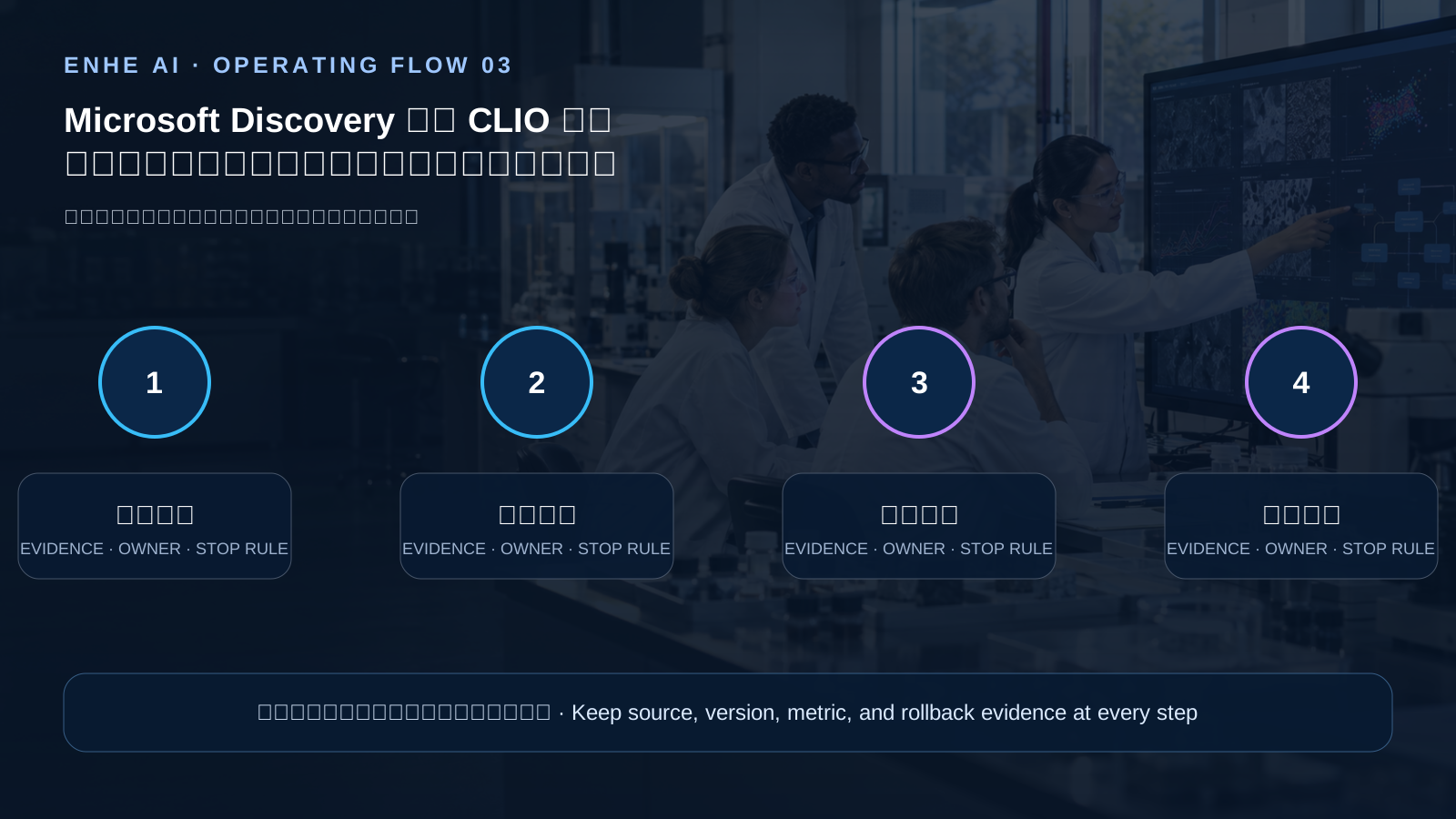
- Parallel hypotheses share evidence
- Strategy and model can change dynamically
- Domain experts become explicit decision nodes
- Scientific outputs emphasize traceability
Impact for AI users
Adaptive research agents suit problems with unknown answers, changing constraints, and multiple tools. Greater flexibility increases the need to record hypotheses, tool calls, evidence selection, and stopping reasons. Benchmark scores do not mean a physical experiment is automatically complete. Organizations must still validate proprietary-data access, instrument interfaces, physical feasibility, and expert accountability.
Operating checklist
- Choose one R&D problem with a known historical answer and fix the data, tools, budget, and stop conditions.
- Require every reasoning path to record hypotheses, evidence, failure causes, and strategy changes.
- Place domain-expert review at critical assumptions, physical constraints, and the final recommendation.
- Measure answer quality, reproduction rate, experimental cost, elapsed time, and wasted exploration separately.
AI frontier news and analysis, AI software and model tools, AI skill tutorials and validation methods, and AI account and permission guidance
FAQ
Is CLIO a new foundation model?
Microsoft describes CLIO as an adaptive reasoning approach in Discovery Engine, focused on coordinating paths and optimizing the process.
Does a benchmark lead prove success in real R&D?
No. Real R&D includes proprietary data, experimental equipment, physical constraints, cost, and expert responsibility.
When should an expert intervene?
Set explicit gates at critical assumptions, irreversible experiments, regulated data, and final R&D conclusions.
Summary
Adaptive research agents create value by exploring evidence-backed candidates faster; reliability comes from complete traces, reproducible experiments, and clear expert responsibility.
This AI-assisted article is checked by ENHE AI automation for official sources, bilingual fields, media rights, page safety, and historical duplication before publication.
What this means for everyday users
Adaptive research agents suit problems with unknown answers, changing constraints, and multiple tools. Greater flexibility increases the need to record hypotheses, tool calls, evidence selection, and stopping reasons. Benchmark scores do not mean a physical experiment is automatically complete. Organizations must still validate proprietary-data access, instrument interfaces, physical feasibility, and expert accountability.
Tools you may use



Related tutorials
[[zh]][[/zh]][[en]]Review a public website[[/en]]
SearchScope SEO/GEO
[[zh]][[/zh]][[en]]Access and usage guide[[/en]]
AI Prompt Management System | 418 Bilingual Prompts for Writing, SEO and AI Creation
High-Frequency AI Prompts for Work, Learning, and Teaching guide
High-Frequency AI Prompts for Work, Learning, and Teaching
Related Tools And Tutorials
Use the following ENHE AI sections to continue from the news signal into tool selection, account-service guidance, or practical learning.
Related reading
NVIDIA Expands DGX Spark With 64GB: Evaluate a Local AI Workstation
On October 2, NVIDIA announced a 64GB unified-memory DGX Spark configuration and said partner availability would begin October 23 at a starting price of $4,999. NVIDIA says one unit can run models up to 100 billion parameters and that two systems can pool 128GB; it reports up to 1.7x performance in its own Qwen 3.8 27B test. Availability is forward-looking, and performance figures are vendor results. Model choice, quantization, context length, and concurrency change outcomes. This article offers a practical evaluation checklist for teams comparing local inference with cloud services. Teams should check applicability against their own environment, record assumptions, and validate decisions with representative operational evidence.
Microsoft’s 2026 Defense Report: AI Is Changing the Pace of Cybersecurity
In its October 1 commentary on the 2026 Microsoft Digital Defense Report, Microsoft says threat actors are using AI in parts of existing workflows, including reconnaissance and social engineering. The post does not claim that attacks have become fully autonomous; it highlights changes in speed and scale. Identity controls, least privilege, data protection, monitoring, testing, and secure development remain central. This article separates Microsoft’s observations from independent conclusions and turns the post into a practical checklist. Teams should compare the claims with their own telemetry and incident history before changing priorities. Teams should check applicability against their own environment, record assumptions, and validate decisions with representative operational evidence.
A One-Week AI Agent Security Review Using the OWASP Risk Framework
The OWASP Gen AI Security Project published its 2026 Top 10 for Agentic Applications in December 2025 as a risk framework for systems that plan, call tools, or act across services. It is a starting point for security discussion, not a certification, compliance attestation, or guarantee of safety. This article turns it into a one-week baseline review: inventory agent identities and tools, narrow permissions, treat external content as untrusted input, record consequential actions, test shutdown and revocation, and define approval and recovery for high-impact operations. Teams should extend the checklist to match their architecture and threat model. Teams should check applicability against their own environment, record assumptions, and validate decisions with representative operational evidence.
Microsoft Announces Streaming Transcription: Voice Agents Can Respond Earlier
On October 1, Microsoft AI announced MAI-Transcribe-2-Streaming, MAI-Voice-2.1, and a Flash variant. Microsoft says the streaming transcription model supports 60 languages with continuous language detection, and that initial partials can appear just over 100 milliseconds after audio arrives. Its speech-generation models are described as supporting 23 languages and 26 locales. Rankings, accuracy, speed, and price claims come from Microsoft’s announcement and do not predict results for every workload. This article explains the interaction changes and suggests tests for latency, revisions, accents, privacy, and total cost. Teams should check applicability against their own environment, record assumptions, and validate decisions with representative operational evidence.
A Banking Agent Writes Then Reverses: AWS Describes a Demo, Not Production Trading
An October 5 AWS post describes Texas Capital Bank’s Trust-Earned Autonomy pattern, in which reviewer agreement can inform an agent’s permissions and a prior write can be reversed if trust declines. AWS explicitly says the agent pattern is still a demonstration running on demo-scale Apache Fineract with synthetic data, not a production workload or real production transaction flow. The bank’s separate document-extraction capability is described as operating in production. This article focuses on revocable authority, auditability, and system boundaries, and avoids presenting the demonstration as an already deployed autonomous banking agent. Teams should check applicability against their own environment, record assumptions, and validate decisions with representative operational evidence.
OpenAI Updates Content Provenance: Extending the Work to EU Text
OpenAI's October 5 announcement sets out a phased approach to text watermarking, including API opt-in and a regional product rollout. The details are public and should be read alongside its broader media-provenance guidance. For publishers, the practical task is to distinguish which checks apply to text, images, and audio, and to keep evidence of how content was created and reviewed. A useful editorial record separates product coverage, source checks, permission to use materials, and AI disclosure. This article explains those distinctions and proposes a review workflow. A provenance signal is supporting evidence, not a substitute for factual verification or a conclusion about an author's identity or ownership.