
Microsoft's Customer Zero lessons move AI transformation from adoption metrics to business outcomes
The company says lasting gains came from redesigning complete workflows, involving employees, and measuring value beyond tool usage.

Key takeaways
Microsoft published lessons from its Customer Zero AI transformation on September 17, arguing that tool access and usage do not equal business change. Its examples start with an outcome, involve employees who understand the work, redesign the complete workflow, and define permissions and human approval points for agents. Microsoft reports that one sales group's adoption of priority use cases tripled, revenue per account manager rose 9.4%, and close rates were 20% higher. Selected cloud supply-chain workflows reduced cycle time by as much as 75%. These are scoped internal cases with stated comparison periods and should not be generalized into industry-wide benchmarks.
Direct answer
Microsoft published lessons from its Customer Zero AI transformation on September 17, arguing that tool access and usage do not equal business change. Its examples start with an outcome, involve employees who understand the work, redesign the complete workflow, and define permissions and human approval points for agents. Microsoft reports that one sales group's adoption of priority use cases tripled, revenue per account manager rose 9.4%, and close rates were 20% higher. Selected cloud supply-chain workflows reduced cycle time by as much as 75%. These are scoped internal cases with stated comparison periods and should not be generalized into industry-wide benchmarks.
Verified facts
Microsoft's five lessons begin with business outcomes rather than technology adoption and redesigning complete workflows rather than accelerating isolated tasks.
Its sales example reports tripled priority-use-case adoption, 9.4% higher revenue per account manager, and 20% higher close rates, with footnotes limiting the claim to a specific internal comparison.
The cloud supply-chain team deployed more than 100 purpose-built agents and cut selected workflow cycle times by up to 75%; Microsoft's note specifies 111 agents as of September 2026.
What changed
- Success metrics move from seats and activity to business outcomes
- Agents operate inside simplified end-to-end workflows
- Frontline employees define judgment and human handoff points
- Lessons are codified into repeatable transformation recipes
Impact for AI users
The review warns leaders not to treat licenses, message counts, or generated code as final value. A credible pilot needs a baseline for the old process, a business owner, quality thresholds, and stop conditions. Microsoft's cases can inform measurement design, but departments differ in data, incentives, and risk. Teams should run a small controlled comparison before expanding an agent's permissions.
Operating checklist
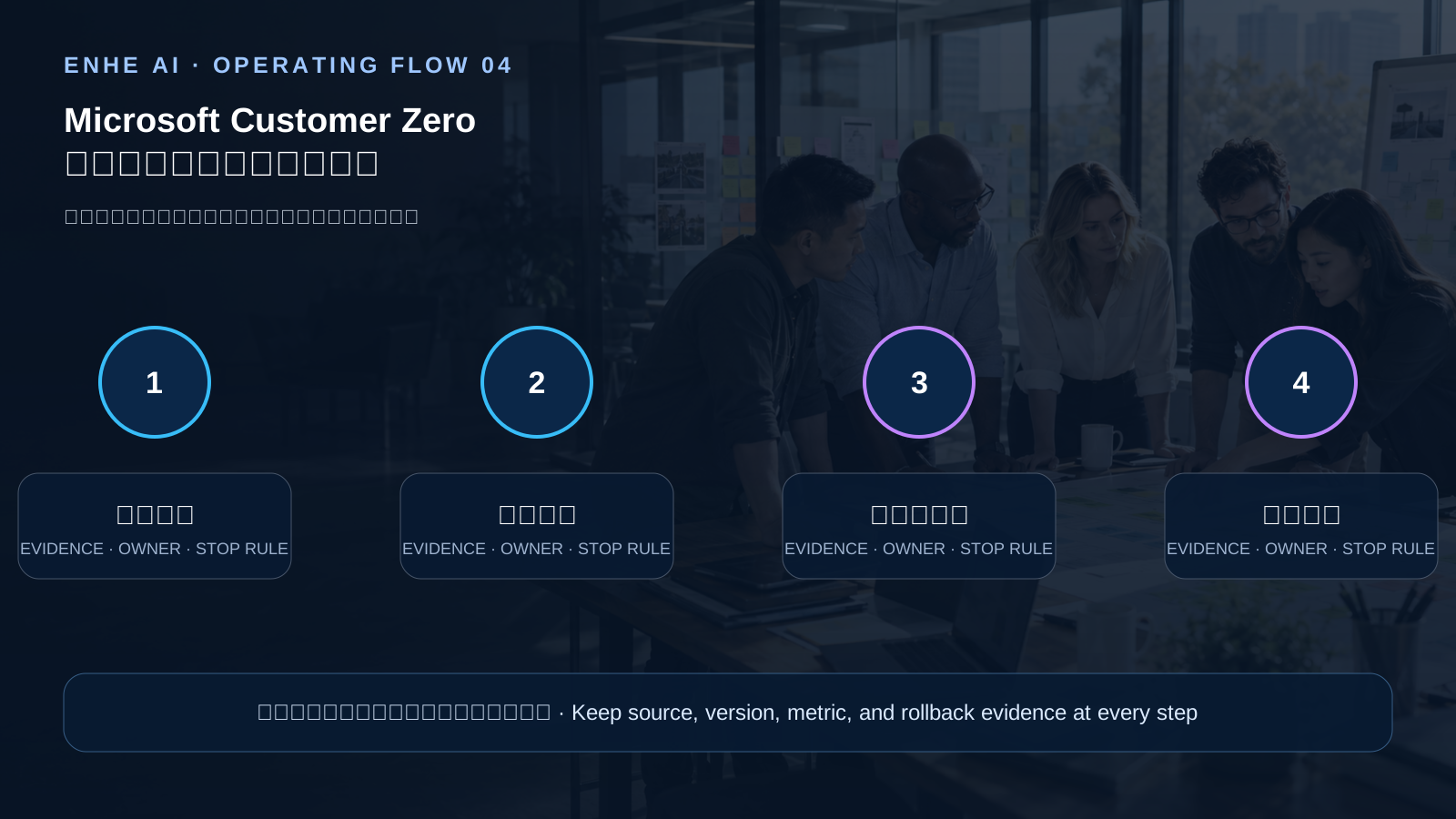
- Choose one business outcome and record the old-process baseline
- Have frontline staff map the full workflow and judgment points
- Set stop rules for agent permissions, approvals, and rollback
- Track speed, quality, risk, and value on one scorecard
AI frontier news and analysis, AI software and model tools, AI skill tutorials and validation methods, and AI account and permission guidance
FAQ
Does high usage prove transformation succeeded?
No. Microsoft explicitly says access and usage do not equal a change in how work gets done.
Can these percentages become my team's targets?
No. They come from specific internal teams, periods, and workflows and should be treated only as references.
Summary
Sustainable AI transformation is not merely running an old process faster. It redesigns people, process, data, and agent accountability around a business outcome.
This AI-assisted article is checked by ENHE AI automation for official sources, bilingual fields, media rights, page safety, and historical duplication before publication.
What this means for everyday users
The review warns leaders not to treat licenses, message counts, or generated code as final value. A credible pilot needs a baseline for the old process, a business owner, quality thresholds, and stop conditions. Microsoft's cases can inform measurement design, but departments differ in data, incentives, and risk. Teams should run a small controlled comparison before expanding an agent's permissions.
Tools you may use


Related tutorials
Related Tools And Tutorials
Use the following ENHE AI sections to continue from the news signal into tool selection, account-service guidance, or practical learning.
Related reading
Microsoft and NVIDIA Publish an Open-Weight Model Risk Guide With Five Risk Categories
Microsoft and NVIDIA published their first joint resource for enterprise open-weight model risk management on October 16, 2026. The guidance organizes discussion into five broad categories: cybersecurity, data protection, content, human-AI interaction, and bias. Its central point is that weight openness alone does not determine risk; the model, intended use, deployment architecture, users, data, tools, and safeguards all shape the actual system. It also distinguishes model access from deployment choice and warns that self-operated deployments can transfer controls from a managed provider to the enterprise. This article turns the framework into a practical selection, ownership, evaluation, and review checklist for ordinary teams.
Microsoft Details Azure Maia 300 for Long-Context and Agentic AI Inference
Microsoft announced an expansion of its Azure Maia system on October 12, 2026. Maia 200 is already serving production workloads including Microsoft Copilot, with GitHub Copilot and Microsoft Foundry planned to follow by year-end. Maia 300 is designed for long-context reasoning, latency-sensitive conversations, and sustained multi-step agent work, with production deployments expected to begin in 2027. This article translates infrastructure claims into user-visible checks. Ordinary users do not need to buy hardware or migrate today. Instead, watch whether the services you already use become faster, more consistent, or cheaper; verify regional availability and data terms; compare quality on the same task; and keep an export or fallback path in case tighter hardware-software integration increases platform dependence.
Microsoft Announces Streaming Transcription: Voice Agents Can Respond Earlier
On October 1, Microsoft AI announced MAI-Transcribe-2-Streaming, MAI-Voice-2.1, and a Flash variant. Microsoft says the streaming transcription model supports 60 languages with continuous language detection, and that initial partials can appear just over 100 milliseconds after audio arrives. Its speech-generation models are described as supporting 23 languages and 26 locales. Rankings, accuracy, speed, and price claims come from Microsoft’s announcement and do not predict results for every workload. This article explains the interaction changes and suggests tests for latency, revisions, accents, privacy, and total cost. Teams should check applicability against their own environment, record assumptions, and validate decisions with representative operational evidence.
Microsoft’s 2026 Defense Report: AI Is Changing the Pace of Cybersecurity
In its October 1 commentary on the 2026 Microsoft Digital Defense Report, Microsoft says threat actors are using AI in parts of existing workflows, including reconnaissance and social engineering. The post does not claim that attacks have become fully autonomous; it highlights changes in speed and scale. Identity controls, least privilege, data protection, monitoring, testing, and secure development remain central. This article separates Microsoft’s observations from independent conclusions and turns the post into a practical checklist. Teams should compare the claims with their own telemetry and incident history before changing priorities. Teams should check applicability against their own environment, record assumptions, and validate decisions with representative operational evidence.
Microsoft Foundry brings model choice, voice, and continuous optimization into one loop
Microsoft announced a set of Foundry Agent Service updates on September 24. Voice agents entered public preview with support for more than 80 languages and 140 locales, and resilience for long-running hosted agents also entered public preview. Tool search in Toolboxes and Agent-to-Agent support are generally available, while Routines can start agents on a schedule, after a delay, or from an event. Foundry also links production traces, issue insights, evaluation data, and agent optimization into a continuous improvement loop. Microsoft's token-reduction figures come from an internal evaluation on a public benchmark, so teams still need their own tool catalog, accents, telephony paths, permissions, and regression tests.
Microsoft's 2026 AI diffusion update finds growth alongside a wider gap
Microsoft published its latest Global AI Diffusion update on September 21. Using aggregated and anonymized telemetry adjusted for operating-system share, device mix, internet penetration, and population, Microsoft estimates that generative-AI use reached 18.8% of the world's working-age population in June, about one percentage point higher than in the first quarter. The reported rates were 28.8% in the Global North and 16.2% in the Global South, widening the measured gap. Microsoft also observes a larger share of education and learning use in the Global South. The measure does not capture every new model or tool and is being revised, so it is useful for directional comparison rather than as a direct ranking of national capability, productivity, or social benefit.