
Microsoft Foundry brings model choice, voice, and continuous optimization into one loop
Microsoft updates voice agents, long-running recovery, tool search, A2A, and production-trace optimization in Foundry.

Key takeaways
Microsoft announced a set of Foundry Agent Service updates on September 24. Voice agents entered public preview with support for more than 80 languages and 140 locales, and resilience for long-running hosted agents also entered public preview. Tool search in Toolboxes and Agent-to-Agent support are generally available, while Routines can start agents on a schedule, after a delay, or from an event. Foundry also links production traces, issue insights, evaluation data, and agent optimization into a continuous improvement loop. Microsoft's token-reduction figures come from an internal evaluation on a public benchmark, so teams still need their own tool catalog, accents, telephony paths, permissions, and regression tests.
Direct answer
Microsoft announced a set of Foundry Agent Service updates on September 24. Voice agents entered public preview with support for more than 80 languages and 140 locales, and resilience for long-running hosted agents also entered public preview. Tool search in Toolboxes and Agent-to-Agent support are generally available, while Routines can start agents on a schedule, after a delay, or from an event. Foundry also links production traces, issue insights, evaluation data, and agent optimization into a continuous improvement loop. Microsoft's token-reduction figures come from an internal evaluation on a public benchmark, so teams still need their own tool catalog, accents, telephony paths, permissions, and regression tests.
Verified facts
Microsoft announced public previews for Foundry voice agents and long-running hosted-agent resilience on September 24, 2026.
Voice agents support more than 80 languages and 140 locales, while tool search and A2A are generally available.
Routines can trigger agents by schedule, delay, or event, and production traces can feed insight, evaluation, and optimization workflows.
What changed
- Voice agents and long-running resilience enter public preview
- Tool search and A2A become generally available
- Routines provide native triggers
- Production traces feed evaluation and optimization
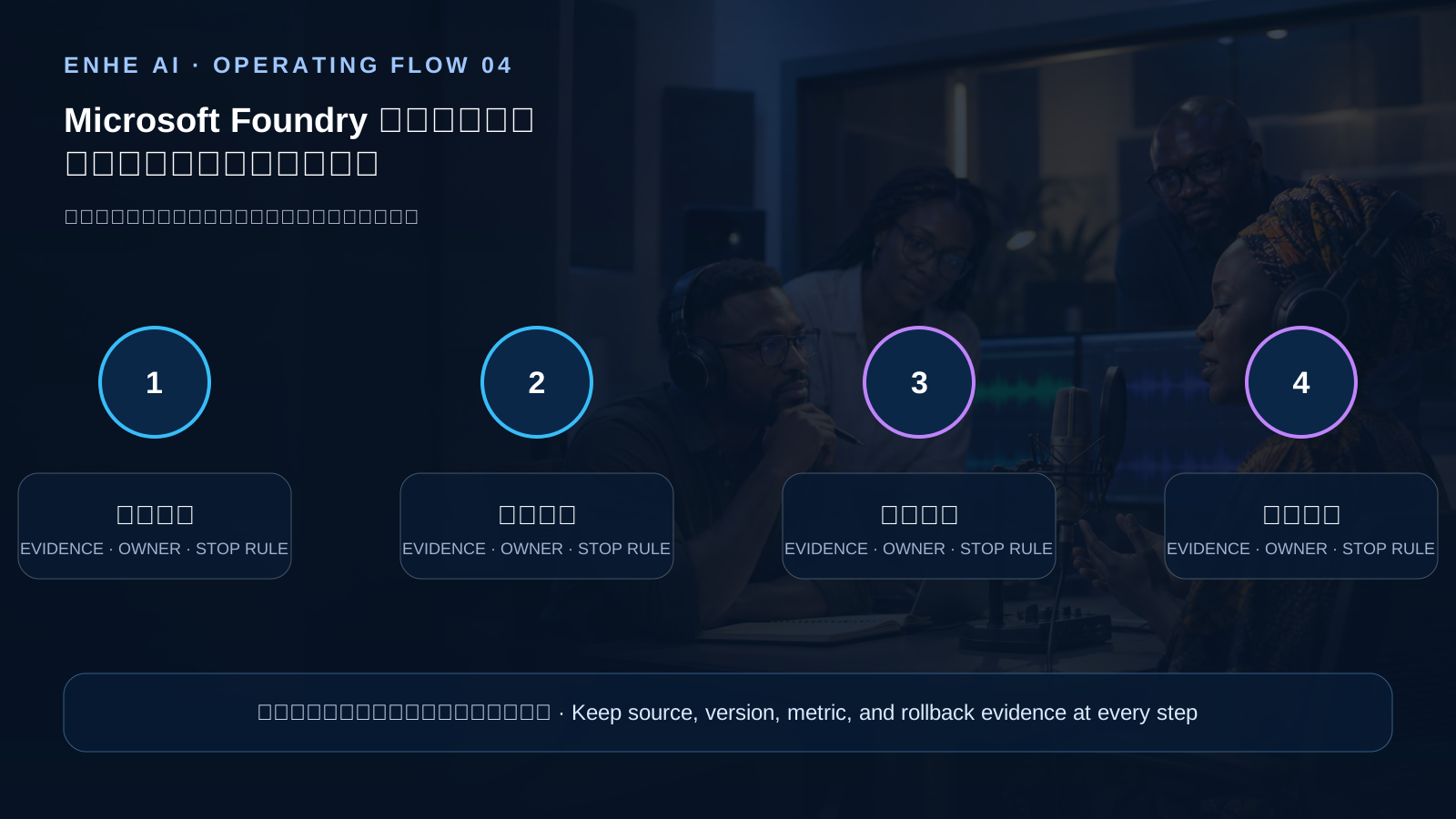
Impact for AI users
Platform teams should manage each capability by release status: keep previews in sandboxes or limited traffic, and still validate generally available features against local permissions and regressions. Voice tests need interruptions, noise, accents, transfers, recording notice, and human takeover. Long-running work needs disconnect, host-failure, and checkpoint drills. Optimization should run only on controlled datasets with rollback conditions.
Operating checklist
- Tier pilots by preview and general-availability status
- Test voice noise, interruption, and takeover
- Drill disconnect and recovery for long tasks
- Pin evaluation data and rollback conditions before optimization
AI frontier news and analysis, AI software and model tools, AI skill tutorials and validation methods, and AI account and permission guidance
FAQ
Are all capabilities generally available?
No. Voice agents and long-running resilience are public previews, while tool search, A2A, and Routines have different release status.
Will every catalog reproduce the token reductions?
Not necessarily. Results depend on tools, queries, and the comparison baseline.
Summary
Foundry is combining agent runtime, voice, tools, and optimization, but production adoption still needs capability-by-capability acceptance based on status and risk.
This AI-assisted article is checked by ENHE AI automation for official sources, bilingual fields, media rights, page safety, and historical duplication before publication.
What this means for everyday users
Platform teams should manage each capability by release status: keep previews in sandboxes or limited traffic, and still validate generally available features against local permissions and regressions. Voice tests need interruptions, noise, accents, transfers, recording notice, and human takeover. Long-running work needs disconnect, host-failure, and checkpoint drills. Optimization should run only on controlled datasets with rollback conditions.
Tools you may use


Related tutorials
Related Tools And Tutorials
Use the following ENHE AI sections to continue from the news signal into tool selection, account-service guidance, or practical learning.
Related reading
Eleven Realtime v1 Mini and Max Launch: Choosing a Voice-Agent Path
ElevenLabs launched Eleven Realtime v1 Mini and v1 Max on October 20, 2026. Both speech-to-speech models support more than 90 languages and over 17,000 voices, but they target different tasks: Mini emphasizes lower-cost natural conversations, while Max is designed for support, lead qualification, and multi-step work. This article offers a selection and migration checklist instead of repeating benchmark claims. It explains how to compare both models on the same script, what OpenAI Realtime API compatibility means, why WebRTC integrations must move to WebSocket, and when ElevenAgents is the better starting point for channels, knowledge bases, guardrails, testing, and monitoring.
Microsoft Details Azure Maia 300 for Long-Context and Agentic AI Inference
Microsoft announced an expansion of its Azure Maia system on October 12, 2026. Maia 200 is already serving production workloads including Microsoft Copilot, with GitHub Copilot and Microsoft Foundry planned to follow by year-end. Maia 300 is designed for long-context reasoning, latency-sensitive conversations, and sustained multi-step agent work, with production deployments expected to begin in 2027. This article translates infrastructure claims into user-visible checks. Ordinary users do not need to buy hardware or migrate today. Instead, watch whether the services you already use become faster, more consistent, or cheaper; verify regional availability and data terms; compare quality on the same task; and keep an export or fallback path in case tighter hardware-software integration increases platform dependence.
ElevenLabs Launches Eleven v4 and v4 Turbo for Expressive Speech
ElevenLabs launched Eleven v4 and the lower-latency Eleven v4 Turbo on September 28, 2026 and updated the announcement on October 5. The company says both models support more than ninety languages, stronger emotional and audio-tag control, multi-speaker dialogue, and more consistent speaker identity across generations. They are available through ElevenAgents, ElevenCreative, and the ElevenAPI. This guide helps creators choose v4 for produced narration, dubbing, and character work or v4 Turbo for interactive voice agents where response time matters. Test pronunciation, pacing, latency, regeneration consistency, and actual credit cost with your own scripts. Obtain clear permission before cloning a real person's voice, label synthetic audio where required, and keep a human listening review before publishing or using a voice agent with customers.
Microsoft Announces Streaming Transcription: Voice Agents Can Respond Earlier
On October 1, Microsoft AI announced MAI-Transcribe-2-Streaming, MAI-Voice-2.1, and a Flash variant. Microsoft says the streaming transcription model supports 60 languages with continuous language detection, and that initial partials can appear just over 100 milliseconds after audio arrives. Its speech-generation models are described as supporting 23 languages and 26 locales. Rankings, accuracy, speed, and price claims come from Microsoft’s announcement and do not predict results for every workload. This article explains the interaction changes and suggests tests for latency, revisions, accents, privacy, and total cost. Teams should check applicability against their own environment, record assumptions, and validate decisions with representative operational evidence.
Agent Trust 2026: Why AI Agent Competition Is Shifting Toward Interoperability
Global AI agent competition is expanding from who has the strongest model to who can connect more systems and complete cross-platform work safely. A July 2026 cooperation initiative emphasizes trust, standards, security, open collaboration, privacy, and inclusion. The ITU's new focus group targets identity and access management for agentic AI. Linux Foundation projects address complementary infrastructure: A2A for agent communication and the proposed Agent Name Service for naming, discovery, and authenticity. This does not mean model quality is becoming irrelevant. It means competitive advantage is increasingly shaped by ecosystem compatibility, permission controls, auditability, data boundaries, operational reliability, and failure recovery. Users should judge agent platforms by governed execution, not only benchmark scores or polished demonstrations.
China Proposes a Global AI Agent Trust and Interoperability Initiative
A global cooperation initiative released on July 17, 2026 calls for mutual trust, connectivity, and interoperability among AI agents. Its nine proposals span ecosystem development, security governance, open-source collaboration, standard interfaces, privacy protection, and digital inclusion. The initiative arrives alongside an ITU focus group on agent identity and access management, the Linux Foundation's Agent Name Service proposal, and the A2A protocol project. Together, these efforts show AI agent competition expanding beyond model quality toward trusted identity, service discovery, cross-platform communication, permission control, and auditable execution. For users and small teams, the immediate task is not to assume a universal standard exists, but to demand clear identities, scoped permissions, logs, approval gates, and rollback paths.