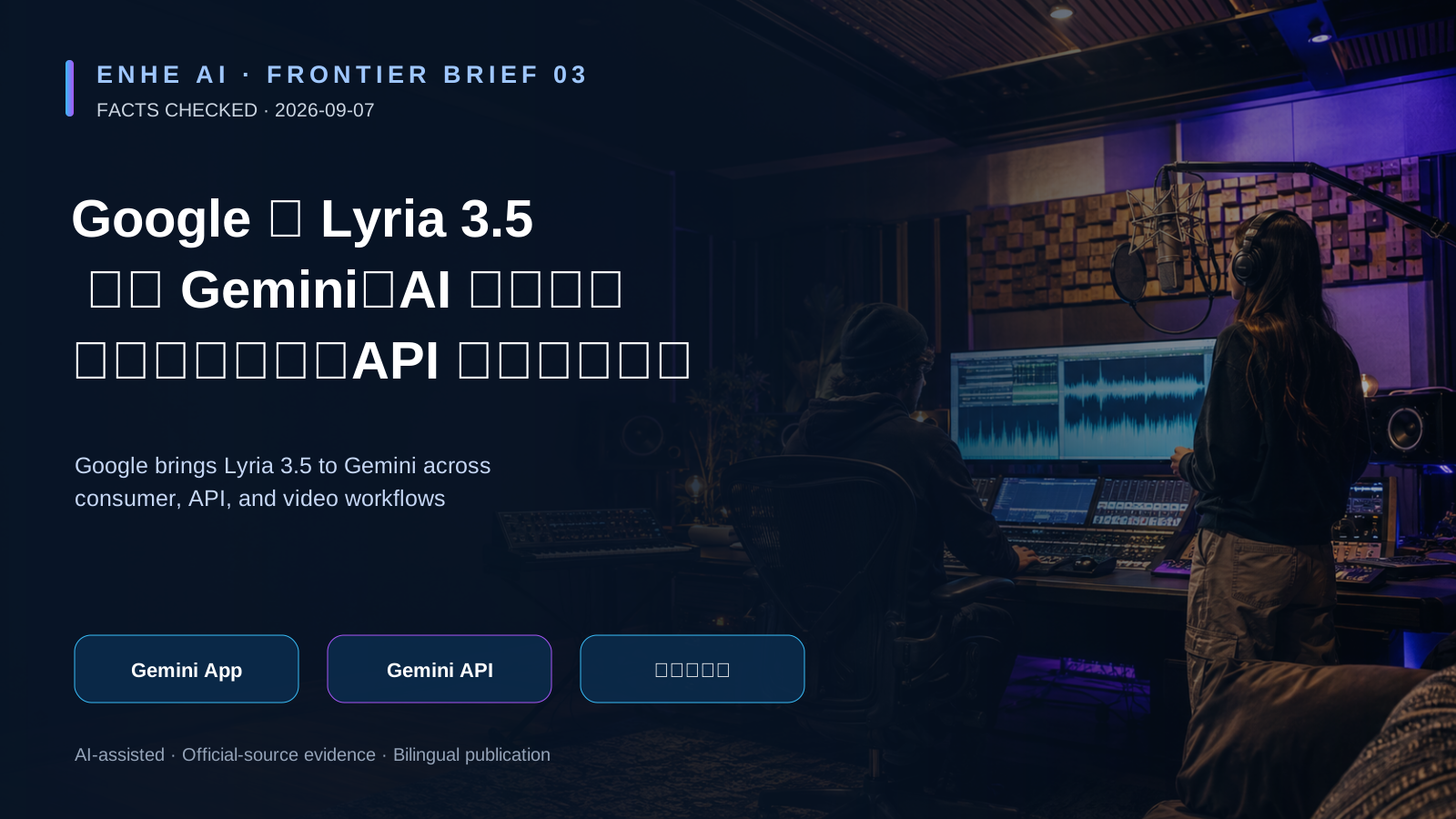
Google brings Lyria 3.5 to Gemini across consumer, API, and video workflows
Richer vocals and arrangements are widely available, while creators still need rights, brand, and release controls.

Key takeaways
Google announced on September 4 that Lyria 3.5 is available in the Gemini app and Gemini API, with more expressive vocals, richer arrangements, and higher-fidelity output. Users can choose or describe a genre, select vocal or instrumental styles, and create short or longer tracks. Google also lists availability through Flow Music, Google AI Studio, and Google Vids, while saying Gemini access is global on web and mobile. For creators, marketers, and product teams, easier generation expands the number of usable drafts but does not remove the need to document source material, permissions, brand review, and final publication. Teams should test prompt repeatability, vocal handling, export quality, and licensing terms in their own account before production use.
Direct answer
Google announced on September 4 that Lyria 3.5 is available in the Gemini app and Gemini API, with more expressive vocals, richer arrangements, and higher-fidelity output. Users can choose or describe a genre, select vocal or instrumental styles, and create short or longer tracks. Google also lists availability through Flow Music, Google AI Studio, and Google Vids, while saying Gemini access is global on web and mobile. For creators, marketers, and product teams, easier generation expands the number of usable drafts but does not remove the need to document source material, permissions, brand review, and final publication. Teams should test prompt repeatability, vocal handling, export quality, and licensing terms in their own account before production use.
Verified facts
Google says Lyria 3.5 is available in the Gemini app and Gemini API, with improvements to vocal expression, arrangement richness, and overall fidelity.
The Gemini experience lets users choose or describe a genre, select vocal or instrumental styles, and choose between short and longer tracks.
Google also lists Flow Music, Google AI Studio, and Google Vids as access points. Gemini web and mobile availability is described as global, while account, region, quota, and commercial terms still need product-level confirmation.
What changed
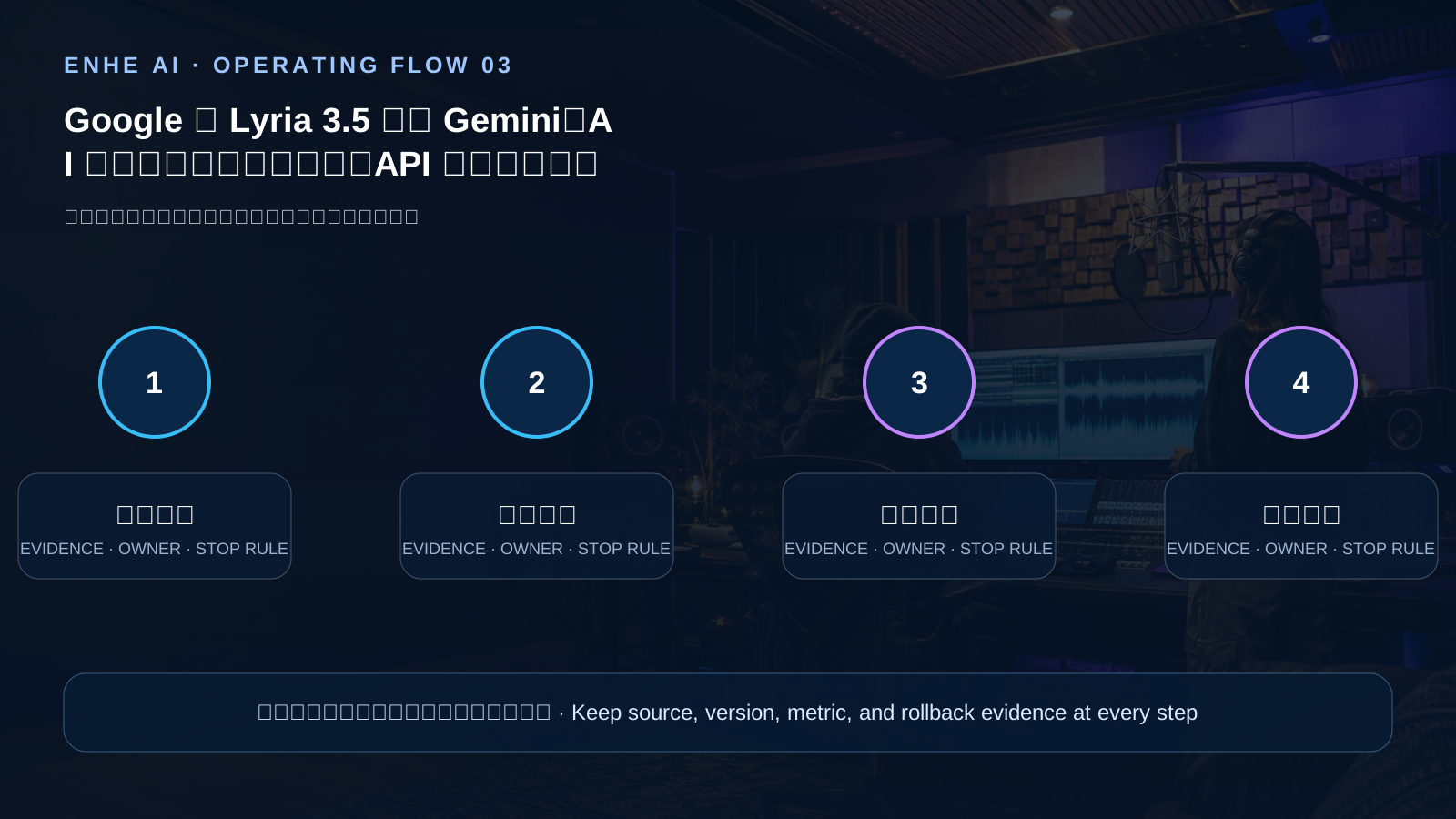
- Improved vocals and arrangements
- Short and longer track options
- Consumer app and API access
- Connections to video and creator workflows
Impact for AI users
Individuals can create backing tracks, ringtones, or song drafts faster, while companies can connect brand videos, podcast intros, and presentation music to one workflow. A usable output is not automatically cleared for commercial release. If a prompt references existing songs, artist styles, brand assets, or customer material, teams should check rights and platform terms and retain version, prompt, and approval records.
Operating checklist
- Classify the use first: internal draft, public content, paid advertising, or client delivery.
- Fix three to five representative prompts and compare vocals, structure, sound quality, editability, and generation cost.
- Maintain a rights record with input sources, model version, prompt, export time, and approver.
- Before release, check brand fit, sensitive content, loudness, and platform format.
AI frontier news and analysis, AI software and model tools, AI skill tutorials and validation methods, and AI account and permission guidance
FAQ
Is Lyria 3.5 limited to the Gemini app?
No. Google also lists the Gemini API, Flow Music, Google AI Studio, and Google Vids.
Can a generated track be placed in an advertisement immediately?
Generation alone does not establish clearance. Check current account terms, source-material rights, brand requirements, and the distribution platform's rules.
How can a team tell whether the upgrade is useful?
Repeat fixed prompts and measure vocal naturalness, structural control, artifacts, export quality, editing time, and final cost per usable track.
Summary
Lyria 3.5 expands access to AI music creation, while a sustainable workflow still has to manage rights, brand fit, versions, and publication evidence together.
This AI-assisted article is checked by ENHE AI automation for official sources, bilingual fields, media rights, page safety, and historical duplication before publication.
What this means for everyday users
Individuals can create backing tracks, ringtones, or song drafts faster, while companies can connect brand videos, podcast intros, and presentation music to one workflow. A usable output is not automatically cleared for commercial release. If a prompt references existing songs, artist styles, brand assets, or customer material, teams should check rights and platform terms and retain version, prompt, and approval records.
Tools you may use


Related tutorials
[[zh]][[/zh]][[en]]Review a public website[[/en]]
SearchScope SEO/GEO
[[zh]][[/zh]][[en]]Access and usage guide[[/en]]
AI Prompt Management System | 418 Bilingual Prompts for Writing, SEO and AI Creation
High-Frequency AI Prompts for Work, Learning, and Teaching guide
High-Frequency AI Prompts for Work, Learning, and Teaching
Related Tools And Tutorials
Use the following ENHE AI sections to continue from the news signal into tool selection, account-service guidance, or practical learning.
Related reading
Gemini Personal Intelligence Reaches Cars: Android Auto Access and Privacy Controls
Google has announced Personal Intelligence for Gemini in cars, adding an optional way to use information from connected Google apps while driving. The rollout covers eligible personal accounts rather than Workspace business, enterprise, or education accounts, and several regions are excluded. This article explains the October 20 announcement, the opt-in privacy control, and the difference between Android Auto timing and cars with Google built-in. It also provides a low-risk flight-gate example with a clear verification step. The goal is to help drivers decide whether the feature is available and useful without treating a spoken answer as the final source for travel changes, appointments, payments, or other consequential decisions.
Gemini Launches a Small-Business Hub for Brand Assets, Connected Apps, and Finance
Google has introduced a dedicated business landing page in the Gemini app for small-business tasks such as brand building, marketing, finance analysis, and customer insights. The announcement also lists connections to Google Business Profile, Ads, Workspace, and third-party apps including Canva, Shopify, Xero, and others. This article explains the global rollout wording and offers a practical two-part workflow: prepare a brand brief for a weekend promotion, then turn verified expense data into a reviewable chart. It emphasizes minimal app connections, source checking, and human approval before publication or financial use. The release can reduce context switching, but it does not mean every account receives the hub immediately or that generated claims, graphics, and numbers are ready to use without review.
Gemini Skills Begin Rolling Out as Workspace Skills Are Delayed
Google’s latest rollout update separates two things that are easy to confuse: skills in the Gemini app and skills inside Workspace. The app rollout begins gradually and is expected to finish by mid-November, while the Workspace launch is delayed pending a revised timeline. For creators, the practical opportunity is to prepare a reusable writing routine rather than assume a scheduled publishing system is already available. This article provides a bounded article-rewrite example, explains where the documented Skills entry point lives, and distinguishes reusable instructions from background scheduling. It also flags account requirements and features still promised for later. The example is a preparation checklist, not a claim of hands-on access or automatic publication.
Gemini 4 Argon Is Now Available: Where Users and Developers Can Access It
Google announced Gemini 4 Argon availability on October 13, 2026. Google AI Pro and Ultra subscribers can use it in the Gemini app, including a task mode for longer work, while developers can access the model through the paid Gemini API tier, Google AI Studio, and Android Studio. Google AI Ultra subscribers can also try it in the Antigravity agent-first development environment. The rollout spans consumer, coding, and API surfaces, but the access terms are not identical. This article separates current availability from product claims and gives users a practical test: choose one bounded task, record the entry point and model, review connected apps, require confirmation for external actions, inspect sources and outputs, and keep a manual fallback for failures.
GitHub Copilot Will Retire Six Models on October 19, 2026
GitHub will retire six models across all Copilot experiences on October 19, 2026: Gemini 3.7 Flash, GPT-5.5, GPT-5.4, GPT-5.4 mini, GPT-5 mini, and Grok 4.5. GitHub recommends Gemini 3.8 Flash, GPT-5.6 Sol, GPT-5.6 Luna, or Grok 4.6 depending on the retired model. The removal covers Copilot Chat, inline edits, ask and agent modes, and code completions, so a model pinned outside the chat picker can still affect a workflow. Suggested alternatives may be enabled automatically for Business and Enterprise customers under default model enablement, but organizations that disabled the global default or explicitly blocked a model must review policy manually. This migration checklist focuses on finding pinned references, approving replacements, testing representative work, and communicating the change before the cutoff.
Google Cloud Introduces the Gemini Agent for Work
Google Cloud introduced the Gemini agent at Gemini at Work on October 8, 2026. Google describes it as a universal work agent that can use an organization's business context, plan work, call skills and tools, connect to business systems, and return completed results inside documents, inboxes, and developer environments. The announcement also highlights model selection, cost controls, security, administration, and governance. Those claims define a product direction, not automatic permission to connect every data source. Before rollout, start with one bounded workflow, list the records and tools the agent can reach, separate read from write access, cap spend, require confirmation before messages or irreversible changes, verify the destination of generated work, and keep a human owner for exceptions and acceptance.