
Google Intelligent Endpoints pair agentic productivity with endpoint governance
Google combines browser, operating system, hardware, and policy controls into an endpoint strategy for agentic work.

Key takeaways
Google Cloud described Google Intelligent Endpoints on September 23 as a strategy that combines Chrome, ChromeOS, Android Enterprise, hardware, and policy management for agentic work. The article argues that agents can execute multi-step processes across applications, but endpoint controls must protect data at the browser, operating-system, and user layers. Google highlights granular data-loss prevention in Chrome Enterprise Premium and previews controls that could block sensitive material at the copy trigger. The practical decision is broader than enabling an agent: teams need to check delegated permissions, clipboard boundaries, legacy-app compatibility, logging, user notice, and recovery when an automated workflow reaches an unexpected screen.
Direct answer
Google Cloud described Google Intelligent Endpoints on September 23 as a strategy that combines Chrome, ChromeOS, Android Enterprise, hardware, and policy management for agentic work. The article argues that agents can execute multi-step processes across applications, but endpoint controls must protect data at the browser, operating-system, and user layers. Google highlights granular data-loss prevention in Chrome Enterprise Premium and previews controls that could block sensitive material at the copy trigger. The practical decision is broader than enabling an agent: teams need to check delegated permissions, clipboard boundaries, legacy-app compatibility, logging, user notice, and recovery when an automated workflow reaches an unexpected screen.
Verified facts
Google Cloud introduced Google Intelligent Endpoints on September 23 as a combination of browser, operating-system, hardware, and management controls.
The article describes agentic workflows in which employees define outcomes and agents execute multi-step processes across apps.
Chrome Enterprise Premium provides browser DLP, while Google previews a control that can block sensitive data at the copy trigger.
What changed
- An endpoint stack spans browser, OS, and hardware
- Agentic workflows become a productivity entry point
- Browser DLP and copy-trigger controls gain emphasis
- Legacy apps remain part of the management path
Impact for AI users
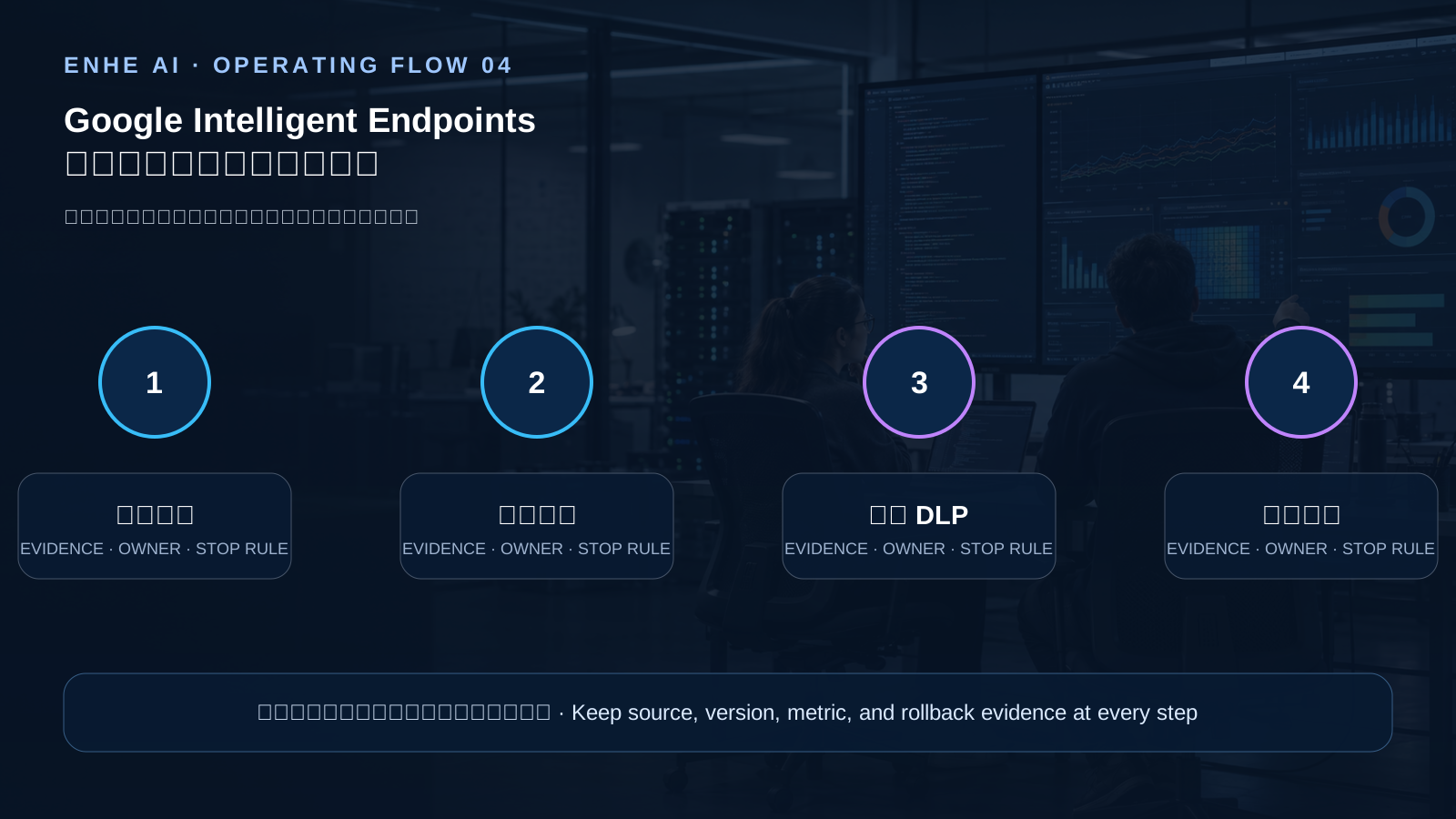
Endpoint governance becomes the practical boundary for agent deployment. Organizations need to measure what an agent reads, copies, and sends into legacy systems, as well as how operators stop it when a screen or policy changes. Start with a sandboxed low-risk workflow, include DLP hits, policy exceptions, and user feedback in acceptance metrics, and keep a human takeover path.
Operating checklist
- Map the data an agent can read and write
- Test DLP and permissions in a sandbox first
- Record unexpected screens and human takeovers
- Include logging and user notice in go-live gates
AI frontier news and analysis, AI software and model tools, AI skill tutorials and validation methods, and AI account and permission guidance
FAQ
Is enabling a browser agent enough for safe workflows?
No. Permissions, DLP, logging, and exception handling must work together.
Can DLP disrupt legacy applications?
It can, so test copy, upload, and exception policies with representative legacy apps.
Summary
The point of an intelligent endpoint is not simply adding more AI, but making agent permissions, data boundaries, and recovery paths visible together.
This AI-assisted article is checked by ENHE AI automation for official sources, bilingual fields, media rights, page safety, and historical duplication before publication.
What this means for everyday users
Endpoint governance becomes the practical boundary for agent deployment. Organizations need to measure what an agent reads, copies, and sends into legacy systems, as well as how operators stop it when a screen or policy changes. Start with a sandboxed low-risk workflow, include DLP hits, policy exceptions, and user feedback in acceptance metrics, and keep a human takeover path.
Tools you may use


Related tutorials
Related Tools And Tutorials
Use the following ENHE AI sections to continue from the news signal into tool selection, account-service guidance, or practical learning.
Related reading
Microsoft Details Azure Maia 300 for Long-Context and Agentic AI Inference
Microsoft announced an expansion of its Azure Maia system on October 12, 2026. Maia 200 is already serving production workloads including Microsoft Copilot, with GitHub Copilot and Microsoft Foundry planned to follow by year-end. Maia 300 is designed for long-context reasoning, latency-sensitive conversations, and sustained multi-step agent work, with production deployments expected to begin in 2027. This article translates infrastructure claims into user-visible checks. Ordinary users do not need to buy hardware or migrate today. Instead, watch whether the services you already use become faster, more consistent, or cheaper; verify regional availability and data terms; compare quality on the same task; and keep an export or fallback path in case tighter hardware-software integration increases platform dependence.
gFiber and Qualcomm Unveil a Wi-Fi 8 Gateway With On-Device Agentic AI
gFiber, Qualcomm, and Gemtek unveiled the Wi-Fi 8 Premium Gateway on October 12, 2026. The device combines Wi-Fi 8, a dedicated NPU, and agentic AI for tasks such as pausing social media on selected devices through natural language, creating guest-access QR codes, and diagnosing network health. Existing gFiber 20 Gig customers are expected to receive the device first after certification, while retail pricing and a broad timetable were not announced. This article explains what households should verify beyond the demo: which requests and logs stay on the gateway, who can authorize network changes, how guests and children are identified, how long security updates last, what happens when AI or cloud services fail, and whether conventional controls remain available.
Intel Details GPU D-Series for Open and Heterogeneous Agentic AI Inference
Intel published new details for its GPU D-series on October 12, 2026 at the OCP Global Summit. The accelerator is described with up to 480 GB of LPDDR5X memory, a standard PCIe form factor, air cooling, and support for long-context, large-model, and concurrent inference workloads. Customer sampling is underway, but the announcement does not provide general availability, retail pricing, or independent task results. This article explains what developers and smaller teams can do now: describe the actual model and concurrency target, verify framework and runtime support, measure memory and power limits, compare cloud rental with owned hardware, test output quality and latency, and delay procurement until a reproducible configuration and support path exist.
A One-Week AI Agent Security Review Using the OWASP Risk Framework
The OWASP Gen AI Security Project published its 2026 Top 10 for Agentic Applications in December 2025 as a risk framework for systems that plan, call tools, or act across services. It is a starting point for security discussion, not a certification, compliance attestation, or guarantee of safety. This article turns it into a one-week baseline review: inventory agent identities and tools, narrow permissions, treat external content as untrusted input, record consequential actions, test shutdown and revocation, and define approval and recovery for high-impact operations. Teams should extend the checklist to match their architecture and threat model. Teams should check applicability against their own environment, record assumptions, and validate decisions with representative operational evidence.
AWS Jam adds three hands-on agent challenges, from specs to production governance
AWS announced three new AWS Jam experiences on September 30 for agentic AI development: spec-driven development with Kiro, building agents with Bedrock AgentCore, and advanced agentic systems. The company lists eight to twelve hands-on challenges covering MCP servers, subagents, content safety, IAM isolation, monitoring, and policy controls. Each is a one-day, team-based exercise in a live AWS console sandbox and can be offered alone or alongside instructor-led training. Participants solve operational tasks with AWS services rather than answer multiple-choice questions. The exercises can reveal gaps in deployment, permissions, and troubleshooting, but completion is not proof that a team is production-ready. Confirm access requirements, delivery format, and possible sandbox resource charges before scheduling a session.
Microsoft publishes its 2026 Responsible AI Transparency Report for agentic systems
Microsoft published its 2026 Responsible AI Transparency Report on September 1. The report describes a re-engineered Responsible AI Standard, stronger governance for agentic AI, expanded evaluation, and work on AI misuse. Microsoft argues that responsible AI cannot remain a static checklist; it must be embedded in development processes, practical tools, and continuous measurement. For product teams, the useful question is whether risk categories, evaluation evidence, launch criteria, and incident feedback form a traceable control loop. The report also gives buyers a public baseline for asking vendors how their governance works in practice. This gives teams a practical comparison point for deployment planning.