
Google Beam expands to six countries and broadens enterprise collaboration
Google Beam adds countries, channel partners, and an extended workspace network while sharing internal collaboration results.

Key takeaways
Google announced on September 23 that Google Beam units would ship to customers in six countries: the United States, Canada, the United Kingdom, France, Germany, and Japan. The company says 18 channel partners can deploy and support the system and that an agreement with Industrious will create an extended network in selected flexible-workspace locations. Google also cites an eight-week internal study in which Beam users reported feeling 50% more connected, found feedback 33% easier to understand, and needed 21% fewer follow-up meetings. Those figures are vendor-reported internal results, so organizations should test their own meeting tasks, privacy requirements, and accessibility needs before treating them as general evidence.
Direct answer
Google announced on September 23 that Google Beam units would ship to customers in six countries: the United States, Canada, the United Kingdom, France, Germany, and Japan. The company says 18 channel partners can deploy and support the system and that an agreement with Industrious will create an extended network in selected flexible-workspace locations. Google also cites an eight-week internal study in which Beam users reported feeling 50% more connected, found feedback 33% easier to understand, and needed 21% fewer follow-up meetings. Those figures are vendor-reported internal results, so organizations should test their own meeting tasks, privacy requirements, and accessibility needs before treating them as general evidence.
Verified facts
Google says Beam units will ship to customers in the United States, Canada, the United Kingdom, France, Germany, and Japan.
The company cites 18 channel partners and an extended-network partnership with Industrious.
An eight-week internal study reported changes in connection, feedback understanding, and follow-up meetings; Google does not present them as universal guarantees.
What changed
- Shipping expands to six countries
- The support ecosystem includes 18 channel partners
- A flexible-workspace network adds access points
- Google shares internal collaboration trial data
Impact for AI users
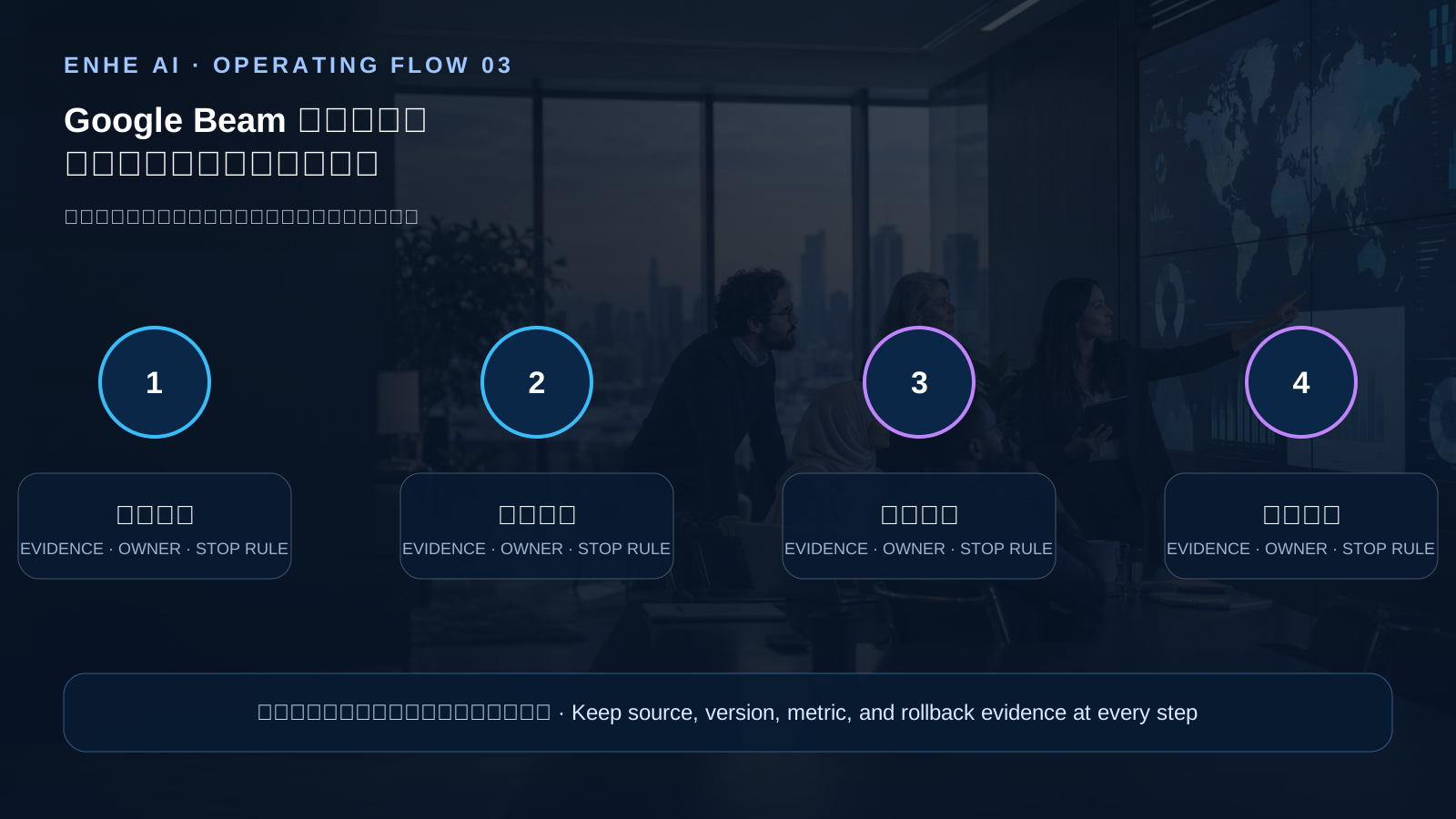
The value of immersive collaboration depends on room setup, connectivity, meeting software, privacy, and accessibility as much as visual presence. Buyers should separate recruiting, manager check-ins, and client consultations, then compare meeting time, misunderstanding, follow-ups, maintenance, and participation equity before scaling.
Operating checklist
- Define success metrics by meeting scenario
- Test remote and in-room participant experiences together
- Review privacy, recording, and accessibility requirements
- Use local pilot data to size procurement
AI frontier news and analysis, AI software and model tools, AI skill tutorials and validation methods, and AI account and permission guidance
FAQ
Does the 50% connection result apply to every team?
It cannot be assumed. It comes from Google's internal eight-week study and depends on team and meeting context.
Does Beam work only with Google Meet?
Google says it integrates with Google Meet and Zoom, but deployment details still need confirmation.
Summary
Beam's rollout shows spatial computing searching for a place in enterprise workflows; the real return still needs local validation.
This AI-assisted article is checked by ENHE AI automation for official sources, bilingual fields, media rights, page safety, and historical duplication before publication.
What this means for everyday users
The value of immersive collaboration depends on room setup, connectivity, meeting software, privacy, and accessibility as much as visual presence. Buyers should separate recruiting, manager check-ins, and client consultations, then compare meeting time, misunderstanding, follow-ups, maintenance, and participation equity before scaling.
Tools you may use


Related tutorials
Related Tools And Tutorials
Use the following ENHE AI sections to continue from the news signal into tool selection, account-service guidance, or practical learning.
Related reading
Google AI Search Adds Clearer Source Links and More Prominent Official Pages
Google announced source-discovery updates for AI Mode and AI Overviews on October 15, 2026. More inline links are being placed earlier in AI responses, and Google will test a dedicated section near the top when only one or two official pages can complete a task or provide the exact information. Timely-article carousels are expanding to additional locations and languages, related-article links are becoming more visual, and clickable creator or publisher names are being tested for video results. These changes make original pages easier to reach, but they do not turn an AI summary into primary evidence. This article gives ordinary users a verification routine: open the source, check date and ownership, compare the cited passage with the summary, prefer the official task page, inspect multiple reports, and save the evidence used for consequential decisions.
Google Play Lets Users Run Private AI Studio Apps on Android Without a Developer Account
Google announced on October 13, 2026 that users can create a custom Android app with AI in Google AI Studio and run it privately on their own device through Google Play without a developer account. Personal apps remain separate from the public store catalog. The initial rollout is for users aged 18 or older in selected markets, including the United States, while sharing with a small circle of friends and family is planned for later. This article distinguishes private testing from public distribution and gives a safe first-run checklist: define one narrow purpose, inspect generated code and permissions, use test data, verify network calls, confirm cost and account ownership, test uninstall and data deletion, and move to a professional developer account only when broader publication is intentional.
Gemini 4 Argon Is Now Available: Where Users and Developers Can Access It
Google announced Gemini 4 Argon availability on October 13, 2026. Google AI Pro and Ultra subscribers can use it in the Gemini app, including a task mode for longer work, while developers can access the model through the paid Gemini API tier, Google AI Studio, and Android Studio. Google AI Ultra subscribers can also try it in the Antigravity agent-first development environment. The rollout spans consumer, coding, and API surfaces, but the access terms are not identical. This article separates current availability from product claims and gives users a practical test: choose one bounded task, record the entry point and model, review connected apps, require confirmation for external actions, inspect sources and outputs, and keep a manual fallback for failures.
Google Launches Playground for No-Code AI Game Creation
Google introduced Playground on October 7, 2026 as an experimental platform for creating, playing, and sharing custom games through conversational prompts. Users can start from a blank canvas or a starter idea, then ask the system to change rules, characters, physics, and environments before testing the result in a browser. Games can remain private, be shared by link, or be submitted to the public Explore gallery; selected genres also support multiplayer and leaderboards. Availability is narrower than the headline may suggest: the launch is for users aged 18 or older in the United States, with tiered creation access based on Google AI subscriptions. Public submissions receive safety screening and can be reported by users. This guide helps creators verify eligibility, ownership of inputs, privacy, gameplay, sharing scope, and disclosure before publishing.
Google Open-Sources ML Drift for On-Device AI GPU Inference
Google AI Edge open-sourced ML Drift on October 8, 2026 under the Apache 2.0 license. The cross-platform GPU inference engine supports OpenGL ES, OpenCL, Metal, and WebGPU and now serves as the core GPU acceleration engine in LiteRT for mobile, web, and desktop workloads. Google says the legacy TensorFlow Lite GPU delegate will no longer receive new feature updates and recommends moving to the LiteRT ML Drift accelerator, while claiming backward compatibility for existing models. Migration should still be evidence-driven. Teams need to run the same representative models on supported devices, compare output quality, startup and steady-state latency, peak memory, battery or power behavior, binary size, and fallback behavior, then keep the old path available until release telemetry proves the new accelerator is stable.
Google brings Lyria 3.5 to Gemini across consumer, API, and video workflows
Google announced on September 4 that Lyria 3.5 is available in the Gemini app and Gemini API, with more expressive vocals, richer arrangements, and higher-fidelity output. Users can choose or describe a genre, select vocal or instrumental styles, and create short or longer tracks. Google also lists availability through Flow Music, Google AI Studio, and Google Vids, while saying Gemini access is global on web and mobile. For creators, marketers, and product teams, easier generation expands the number of usable drafts but does not remove the need to document source material, permissions, brand review, and final publication. Teams should test prompt repeatability, vocal handling, export quality, and licensing terms in their own account before production use.