
Turn DORA's seven AI capabilities into a weekly operating checklist for software delivery
Clear policy, healthy data, small batches, version control, user focus, and internal platforms have to reinforce one another.

Key takeaways
DORA's AI Capabilities Model draws on qualitative interviews, survey development, and responses from almost 5,000 participants. It identifies seven organizational capabilities that amplify or unlock value from AI-assisted software development: a clear and communicated AI stance, a healthy data ecosystem, AI-accessible internal data, strong version control, working in small batches, user-centric focus, and a quality internal platform. This durable guide converts those findings into a weekly operating checklist with owners and evidence. The objective is not to maximize generated code. It is to connect faster assistance to user outcomes, trusted internal context, reversible delivery, and shared platform controls. Teams can use the checklist during model changes, new tool rollouts, incidents, and regular delivery reviews.
Direct answer
DORA's AI Capabilities Model draws on qualitative interviews, survey development, and responses from almost 5,000 participants. It identifies seven organizational capabilities that amplify or unlock value from AI-assisted software development: a clear and communicated AI stance, a healthy data ecosystem, AI-accessible internal data, strong version control, working in small batches, user-centric focus, and a quality internal platform. This durable guide converts those findings into a weekly operating checklist with owners and evidence. The objective is not to maximize generated code. It is to connect faster assistance to user outcomes, trusted internal context, reversible delivery, and shared platform controls. Teams can use the checklist during model changes, new tool rollouts, incidents, and regular delivery reviews.
Verified facts
DORA identified candidate capabilities through 78 interviews and existing research, validated survey questions, and then analyzed responses from almost 5,000 people in its annual study. Seven capabilities emerged as relevant to the value of AI-assisted development.
The seven capabilities are organizational conditions: clear AI policy, healthy data, secure access to internal context, strong version control, small batches, user focus, and a quality internal platform.
DORA highlights small batches and rollback as safety nets for higher delivery velocity. Without user-centric focus, faster AI-assisted production can move a team more quickly in the wrong direction.
What changed
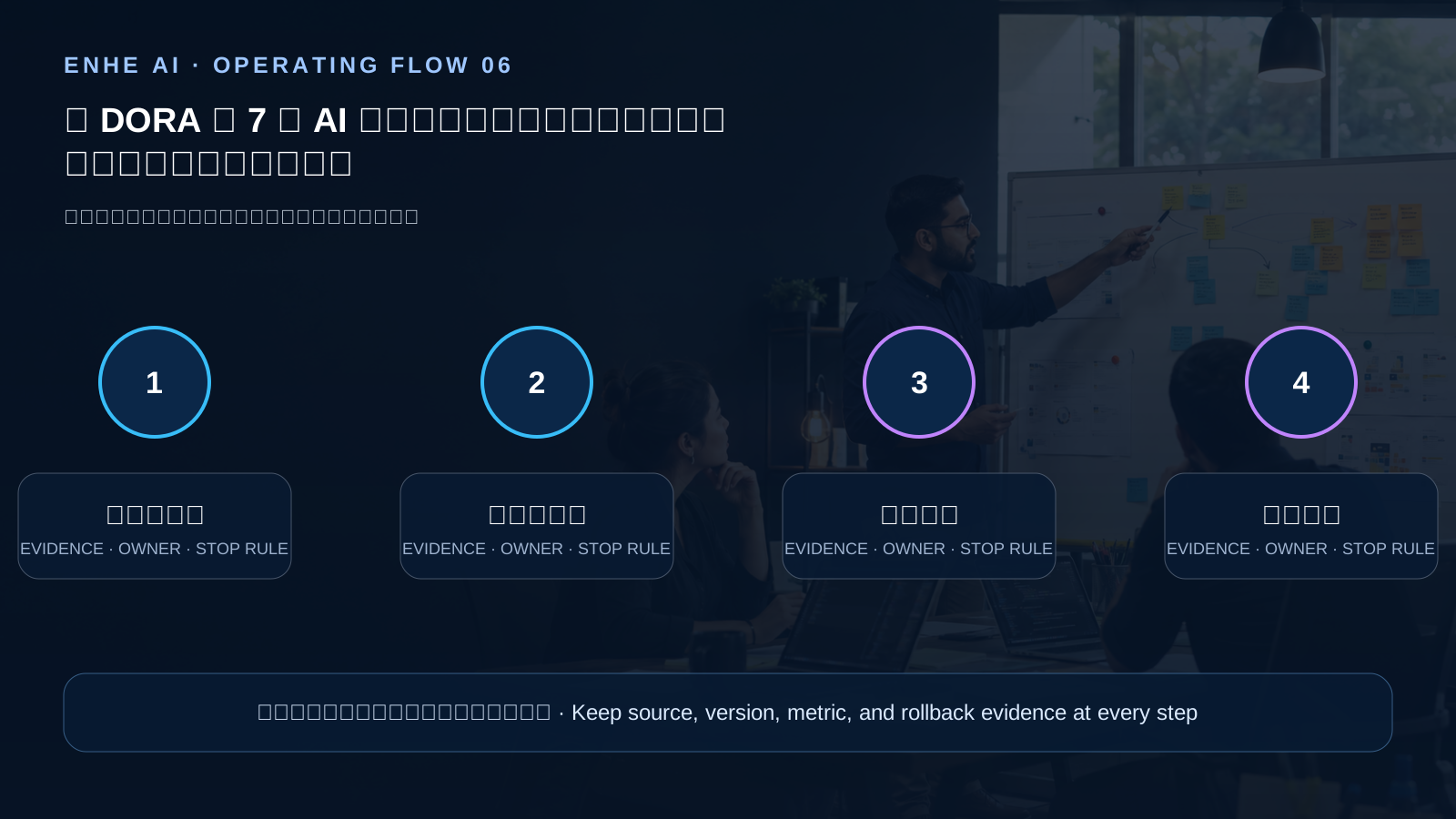
- Policy: permitted and prohibited use
- Data: quality, access, and provenance
- Delivery: small batches and rollback
- Outcomes: user value and platform measures
Impact for AI users
Employees need to know which tools are allowed, what data can be entered, and how to escalate a problem. Developers should place AI-generated changes inside the same version-control, testing, and rollback discipline as other work. Leaders should measure user outcomes, rework, incidents, and cycle time instead of treating generated-code volume or activated seats as success.
Operating checklist
- On Monday, update allowed tools, data boundaries, owners, and exception handling in one discoverable place.
- Sample internal context for quality, access, and provenance, and remove material that is no longer valid.
- Split one large change into independently testable and reversible batches, recording the result of each batch.
- On Friday, review user outcomes, rework, incidents, and cycle time, then decide to continue, adjust, or stop.
AI frontier news and analysis, AI software and model tools, AI skill tutorials and validation methods, and AI account and permission guidance
FAQ
Must all seven capabilities be completed at once?
No. Improve one or two weak areas first, but review every week whether they connect user outcomes to delivery safety.
Why is version control called out separately?
As AI increases change velocity, frequent commits, clear diffs, and practiced rollback become the infrastructure for correction.
How can a team judge internal-platform quality?
Check whether teams can consistently access authorized data, run tests, observe cost and errors, stop work, and recover to a known state.
Summary
Maturity in AI-assisted development is not the number of tools purchased; it is a weekly, verifiable feedback loop across policy, data, delivery, and user outcomes.
This AI-assisted article is checked by ENHE AI automation for official sources, bilingual fields, media rights, page safety, and historical duplication before publication.
What this means for everyday users
Employees need to know which tools are allowed, what data can be entered, and how to escalate a problem. Developers should place AI-generated changes inside the same version-control, testing, and rollback discipline as other work. Leaders should measure user outcomes, rework, incidents, and cycle time instead of treating generated-code volume or activated seats as success.
Tools you may use



Related tutorials
[[zh]][[/zh]][[en]]Review a public website[[/en]]
SearchScope SEO/GEO
[[zh]][[/zh]][[en]]Access and usage guide[[/en]]
AI Prompt Management System | 418 Bilingual Prompts for Writing, SEO and AI Creation
High-Frequency AI Prompts for Work, Learning, and Teaching guide
High-Frequency AI Prompts for Work, Learning, and Teaching
Related Tools And Tutorials
Use the following ENHE AI sections to continue from the news signal into tool selection, account-service guidance, or practical learning.
Related reading
Gemini Adds Connected Apps from Granola and Wix to OpenTable and Zocdoc
Google announced on August 12, 2026 that a new group of connected apps will roll out to Gemini over the coming weeks. The list includes Granola, Otter.ai, Wix, Fever, GetYourGuide, Localiza, OpenTable, Ticketmaster, iHeartRadio, Pandora, Angi, Thumbtack, and Zocdoc. Tasks range from summarizing meetings and editing a website to booking experiences, finding music, and scheduling services. Availability and exact actions will vary by region, account, and provider. Connect only the service needed for the current task, inspect read and write permissions, start with a non-sensitive read-only test, require confirmation before publishing, booking, or paying, and document how to disconnect and recover from partial or duplicate actions.
GitHub's Updates Show AI Developer Tools Entering a Cost Governance Era
GitHub's July 2026 announcements point to a broader shift in global AI developer tools. Copilot CLI is easier to use inside GitHub Actions, session limits can cap AI credit use, cost centers can manage included usage caps, and GitHub Models is scheduled for retirement. Together, these updates show that AI competition is moving beyond model demos. Developers, small teams, and enterprises now need to compare permission models, budget controls, audit logs, model-access stability, and human review. For ENHE AI readers, the practical insight is that AI tooling strategy should include governance from the beginning, even when the first trial looks small.
What Is Git Worktree and Why Do AI Coding Tools Need Multiple Working Trees?
Git worktree is a Git feature for managing multiple working trees attached to the same repository. It is not an AI feature by itself, but it becomes important when AI coding tools assist with branches, commits, conflict resolution, and parallel tasks. GitHub Desktop 3.6 added worktree support on June 26, 2026, making the term useful for ordinary users who want to understand safer, cleaner AI-assisted development. The concept helps beginners separate experiments, urgent fixes, and mainline work before asking an AI assistant to explain changes or draft commits. It also gives teams a clearer way to isolate AI-assisted edits, compare results, and roll back without mixing unrelated work.
GitHub Desktop 3.6 Shows Global AI Coding Is Moving from Plugins to Workflow Entry Points
GitHub Desktop 3.6, announced on June 26, 2026, added worktrees and deeper Copilot integration for commit authoring and merge-conflict resolution. The broader signal is that global AI coding competition is moving beyond editor plugins into development workflow entry points. For ordinary AI users, the key issue is whether these embedded AI features are useful, permission-aware, reviewable, and safe enough for real projects. The update also suggests that future AI tools will often appear inside existing software rather than as separate chat windows. Users should therefore evaluate AI products by workflow fit, governance, and recovery options, not only by generation quality.
Microsoft’s 2026 Defense Report: AI Is Changing the Pace of Cybersecurity
In its October 1 commentary on the 2026 Microsoft Digital Defense Report, Microsoft says threat actors are using AI in parts of existing workflows, including reconnaissance and social engineering. The post does not claim that attacks have become fully autonomous; it highlights changes in speed and scale. Identity controls, least privilege, data protection, monitoring, testing, and secure development remain central. This article separates Microsoft’s observations from independent conclusions and turns the post into a practical checklist. Teams should compare the claims with their own telemetry and incident history before changing priorities. Teams should check applicability against their own environment, record assumptions, and validate decisions with representative operational evidence.
NVIDIA Expands DGX Spark With 64GB: Evaluate a Local AI Workstation
On October 2, NVIDIA announced a 64GB unified-memory DGX Spark configuration and said partner availability would begin October 23 at a starting price of $4,999. NVIDIA says one unit can run models up to 100 billion parameters and that two systems can pool 128GB; it reports up to 1.7x performance in its own Qwen 3.8 27B test. Availability is forward-looking, and performance figures are vendor results. Model choice, quantization, context length, and concurrency change outcomes. This article offers a practical evaluation checklist for teams comparing local inference with cloud services. Teams should check applicability against their own environment, record assumptions, and validate decisions with representative operational evidence.