
AWS NarrateAI unifies numerical accuracy, streaming, and failover quality checks
AWS describes five quality mechanisms for an internal executive analytics assistant and reports six months of production metrics.
AWS published the real-time quality-assurance design behind NarrateAI on September 25. The internal assistant serves more than 4,000 AWS executive users and combines adaptive pipeline orchestration, cross-account multi-model failover, streaming evaluation, a composite evaluation framework, and numerical data verification. AWS reports approximately 13 seconds to begin streaming, 99.3 percent numerical accuracy, and sustained availability across a six-month production deployment, with roughly 90 percent of queries taking a single fast path. These are internal workload results, so another organization must redefine numerical tolerances, source-of-truth checks, latency budgets, and degraded behavior before using them as acceptance targets. Teams should verify every vendor-reported result against their own workloads, controls, data boundaries, and operating environment before making a production decision.

Key takeaways
Direct answer
AWS published the real-time quality-assurance design behind NarrateAI on September 25. The internal assistant serves more than 4,000 AWS executive users and combines adaptive pipeline orchestration, cross-account multi-model failover, streaming evaluation, a composite evaluation framework, and numerical data verification. AWS reports approximately 13 seconds to begin streaming, 99.3 percent numerical accuracy, and sustained availability across a six-month production deployment, with roughly 90 percent of queries taking a single fast path. These are internal workload results, so another organization must redefine numerical tolerances, source-of-truth checks, latency budgets, and degraded behavior before using them as acceptance targets. Teams should verify every vendor-reported result against their own workloads, controls, data boundaries, and operating environment before making a production decision.
Verified facts
AWS published five production quality-assurance mechanisms for NarrateAI's real-time layer on September 25, 2026.
NarrateAI serves more than 4,000 AWS executive users and combines adaptive routing, failover, streaming evaluation, composite scoring, and data verification.
AWS reports about 13 seconds to start streaming, 99.3 percent numerical accuracy over six months, and roughly 90 percent of queries on a single fast path.

What changed
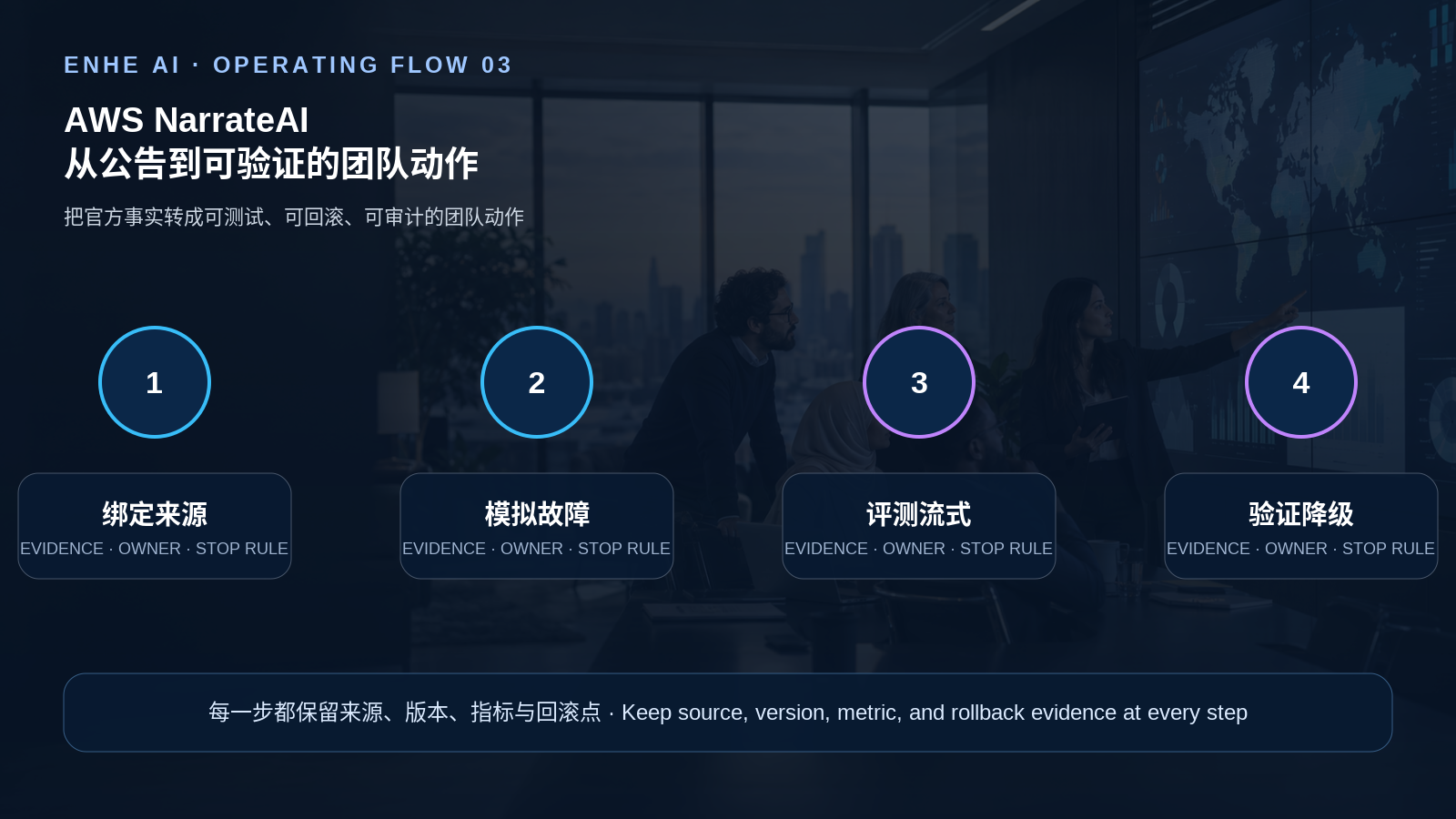
- Five quality mechanisms share one real-time pipeline
- Simple queries use a fast path
- Models fail over across accounts
- Numerical accuracy and streaming latency are measured together
Impact for AI users
Enterprise analytics assistants need more than fluent prose tests. Define source checks, units, time windows, and tolerances for critical numbers, then design degraded behavior for throttling, model outages, validation timeouts, and subjective wording. Turn production traces into a continuously refreshed evaluation set only after redaction, and do not copy internal metrics directly into a cross-organization SLA.
Operating checklist
- Define sources and tolerances for critical numbers
- Simulate throttling, timeouts, and model outages
- Convert redacted production traces into evaluation data
- Accept accuracy, latency, and degraded behavior together
AI frontier news and analysis, AI software and model tools, AI skill tutorials and validation methods, and AI account and permission guidance
FAQ
Can every company use 99.3% as its target?
No. It is an AWS internal result with workload-specific data, queries, and tolerances.
Does streaming bypass validation?
It should not. The design coordinates evaluation with streaming rather than removing checks.
Summary
NarrateAI's value is accepting accuracy, latency, and availability together instead of trusting one model answer or one score.
This AI-assisted article is checked by ENHE AI automation for official sources, bilingual fields, media rights, page safety, and historical duplication before publication.
What this means for everyday users
Enterprise analytics assistants need more than fluent prose tests. Define source checks, units, time windows, and tolerances for critical numbers, then design degraded behavior for throttling, model outages, validation timeouts, and subjective wording. Turn production traces into a continuously refreshed evaluation set only after redaction, and do not copy internal metrics directly into a cross-organization SLA.
Tools you may use

Related reading
SageMaker Adds SOCI Lazy Loading: Measure the Right Baseline Before Claiming Faster Jobs
AWS announced Seekable OCI indexed images for Amazon SageMaker AI training and processing jobs on October 27, 2026. SageMaker can lazy-load an image by fetching the files needed to start the container and streaming the remaining layers while code runs. AWS says jobs can start in seconds instead of minutes. Teams can use a pre-indexed AWS Deep Learning Container or create an index for a custom image without changing the job definition, entry point, or data channels, and the capability is available across AWS Regions. This article turns the announcement into a cautious adoption test covering image size, cold-start baseline, index creation, training correctness, failure fallback, and billable time.
How to Validate Prompt Caching Savings for AI Agents on Bedrock in Four Steps
AWS published prompt-caching patterns for OpenAI models on Amazon Bedrock on October 26, 2026. An agent can reuse an identical prefix containing system instructions, tools, content, and history so a later request processes only the new portion. Bedrock supports implicit and explicit caching, while a cache key can share a reusable starting point across sessions or helper agents. AWS says cached prefixes have a minimum 30-minute time to live that is refreshed by successful reuse. This durable guide gives teams a four-step acceptance plan for stable-prefix design, cache-hit evidence, intentional invalidation after tool changes, latency measurement, and complete request cost instead of assuming every cache hit saves money.
When Should an AI Agent Use a Local Small Model or the Cloud? A Hybrid Routing Checklist
AWS published an Adaptive Agentic Intelligence Framework guide using Strands Agents on October 21, 2026. The reference routes routine status checks and local vision work to small models through Ollama, while complex analysis goes to Amazon Bedrock. This durable guide helps teams decide when an AI agent should stay local and when it should use a cloud model. It classifies tasks, marks data that may leave the device, establishes local and cloud quality baselines, defines timeouts and fallbacks, applies one safety policy across both paths, and measures actual routing before estimating cost. The example can run on an 8 GB Raspberry Pi, but that hardware detail is not evidence that every workload belongs on a small local model.
IskayPet Connects SharePoint to a Managed Knowledge Base: Validate Permissions Before Answers
AWS published IskayPet’s corporate knowledge assistant case study on October 22, 2026. The system connects Amazon Bedrock Managed Knowledge Bases to existing SharePoint repositories and answers cited questions across retail operations, veterinary care, onboarding, and procurement in four languages and three countries. This article turns the case into a practical acceptance plan for knowledge owners. It checks source scope, inherited permissions, hybrid retrieval, duplicate and fragment removal, citation quality, feedback, and token cost before expansion. It also separates the customer’s reported production results from what another organization should expect. A managed retrieval stack reduces infrastructure work, but it does not remove content ownership, access reviews, evaluation datasets, or human verification of important answers.
Bayer Shares Production Lessons From 22 Specialist Agents: HTTP Success Is Not Task Success
AWS published Bayer Crop Science’s Agentic Decision Engine case study on October 23, 2026. The production system runs 22 specialist agents over governed analytics workflows, models, logs, and visualization tools. This article turns the architecture into five reusable acceptance checks for enterprise agent teams: persist the state needed to resume work, define identity and authorization at every boundary, scope each agent’s tool catalog, distinguish transport success from task success, and release to a gated group before broader access. It also explains why Bayer’s adoption and resolution figures are evidence about one implementation, not promises for another organization. The focus is operational proof, least privilege, rollback, and observable outcomes rather than prompt polish.
How to Validate Amazon Quick Before Health-Data Use: HIPAA Eligible Does Not Mean Automatically Compliant
AWS published an Amazon Quick deployment guide for HIPAA-regulated environments on October 22, 2026. Its central distinction is durable: HIPAA eligible means the service can be used to process protected health information under the right agreement and configuration; it does not make an entire environment automatically compliant. This guide is for healthcare organizations, business associates, and technical owners working with legal, compliance, and security reviewers. It turns the source into an acceptance checklist covering the business associate addendum, data classification, irreversible key and identity choices, ACL-aware knowledge bases, least-privilege and read-only connectors, masked audit logs, adversarial access tests, and staged expansion from non-PHI work. It is operational guidance, not individualized legal advice or a substitute for professional review.