
A durable AI value scorecard connects usage to quality, cycle time, cost, and business outcomes
A four-week operating task turns activity and spend into a controlled workflow comparison with owners, baselines, and stop rules.

Key takeaways
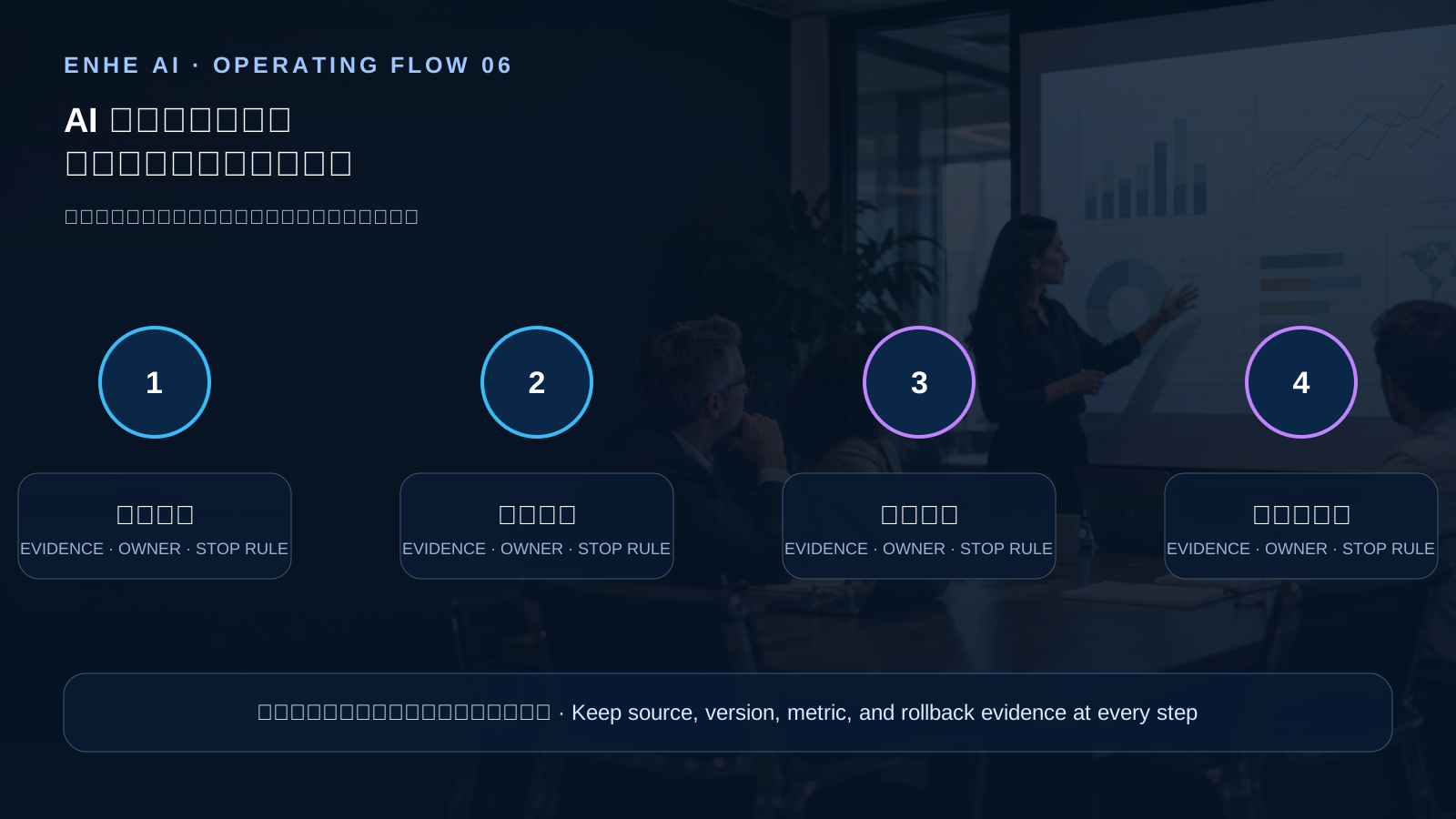
This durable operating task adapts OpenAI's September 16 guidance without treating activity as value. A team chooses one frequent workflow, records the current cycle time, quality, rework, and cost, then runs a controlled four-week pilot. AI usage is segmented by task, model, and tool, while human review and correction time are counted rather than ignored. The final decision compares delivery time, acceptance rate, rework rate, and cost per accepted outcome with the baseline. Expansion requires a named business owner and evidence that gains survive quality checks. If quality falls, total cost rises, or accountability becomes unclear, the team pauses and rolls back.
Direct answer
This durable operating task adapts OpenAI's September 16 guidance without treating activity as value. A team chooses one frequent workflow, records the current cycle time, quality, rework, and cost, then runs a controlled four-week pilot. AI usage is segmented by task, model, and tool, while human review and correction time are counted rather than ignored. The final decision compares delivery time, acceptance rate, rework rate, and cost per accepted outcome with the baseline. Expansion requires a named business owner and evidence that gains survive quality checks. If quality falls, total cost rises, or accountability becomes unclear, the team pauses and rolls back.
Verified facts
OpenAI recommends choosing an outcome the team values and recording task frequency, time, and a definition of good work as the baseline.
Its method includes human review and correction time so faster generation does not hide a quality cost.
Usage and task classification are starting points; business owners still need to connect changes to delivery, quality, profitability, or another outcome.

What changed
- Measurement moves from product activity to one workflow outcome
- Human review and rework enter total cost
- A business owner interprets metric changes
- Expansion and rollback use quantified stop conditions
Impact for AI users
The scorecard works for repeatable processes such as sales research, content production, support, and engineering maintenance. It does not automatically prove causality, but it prevents teams from stopping at adoption metrics. Small samples should be reported with ranges and exceptions rather than polished percentages. If the underlying workflow is unstable, stabilize it before judging the AI system.
Operating checklist
- Choose one frequent workflow and lock a four-week observation period
- Record baseline time, quality, rework, and unit cost
- Measure AI activity together with human review effort
- Use stop rules to expand, revise, or roll back
AI frontier news and analysis, AI software and model tools, AI skill tutorials and validation methods, and AI account and permission guidance
FAQ
Does higher message volume prove better ROI?
No. Volume measures activity and must be paired with workflow outcomes and total cost.
How long should the pilot run?
This task uses four weeks. Lower-frequency workflows should extend the window rather than manufacture a sample.
Summary
AI value is not the number of interactions. It is a better business outcome delivered at lower total cost without weakening quality or accountability.
This AI-assisted article is checked by ENHE AI automation for official sources, bilingual fields, media rights, page safety, and historical duplication before publication.
What this means for everyday users
The scorecard works for repeatable processes such as sales research, content production, support, and engineering maintenance. It does not automatically prove causality, but it prevents teams from stopping at adoption metrics. Small samples should be reported with ranges and exceptions rather than polished percentages. If the underlying workflow is unstable, stabilize it before judging the AI system.
Tools you may use



Related tutorials
Related Tools And Tutorials
Use the following ENHE AI sections to continue from the news signal into tool selection, account-service guidance, or practical learning.
Related reading
How to Verify AI Productivity Case Studies Before Using Their Numbers in Your ROI
Recent OpenAI case studies report that Asana used Codex to remove Enzyme in about two weeks with roughly $12,000 in model and infrastructure cost, while NVIDIA participants describe a ChatGPT Work process saving about 16 hours per week and another workflow turning 25 to 40 external updates into 5 to 8 actionable signals. These are observed results from specific organizations, people, tasks, and vendor-published case studies. They are not transferable ROI guarantees. A team should reconstruct the original baseline, define one reversible task, record human review and rework, include model and infrastructure cost, and compare accepted outcomes against the same non-AI or historical standard before expanding deployment.
GitHub Copilot Usage Metrics Adds Agent-App Activity
GitHub announced on August 7, 2026 that the Copilot Usage Metrics API now reports activity from third-party agent apps. Enterprise, organization, enterprise-user, and organization-user reports can expose the activity in one-day and 28-day windows. The new totals_by_3rd_party_agent data includes a stable agent_id and a display name that may change; the identifier should be the join key. This gives administrators a finer view of cost, permissions, and workflow adoption, but it does not automatically explain business value. Start with a read-only sample, reconcile time zones, pagination, and overlapping windows, then associate agent activity with AI credits, members, repositories, and permission changes before changing budgets or access.
OpenAI Adds Spend Controls and Usage Analytics to ChatGPT Enterprise
OpenAI has added spend controls and enhanced usage analytics for ChatGPT Enterprise, according to Computerworld's June 19, 2026 report. The update helps administrators monitor adoption, track usage across teams, and understand ChatGPT and Codex credit consumption by user, product, and model.
A Banking Agent Writes Then Reverses: AWS Describes a Demo, Not Production Trading
An October 5 AWS post describes Texas Capital Bank’s Trust-Earned Autonomy pattern, in which reviewer agreement can inform an agent’s permissions and a prior write can be reversed if trust declines. AWS explicitly says the agent pattern is still a demonstration running on demo-scale Apache Fineract with synthetic data, not a production workload or real production transaction flow. The bank’s separate document-extraction capability is described as operating in production. This article focuses on revocable authority, auditability, and system boundaries, and avoids presenting the demonstration as an already deployed autonomous banking agent. Teams should check applicability against their own environment, record assumptions, and validate decisions with representative operational evidence.
Microsoft’s 2026 Defense Report: AI Is Changing the Pace of Cybersecurity
In its October 1 commentary on the 2026 Microsoft Digital Defense Report, Microsoft says threat actors are using AI in parts of existing workflows, including reconnaissance and social engineering. The post does not claim that attacks have become fully autonomous; it highlights changes in speed and scale. Identity controls, least privilege, data protection, monitoring, testing, and secure development remain central. This article separates Microsoft’s observations from independent conclusions and turns the post into a practical checklist. Teams should compare the claims with their own telemetry and incident history before changing priorities. Teams should check applicability against their own environment, record assumptions, and validate decisions with representative operational evidence.
A One-Week AI Agent Security Review Using the OWASP Risk Framework
The OWASP Gen AI Security Project published its 2026 Top 10 for Agentic Applications in December 2025 as a risk framework for systems that plan, call tools, or act across services. It is a starting point for security discussion, not a certification, compliance attestation, or guarantee of safety. This article turns it into a one-week baseline review: inventory agent identities and tools, narrow permissions, treat external content as untrusted input, record consequential actions, test shutdown and revocation, and define approval and recovery for high-impact operations. Teams should extend the checklist to match their architecture and threat model. Teams should check applicability against their own environment, record assumptions, and validate decisions with representative operational evidence.