
Use NIST’s AI Risk Framework to map and manage a pilot
Govern, Map, Measure, and Manage help teams structure ongoing work

Key takeaways
NIST’s AI Risk Management Framework offers a way to organize governance, context mapping, measurement, and risk response for an AI pilot. Teams can document the intended use, affected people, owners, tests, and stop conditions, then revisit them as evidence changes. The framework is voluntary guidance, not a certification, legal opinion, or one-time checklist that proves compliance. NIST states that the four functions are not a fixed sequence. This practical guide focuses on making responsibilities and evidence visible for a bounded pilot, distinct from the previous batch’s OWASP Agentic Top 10, which catalogs specific agentic-application risks and accountable ongoing operations.
Direct answer
NIST’s AI Risk Management Framework offers a way to organize governance, context mapping, measurement, and risk response for an AI pilot. Teams can document the intended use, affected people, owners, tests, and stop conditions, then revisit them as evidence changes. The framework is voluntary guidance, not a certification, legal opinion, or one-time checklist that proves compliance. NIST states that the four functions are not a fixed sequence. This practical guide focuses on making responsibilities and evidence visible for a bounded pilot, distinct from the previous batch’s OWASP Agentic Top 10, which catalogs specific agentic-application risks and accountable ongoing operations.
Verified facts
The NIST AI RMF 1.0 Core organizes risk-management outcomes through GOVERN, MAP, MEASURE, and MANAGE.
GOVERN is a cross-cutting function that informs the other three functions.
NIST says the actions are not a checklist or a fixed sequence; risk management should continue throughout an AI system’s lifecycle.
NIST describes the AI RMF as voluntary and says the framework is being revised.

What changed
- Owners, intended use, and affected groups are documented explicitly.
- Measurement criteria are tied to business goals and risk boundaries.
- Monitoring and response continue during the pilot rather than ending at launch.
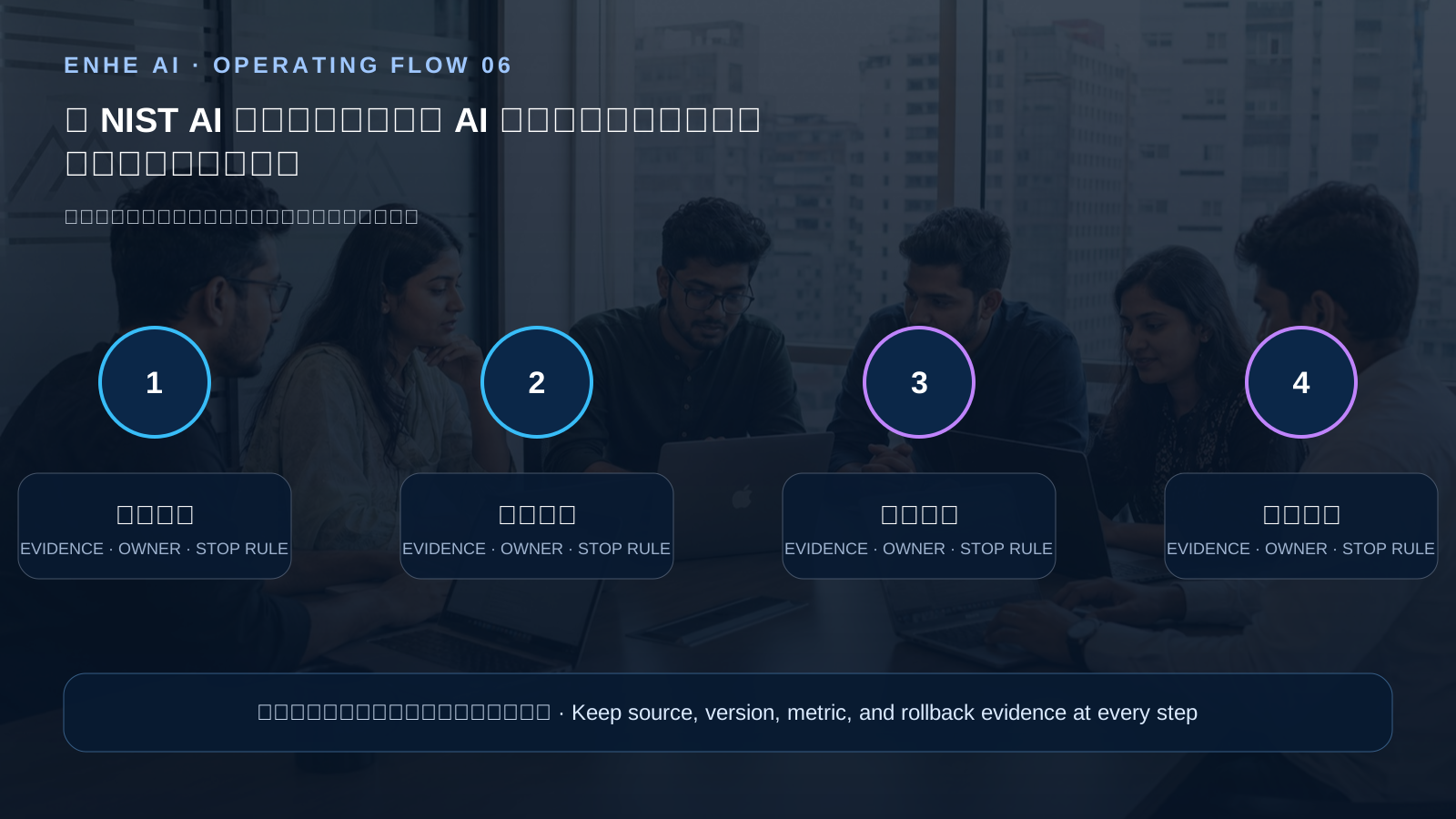
Impact for AI users
For small teams, the value is clarifying who owns decisions, what is measured, and when to pause—not creating paperwork for its own sake.
Operating checklist
- GOVERN: name decision owners, responsibilities, escalation routes, and stop authority.
- MAP: document purpose, environment, users, data sources, and affected groups.
- MEASURE: choose quality, safety, bias, stability, and human-intervention metrics.
- MANAGE: set thresholds, incident response, pause conditions, and review cycles.
AI frontier news and analysis, AI software and model tools, AI skill tutorials and validation methods, and AI account and permission guidance
FAQ
Does completing the four functions prove legal compliance?
No. The framework is voluntary guidance and does not replace applicable law or professional review.
Must the functions be followed in order?
NIST says they are not a fixed linear sequence; teams can iterate based on context.
Summary
Apply the four functions to a bounded pilot, make ownership and stop conditions explicit, and revisit them as evidence changes. Do not present the framework as certification or legal advice.
AI-assisted: key claims were checked against the listed official sources.
What this means for everyday users
For small teams, the value is clarifying who owns decisions, what is measured, and when to pause—not creating paperwork for its own sake.
Tools you may use


Related tutorials
Related Tools And Tutorials
Use the following ENHE AI sections to continue from the news signal into tool selection, account-service guidance, or practical learning.
Related reading
Smartsheet MCP Is Generally Available for Amazon Quick and Kiro Workflows
AWS has published a guide to the generally available Smartsheet MCP Server, which exposes more than forty tools for reading, writing, and managing sheets, rows, columns, and automations. Business users can connect through Amazon Quick, while developers can configure the server in Kiro. This article compares the two paths, lists the documented account, authentication, and regional requirements, and proposes a safe first task: identify blocked work and produce a review checklist without writing changes. Only after results, user permissions, and organization controls are verified should a team enable a narrowly scoped write action. Natural-language requests do not grant extra access, and a connected agent should not be treated as an unrestricted project administrator.
GitHub Copilot Model Policy API Is Generally Available Across Four Control Levels
GitHub has made GET and PATCH endpoints for Copilot model policies generally available at four levels: enterprise, enterprise team, agent application, and organization. This is an administrative API release, distinct from the earlier global model policy interface. The article gives technical administrators a cautious workflow: read current state, save a baseline, identify the controlling level, review the intended delta, apply one minimal update, and read the result back. No live organization, credential, or production mutation is used in the example. The approach helps teams automate inventory and consistency checks without turning an API into an unreviewed bulk-change mechanism, especially where enterprise policy delegates control to lower levels.
Microsoft and NVIDIA Publish an Open-Weight Model Risk Guide With Five Risk Categories
Microsoft and NVIDIA published their first joint resource for enterprise open-weight model risk management on October 16, 2026. The guidance organizes discussion into five broad categories: cybersecurity, data protection, content, human-AI interaction, and bias. Its central point is that weight openness alone does not determine risk; the model, intended use, deployment architecture, users, data, tools, and safeguards all shape the actual system. It also distinguishes model access from deployment choice and warns that self-operated deployments can transfer controls from a managed provider to the enterprise. This article turns the framework into a practical selection, ownership, evaluation, and review checklist for ordinary teams.
GitHub Copilot Model Retirement on November 16: A Migration Checklist
GitHub announced on October 15, 2026 that three models will be removed from GitHub Copilot experiences on November 16: Claude Opus 4.8, Claude Opus 5, and GPT-5.6 Terra. The change covers Copilot Chat, inline edits, ask and agent modes, and code completions. GitHub recommends Claude Opus 5.5 for both Claude models and either GPT-6.1 Sol or GPT-6 Luna for GPT-5.6 Terra. Under default model enablement, suggested alternatives are enabled automatically for Copilot Business and Enterprise unless an administrator disabled the global default or the specific model. Claude Opus 4.8 remains available to individual annual subscribers as an exception. This guide provides a durable migration checklist for inventorying model references, checking policies, testing prompts and integrations, comparing quality and cost, communicating the switch, and keeping a rollback path before the deadline.
GitHub Adds AI Scan Metrics for Findings, Remediation, and Autofix Adoption
GitHub added security-overview metrics for AI Scan on pull requests on October 13, 2026. Organization and enterprise administrators can now see generated and resolved findings, remediation rate, repositories producing findings, trends over a selected reporting period, and how often developers applied autofix suggestions. The CodeQL pull-request view is renamed Code scanning on pull requests and separates CodeQL and AI Scan into different tabs. The feature is a public preview on github.com, including GitHub Enterprise Cloud, for customers with GitHub Code Security or GitHub Advanced Security; GitHub Enterprise Server is not supported. This article explains how to run a bounded pilot, establish a baseline, sample true and false positives, compare repositories, review autofix rather than trusting it, and decide whether the tool improves real remediation work.
How to Choose an AI Home Gateway: Eight Checks Beyond Local Processing
An AI home gateway can see connected devices, access records, and network controls, so a dedicated NPU or a 'local processing' label is not enough. NIST guidance for consumer routers and trusted IoT onboarding emphasizes asset identification, minimized interfaces, reliable updates, explicit authorization, secure credential delivery, and lifecycle management. This durable guide turns those principles into eight purchase checks for AI routers, smart-home hubs, and provider-supplied gateways. Before buying or enabling one, identify every product component, map local and cloud data flows, separate administrator and guest roles, test device onboarding and removal, verify signed update support, review logs and network segmentation, preserve a manual recovery route, and obtain a clear end-of-support and data-export plan.