
CloudWatch Omni unifies evaluation, tracing, and production observability
AWS's new experience follows AI agents from local experiments to production dashboards across models, frameworks, and runtimes.

Key takeaways
AWS introduced Amazon CloudWatch Omni on September 22 as a unified observability experience for applications, generative AI, and agentic workloads. AWS describes it as application-centric, AI-powered, based on open standards, and available in the tools where teams work, including an IDE experience and a standalone web interface. It is designed to evaluate, experiment with, and operate agents across model providers, frameworks, and runtimes. Developers can work locally and optionally use Cloud Login to persist telemetry in CloudWatch, share traces, and reach production dashboards. Adoption should start with common trace fields, evaluation datasets, model and prompt versions, incident identifiers, retention rules, and explicit ownership so a single screen does not become a collection of incomparable signals.
Direct answer
AWS introduced Amazon CloudWatch Omni on September 22 as a unified observability experience for applications, generative AI, and agentic workloads. AWS describes it as application-centric, AI-powered, based on open standards, and available in the tools where teams work, including an IDE experience and a standalone web interface. It is designed to evaluate, experiment with, and operate agents across model providers, frameworks, and runtimes. Developers can work locally and optionally use Cloud Login to persist telemetry in CloudWatch, share traces, and reach production dashboards. Adoption should start with common trace fields, evaluation datasets, model and prompt versions, incident identifiers, retention rules, and explicit ownership so a single screen does not become a collection of incomparable signals.
Verified facts
CloudWatch Omni launched on September 22 as a unified observability experience for application and AI workloads.
AWS says it supports agent evaluation, experimentation, and operations across model providers, frameworks, and runtimes through an IDE and standalone web experience.
Optional Cloud Login can persist local telemetry to CloudWatch, share traces with a team, and provide access to production dashboards.
What changed
- Agent evaluation and runtime traces share one work surface
- Local development can optionally connect to cloud telemetry
- A common signal layer spans model and framework differences
- The IDE becomes an observability entry point
Impact for AI users
A unified tool does not automatically make metrics comparable. If teams define a run, tool call, success, timeout, or human takeover differently, cross-system views will mislead. Before rollout, define trace-ID propagation, sensitive-field handling, retention, sampling, and alert ownership, then replay a known failure to verify the path from user request through every tool call.
Operating checklist
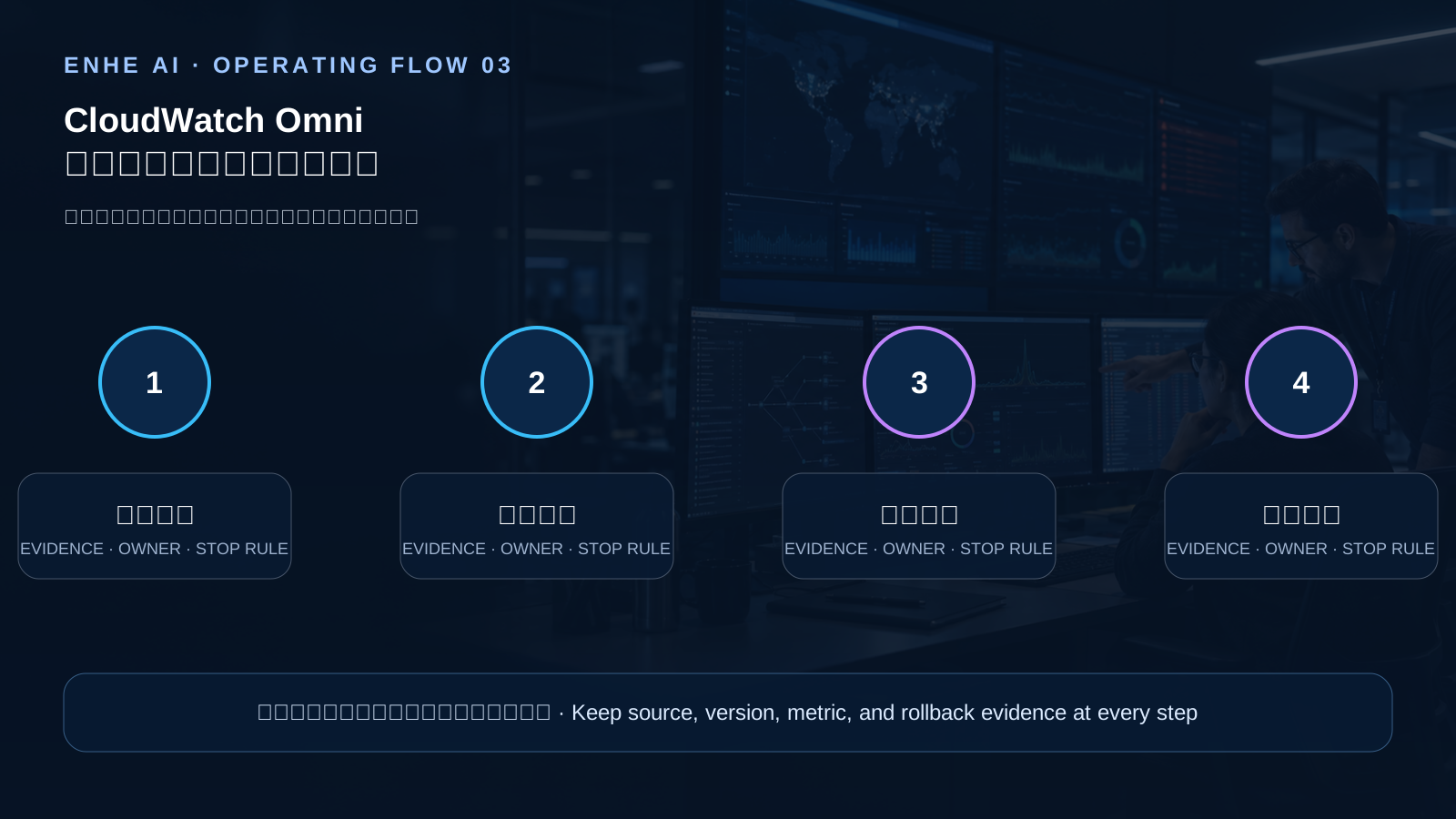
- Define shared run and tool-call identifiers
- Attach model, prompt, and evaluation-set versions
- Set sensitive-field and retention rules
- Replay a known failure to test tracing and alerts
AI frontier news and analysis, AI software and model tools, AI skill tutorials and validation methods, and AI account and permission guidance
FAQ
Must local telemetry be uploaded to AWS?
AWS describes Cloud Login as optional, allowing local use before connecting for persistence and sharing.
Can one dashboard replace evaluation design?
No. Stable datasets, success criteria, version metadata, and clear owners remain necessary.
Summary
CloudWatch Omni aims to connect evidence from agent experiments through production. Its value depends on shared trace semantics, data boundaries, and response ownership.
This AI-assisted article is checked by ENHE AI automation for official sources, bilingual fields, media rights, page safety, and historical duplication before publication.
What this means for everyday users
A unified tool does not automatically make metrics comparable. If teams define a run, tool call, success, timeout, or human takeover differently, cross-system views will mislead. Before rollout, define trace-ID propagation, sensitive-field handling, retention, sampling, and alert ownership, then replay a known failure to verify the path from user request through every tool call.
Tools you may use


Related tutorials
Related Tools And Tutorials
Use the following ENHE AI sections to continue from the news signal into tool selection, account-service guidance, or practical learning.
Related reading
Nine-Stage AI Agent Evaluation Checklist: From First Commit to Production Drift
AWS published a nine-stage production AI-agent evaluation framework built around Amazon Bedrock AgentCore on October 16, 2026. It follows an agent from defining quality and comparing experiments through merge checks, deployment gates, canary scoring, adversarial testing, drift detection, live pulse monitoring, and feedback-driven improvement. The framework evaluates five dimensions—safety, quality, performance, cost, and operational control—at tool, individual-agent, and multi-agent levels. This durable guide converts the public framework into a vendor-neutral checklist for ordinary teams, with minimum evidence, ownership, and stop conditions designed to catch soft failures where latency and uptime remain normal while answer quality quietly declines over time.
How to Build an AI Agent Evaluation Baseline: From Offline Tests to Production Review
How to Build an AI Agent Evaluation Baseline: From Offline Tests to Production Review. The official source dated August 2026 describes a concrete product, research, or governance change rather than a universal guarantee. This article separates what is available now from preview or planned access, then translates the change into one ordinary-user task: establishing a repeatable baseline for AI-agent quality, risk, cost, and human review. Before using it, readers should verify account eligibility, workspace permissions, data boundaries, model or service cost, human review, audit logs, and rollback. A small reversible pilot with explicit acceptance checks is safer than copying a headline result or assuming that a new integration can publish, merge, or make decisions without approval. The source set is linked so teams can recheck availability and scope when the product changes.
Cloudflare Unifies Workers AI and AI Gateway: Choosing an AI Control Plane
Cloudflare announced on August 7, 2026 that Workers AI and AI Gateway are moving toward one AI control plane. The announcement describes unified bindings, observability, billing, and dynamic routing across Cloudflare-managed GPUs and external providers. That can simplify multi-model operations, but it does not guarantee lower cost, consistent quality, or compliance. Choose the control plane around a real task: define model and latency needs, data sensitivity, budget, routing and fallback requirements, then test one low-risk endpoint with read-only logs. Preserve the actual model and version, latency, error, cost, permission, and fallback evidence before moving broader traffic. Small applications may be better served by one provider and clear logs until routing complexity has a measurable benefit.
NVIDIA Launches Open Secure AI Alliance as Open AI Agents Move Toward Auditable Collaboration
NVIDIA and a group of AI and infrastructure organizations launched the Open Secure AI Alliance on July 27, 2026 and highlighted the open-source NOOA agent framework. For ordinary users and teams, the practical lesson is not to treat open source as an automatic security guarantee. A deployable agent should expose its model choice, Python agent code, tool permissions, dependencies, traces, approval steps, and containment boundary. NOOA supports familiar testing, tracing, refactoring, and version-control workflows, but its repository also warns that in-process validation is not a security boundary when agents execute model-generated code. Use non-sensitive data and operating-system-level isolation before granting real accounts, files, publishing rights, or payment access.
A Banking Agent Writes Then Reverses: AWS Describes a Demo, Not Production Trading
An October 5 AWS post describes Texas Capital Bank’s Trust-Earned Autonomy pattern, in which reviewer agreement can inform an agent’s permissions and a prior write can be reversed if trust declines. AWS explicitly says the agent pattern is still a demonstration running on demo-scale Apache Fineract with synthetic data, not a production workload or real production transaction flow. The bank’s separate document-extraction capability is described as operating in production. This article focuses on revocable authority, auditability, and system boundaries, and avoids presenting the demonstration as an already deployed autonomous banking agent. Teams should check applicability against their own environment, record assumptions, and validate decisions with representative operational evidence.
Microsoft’s 2026 Defense Report: AI Is Changing the Pace of Cybersecurity
In its October 1 commentary on the 2026 Microsoft Digital Defense Report, Microsoft says threat actors are using AI in parts of existing workflows, including reconnaissance and social engineering. The post does not claim that attacks have become fully autonomous; it highlights changes in speed and scale. Identity controls, least privilege, data protection, monitoring, testing, and secure development remain central. This article separates Microsoft’s observations from independent conclusions and turns the post into a practical checklist. Teams should compare the claims with their own telemetry and incident history before changing priorities. Teams should check applicability against their own environment, record assumptions, and validate decisions with representative operational evidence.