
Anthropic commits $100 million to train enterprise AI practitioners
The program combines practical exercises with longer enterprise residencies

Key takeaways
Anthropic announced Claude Frontier Academy with a stated $100 million commitment and a goal of training 10,000 forward-deployed engineers by the end of 2027. The program is designed around enterprise implementation: nominated cohorts, hands-on in-person exercises, and a longer residency option. The announcement is a training and workforce initiative, not a guarantee of employment, a measure of independent outcomes, or proof that every enterprise deployment will succeed. Companies evaluating the model should ask who can nominate staff, what the training covers, how completion is assessed, and whether the residency fits their operating needs. Treat the scale and timeline as Anthropic’s stated goals until independently measured results are available.
Direct answer
Anthropic announced Claude Frontier Academy with a stated $100 million commitment and a goal of training 10,000 forward-deployed engineers by the end of 2027. The program is designed around enterprise implementation: nominated cohorts, hands-on in-person exercises, and a longer residency option. The announcement is a training and workforce initiative, not a guarantee of employment, a measure of independent outcomes, or proof that every enterprise deployment will succeed. Companies evaluating the model should ask who can nominate staff, what the training covers, how completion is assessed, and whether the residency fits their operating needs. Treat the scale and timeline as Anthropic’s stated goals until independently measured results are available.
Verified facts
Anthropic announced Claude Frontier Academy on October 2, 2026 and said it would commit $100 million to the initiative.
The company set a goal of training 10,000 forward-deployed engineers by the end of 2027; this is a target, not a completed count.
The announcement describes multi-day in-person training and an optional 12-week residency for enterprise practitioners.
The announcement does not publish independently audited employment, graduation, or deployment-success rates.
What changed
- Training is framed around practical enterprise work rather than model demonstrations alone.
- Organizations need to plan nominations, staff time, and suitable business problems.
- A residency requires a different commitment from a short course, so seats alone are not a useful comparison.
Impact for AI users
Enterprise AI work needs people who understand business processes and can connect models to real systems. Training can build skills, but it cannot replace data permissions, process ownership, or release validation.
Operating checklist
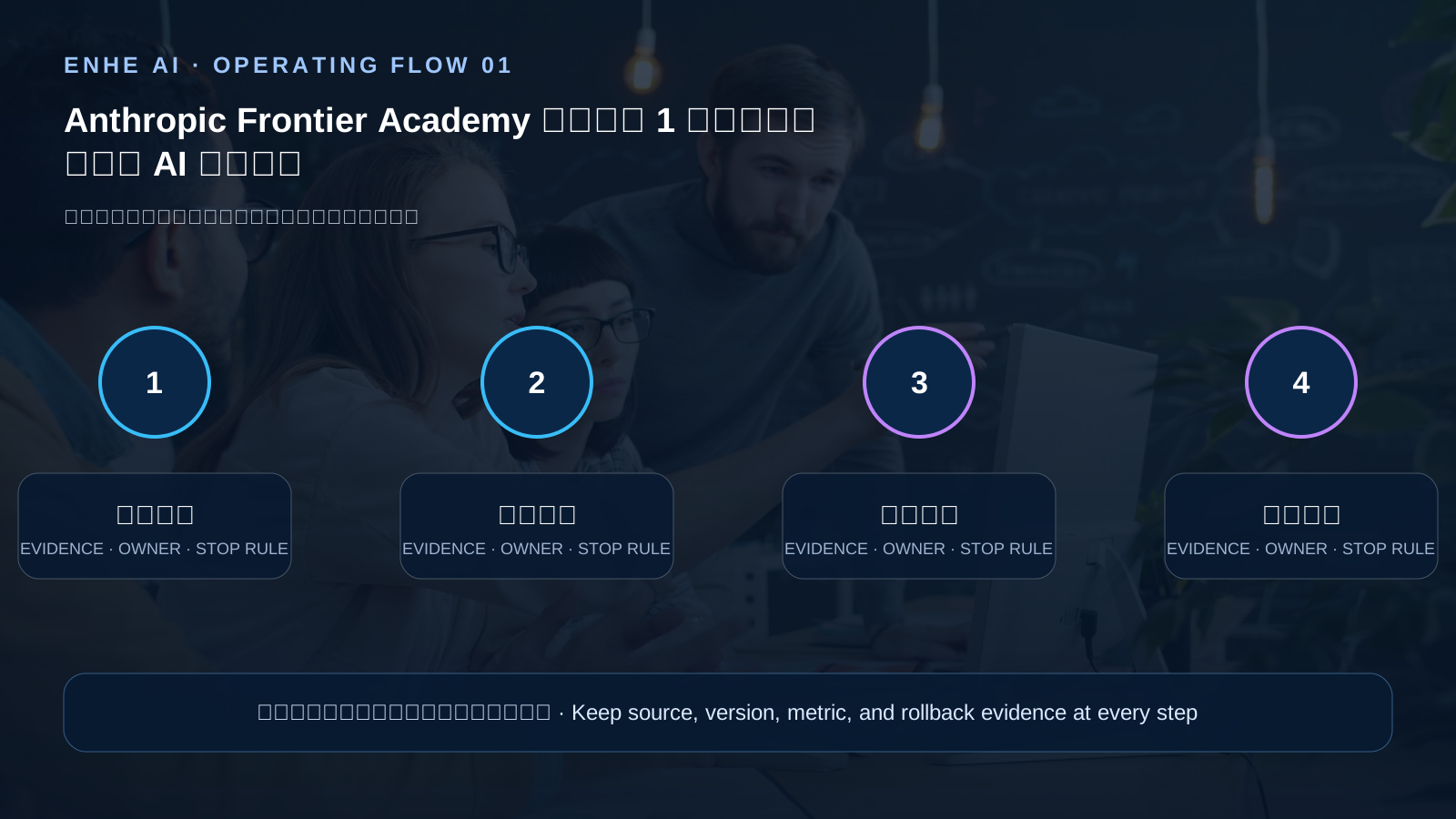
- Confirm nomination eligibility and assign a business owner.
- Keep exercises inside a reversible sandbox with non-production data.
- Record task quality, time, and human rework before and after training.
- Report Anthropic’s stated target separately from measured completion and deployment outcomes.
AI frontier news and analysis, AI software and model tools, AI skill tutorials and validation methods, and AI account and permission guidance
FAQ
Does participation guarantee a job?
No. The announcement describes training and residency options, not guaranteed employment.
What should an organization prepare?
Confirm nomination rules, staff time, safe sandbox tasks, and outcome measures before enrolling.
Summary
Read the announcement as a workforce-training commitment. Evaluate curriculum, eligibility, and measurable outcomes; do not treat the budget or target as proof of results.
AI-assisted: key claims were checked against the listed official sources.
What this means for everyday users
Enterprise AI work needs people who understand business processes and can connect models to real systems. Training can build skills, but it cannot replace data permissions, process ownership, or release validation.
Tools you may use


Related tutorials
Related Tools And Tutorials
Use the following ENHE AI sections to continue from the news signal into tool selection, account-service guidance, or practical learning.
Related reading
ElevenLabs Launches Realtime Translation Alpha: How to Validate 90+ Languages
ElevenLabs announced the alpha release of Eleven Realtime Translation on October 21, 2026 for ElevenAPI enterprise customers. The service uses Eleven v4 Turbo, supports automatic language detection across more than 90 languages, and lets teams select from over 17,500 library voices or their own clones. This article turns the announcement into a small validation plan for customer calls and live events. It explains how to test language detection, names, numbers, latency, voice consistency, and human handoff while preserving the original transcript. The alpha label matters: teams should verify their actual language pairs and failure paths before treating the service as an unattended production interpreter.
Anthropic Gives METR Deep Evaluation Access: How to Read Independent AI Reviews
Anthropic announced on October 15, 2026 that six people from the nonprofit evaluator METR had received company hardware, office space, and internal access roughly comparable to its own risk-assessment teams. METR is expected to publish analysis of Anthropic's risk levels, incidents, or practices. Anthropic says it cannot veto publication, but it may require redaction of predefined categories such as customer data, privileged legal information, and some architecture details, and Anthropic ultimately classifies those categories. The company also described three access tiers and other work with SecureBio, Accenture, Faculty, and Hugging Face. This article explains how ordinary readers can evaluate independence, scope, evidence, access limits, and publication rights.
GitHub Copilot Model Retirement on November 16: A Migration Checklist
GitHub announced on October 15, 2026 that three models will be removed from GitHub Copilot experiences on November 16: Claude Opus 4.8, Claude Opus 5, and GPT-5.6 Terra. The change covers Copilot Chat, inline edits, ask and agent modes, and code completions. GitHub recommends Claude Opus 5.5 for both Claude models and either GPT-6.1 Sol or GPT-6 Luna for GPT-5.6 Terra. Under default model enablement, suggested alternatives are enabled automatically for Copilot Business and Enterprise unless an administrator disabled the global default or the specific model. Claude Opus 4.8 remains available to individual annual subscribers as an exception. This guide provides a durable migration checklist for inventorying model references, checking policies, testing prompts and integrations, comparing quality and cost, communicating the switch, and keeping a rollback path before the deadline.
What to Do After a Claude API Key Leak: A Seven-Step Response Checklist
GitHub added detection for anthropic_service_api_key and anthropic_user_api_key on October 13, 2026 and included both patterns in push protection by default for repositories with secret scanning enabled, including free public repositories. Prevention does not replace incident response. Anthropic recommends immediately revoking a suspected compromised key in Claude Console, using environment variables or encrypted secret storage, separating keys by environment and purpose, rotating keys, and scanning repositories. This durable seven-step checklist covers the full response: stop the affected workload, revoke the key, review usage and billing evidence, remove exposed copies from code and logs, issue a narrowly scoped replacement, redeploy and verify, then document the cause and add preventive controls. Never paste a real key into chat, screenshots, tickets, or public cleanup requests.
Intel Details GPU D-Series for Open and Heterogeneous Agentic AI Inference
Intel published new details for its GPU D-series on October 12, 2026 at the OCP Global Summit. The accelerator is described with up to 480 GB of LPDDR5X memory, a standard PCIe form factor, air cooling, and support for long-context, large-model, and concurrent inference workloads. Customer sampling is underway, but the announcement does not provide general availability, retail pricing, or independent task results. This article explains what developers and smaller teams can do now: describe the actual model and concurrency target, verify framework and runtime support, measure memory and power limits, compare cloud rental with owned hardware, test output quality and latency, and delay procurement until a reproducible configuration and support path exist.
ElevenLabs Expands Its MCP Connector to Voice, Music, Images, and Video
ElevenLabs updated its MCP connector announcement on October 12, 2026. Through an OAuth sign-in, users can access speech generation, transcription, dubbing, music, sound effects, images, and video from compatible assistants such as Claude, ChatGPT, and Cursor, with outputs stored in an ElevenCreative workspace. The connector removes manual API-key handling and can expose more than 50 models, but that does not remove billing, permission, privacy, or rights obligations. This article gives a minimum workflow from connection to publication: choose the correct workspace, review requested scopes, restrict available tools, test with non-sensitive material, inspect model and cost records, verify consent and asset rights, edit the result, and require a human approval before anything is published externally.