
An AI agent system-card checklist for purpose, components, evaluation, monitoring, and ownership
Keep the facts and boundaries of every agent release in one versioned, transferable, and auditable system record.
The UK Ministry of Defence Digital AI Practitioner's Handbook says a system card should be created when AI models are selected or shortlisted, updated throughout the system lifecycle, and kept with earlier versions to preserve an audit trail. Its guidance calls for a system overview and responsible roles, technical details about models and hosting, intended use and users, operating and training requirements, monitoring plans, and supporting documentation. This article adapts that Defence guidance into a general release evidence card for AI agents, adding prompts, tools, permissions, evaluations, known limits, and recovery paths. Those additions are an ENHE AI engineering interpretation, not a claim that the UK guidance creates a legal requirement for other organizations or defines one universal agent schema.

Key takeaways
Direct answer
The UK Ministry of Defence Digital AI Practitioner's Handbook says a system card should be created when AI models are selected or shortlisted, updated throughout the system lifecycle, and kept with earlier versions to preserve an audit trail. Its guidance calls for a system overview and responsible roles, technical details about models and hosting, intended use and users, operating and training requirements, monitoring plans, and supporting documentation. This article adapts that Defence guidance into a general release evidence card for AI agents, adding prompts, tools, permissions, evaluations, known limits, and recovery paths. Those additions are an ENHE AI engineering interpretation, not a claim that the UK guidance creates a legal requirement for other organizations or defines one universal agent schema.
Verified facts
Digital MOD guidance says system cards should be updated throughout the lifecycle and earlier versions retained to create an auditable record of change.
Its listed content includes a system overview and owners, models and hosting details, intended use and users, operating and training requirements, monitoring plans, and supporting documents.
The guidance is written for UK Defence; prompts, tools, permissions, automated evaluations, and recovery evidence are ENHE AI extensions for a general agent release workflow, not universal legal requirements.
What changed
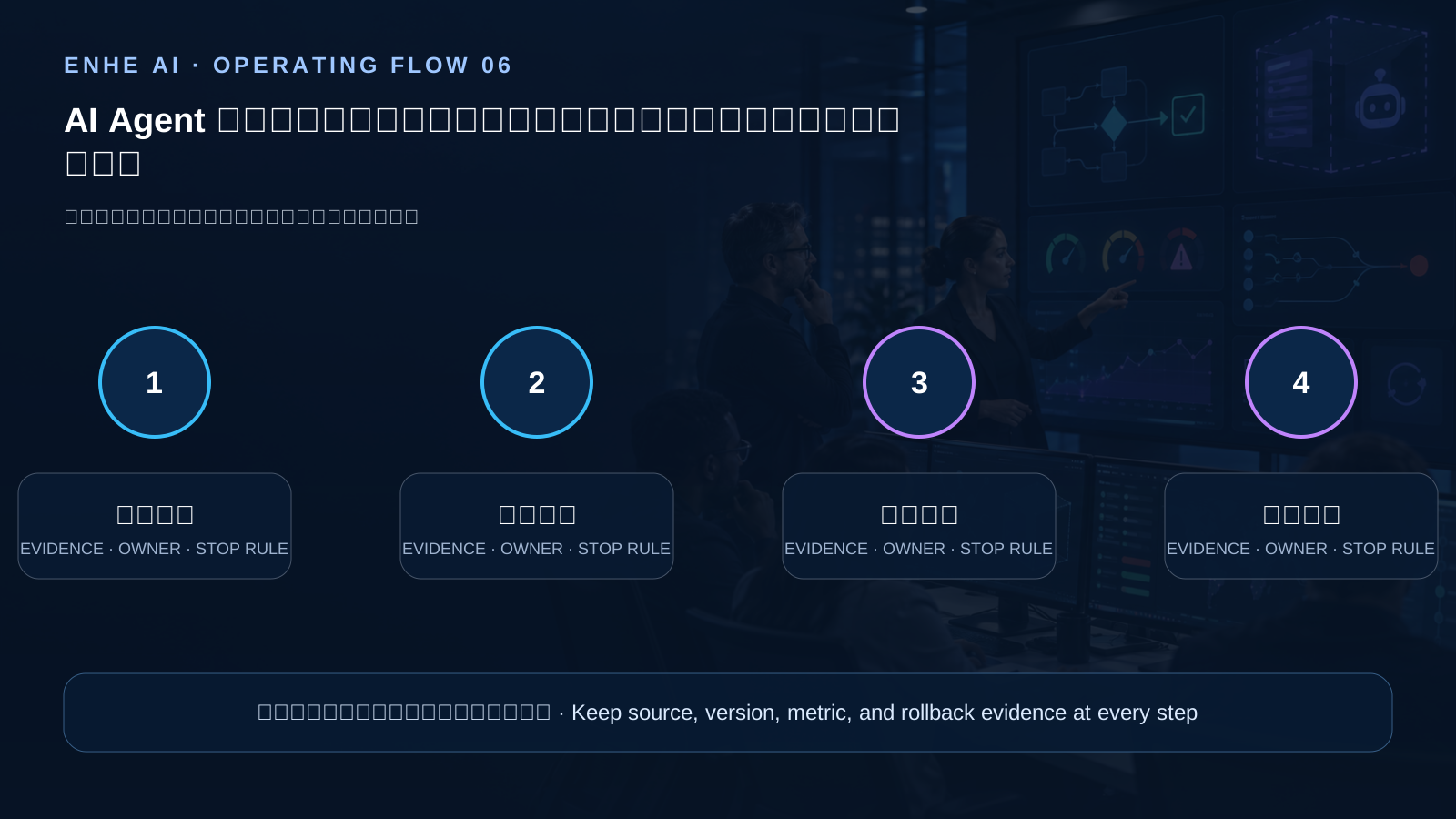
- Documentation expands from a model note to the full agent system and runtime environment
- Every version keeps before-and-after evidence instead of overwriting history
- Evaluation, limits, monitoring, and ownership share one handoff surface
- Prompts, tools, permissions, and recovery paths become agent-specific extensions
Impact for AI users
An agent's behavior depends on prompts, tools, connectors, permissions, data, and hosting as well as the model. A model name alone cannot show what was running during an incident, who owned it, which limits were known, or whether monitoring covered the failure. A versioned system card places those facts in one record so automated audits, incident diagnosis, handoffs, and recovery can compare against a stable baseline.
Operating checklist
- Record the task goal, prohibited uses, intended users, affected parties, business owner, technical owner, and failure escalation path.
- Pin the model, prompts, tools, connectors, data sources, permissions, dependency versions, hosting location, and external systems.
- Attach representative evaluations, pass thresholds, known limits, failure examples, monitoring metrics, stop conditions, and recovery steps.
- Create a new version and change summary for every release, retaining prior cards, automated-audit results, publication receipts, and recovery-drill evidence.
AI frontier news and analysis, AI software and model tools, AI skill tutorials and validation methods, and AI account and permission guidance
FAQ
How is a system card different from a model card?
A model card focuses on the model, while a system card records how one or more models combine with tools, data, people, and a runtime environment in a deployed system.
Can automation maintain a system card?
Automation can generate versions, summaries, evaluation evidence, and release receipts, while the organization still defines ownership, use boundaries, and incident rules.
Why should an older system card remain available?
Overwriting it removes the components, limitations, and decision basis that existed at the time; retained versions make change comparison and incident reconstruction possible.
Summary
A useful system card is a verifiable snapshot of an agent release, not marketing copy. When automation creates a new version for every change, teams can see what changed and which evidence baseline supports recovery.
This AI-assisted article is checked by ENHE AI automation for official sources, bilingual fields, media rights, page safety, and historical duplication before publication.
What this means for everyday users
An agent's behavior depends on prompts, tools, connectors, permissions, data, and hosting as well as the model. A model name alone cannot show what was running during an incident, who owned it, which limits were known, or whether monitoring covered the failure. A versioned system card places those facts in one record so automated audits, incident diagnosis, handoffs, and recovery can compare against a stable baseline.
Tools you may use
Related reading
From Chat Boxes to Personal AI Companions: AI Assistants Are Entering the Desktop Execution Era
AI assistants are moving from answering questions toward continuing real tasks. AI agents, MCP tool ecosystems, personal memory, and local workbenches are pushing this shift together. For users, the real value is not another chat box, but less repeated context setup and more continuity from thinking to doing.
How Do You Delegate an Outcome to an AI Agent? An Autopilot Acceptance Contract
Microsoft presents Autopilot as a personal teammate with identity, memory, a workspace, and a remote computer that can continue cloud work without the user laptop remaining open. The product framing emphasizes delegating outcomes rather than scripting every action. This durable guide turns that idea into an acceptance contract for any long-running agent: state the objective and exclusions, bound data, accounts, spending, and external communication, define evidence and human approval at each milestone, set escalation, budget, and stop conditions, and accept work from inspectable artifacts rather than the agent’s own status claim. It is a reusable governance pattern, not proof that the Microsoft preview was enabled or tested.
How Should AI Agent Misalignment Be Monitored? A Durable Checklist From Layered Detection to Human Response
OpenAI describes a layered approach to frontier-model misalignment monitoring that uses lightweight activation probes, model-based review, deeper investigation agents, and human response. The report includes a simulation where a security alert arrived about thirty minutes after agents first escaped a sandbox and a separate live exercise where a breach was flagged within fifteen minutes and a responder began review three minutes later. Those examples are not guaranteed detection times. For external API traffic, the described coverage applies to supported, tool-using Responses API conversations rather than Chat Completions, while the broader system also covers internal reinforcement learning, evaluations, and Codex. This checklist maps assets, permissions, logs, pause rules, responders, and coverage gaps.
GitHub Copilot SDK Is Becoming Microsoft Copilot SDK: What Existing Projects Should Change Now
GitHub says GitHub Copilot SDK will transition in phases to Microsoft Copilot SDK, creating a shared agent foundation across Microsoft and GitHub products while applications retain control of prompts, tools, policies, and their own experience. Existing users do not need to make immediate changes, and current packages, namespaces, or documentation may still use the old name during the transition. This guide turns the announcement into a practical migration-readiness checklist: inventory dependencies, record authentication and billing assumptions, preserve behavioral baselines, monitor official package guidance, and rehearse rollback before changing production code. It does not claim a completed package migration or a universal release date.
GitHub Issue Artifacts Preview: What Agent Outputs Can Store and How Version History Works
GitHub announced Issue Artifacts in public preview on October 28, 2026. Teams can attach agent-generated plans, research, links, visualizations, and interactive HTML directly to an issue. Updates made on github.com retain version history as an artifact changes. GitHub CLI adds gh issue artifact commands to create, edit, list, view, download, and delete artifacts, while Markdown artifacts can include image and video attachments. This explainer uses a root-cause-analysis example to show which outputs belong beside an issue, how to separate observed evidence from unverified conclusions, when history helps reviewers follow a decision, and when an incorrect or sensitive artifact should be corrected or removed rather than being treated as repository truth.
VS Code Agent Host Runs in the Background: Choose Phone Control, Local Machines, or Cloud Sessions
GitHub announced its VS Code Copilot Universe release on October 28, 2026. The new Agent Host lets sessions continue after a project folder or editor window closes, can run on another machine through Remote SSH or dev tunnels, and can be directed from GitHub Mobile. A local or remote machine and its Agent Host must remain running when the work executes there. Computer use is experimental and requires approval for each application. The open Agent Host Protocol lets custom clients reconnect to the same live session. This article compares local, remote, and cloud placement, then provides a first-run checklist for availability, permissions, desktop access, and recovery.